
Caring for a parent after a stroke usually starts with the hospital's discharge plan, then steady support at home while recovery continues. The NHS says recovery varies, from weeks to months or years. Help with washing, meals and routines can save your dad's energy for rehabilitation. If you think he is having another stroke, call 999.
To talk anything through with someone local, our Hitchin team is on 01462 534739.
The days after a stroke can feel like a blur. You might be juggling hospital visits with work and your own family, and it can be sad to see your dad tired, frustrated or finding words harder. Not knowing what recovery will look like, or who to ask, can be the hardest part.
Coming home after a stroke is a situation our team knows well, and there is a clear way through the first weeks.
What can recovery look like at home?
Every stroke is different. The NHS guide to stroke recovery says a home recovery plan can include movement therapy, talking therapy for low mood, anxiety and tiredness, memory and thinking activities, and exercises for speech, swallowing and vision. It also says the healthcare team will make sure the right equipment is in place.
The Stroke Association says the biggest improvements usually take place in the early weeks or months, and recovery may continue for years. It adds that many people will not return straight away to their usual routines, so patience matters for everyone.
What should you check before Dad leaves hospital?
The Stroke Association's guide to leaving hospital says the stroke team should review the discharge plan with you and give you a copy. Before the day itself, it helps to know:
- What is in the discharge plan, and who has a copy.
- How to use any new equipment. The Stroke Association says you should be able to use it confidently.
- Which exercises the therapists want him to keep doing at home.
- Any changes to his medicines, and who to ask about them.
- Who to contact if you need more help.
What helps in the first weeks at home?
Small, steady routines tend to help most. In practice, that can mean:
- Building rest into the day. The NHS says a recovery plan can include help with tiredness.
- Keeping to the exercises the therapy team has set, little and often.
- Giving him time to find words, rather than finishing his sentences.
- Letting him do what he can, even when it is slower.
- Looking after yourself too. The NHS says caring for someone after a stroke can be difficult, frustrating and lonely.
How do you talk to Dad about help at home?
After a stroke, many people want to prove they can manage. Linking help to his recovery often works better than linking it to risk. You could try:
- "If someone helps with the shower in the morning, you'll have more energy for your exercises."
- "It's for the first few weeks while you get your strength back. We'll review it together."
- "Would you be happy for someone to pop round for a chat first, just to meet them?"
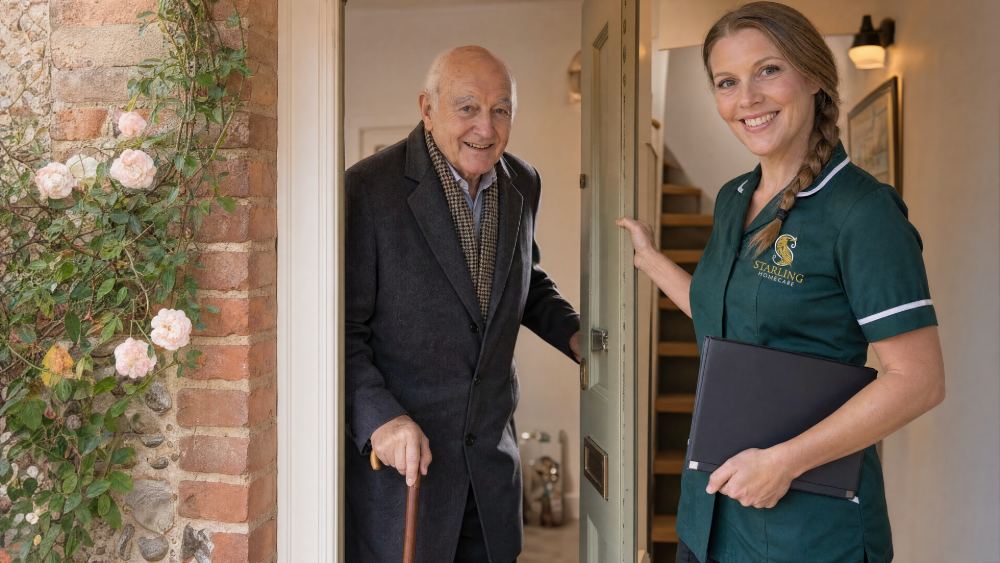
When a parent is unsure, it can start with someone from Starling simply coming round for a chat. It does not have to be formal, and it often breaks the ice.
Who can help in Hertfordshire?
- 999 if you think he is having a stroke. The NHS uses FAST: face, arms, speech, time to call 999.
- His GP and the stroke or therapy team named on the discharge plan.
- The Stroke Association's Stroke Support Helpline on 0303 3033 100, Monday to Friday 9am to 5pm and Saturday 10am to 1pm.
- HertsHelp on 0300 123 4044, Hertfordshire County Council's free advice service, for needs assessments and a carer's assessment. The Stroke Association says you are entitled to a carer's assessment even if the person you care for refuses help.
How Starling Homecare can help
Sons and daughters call us at exactly this point. On the first call, we want to understand what has happened and what life looks like for your dad now. Usually the best next step is an informal chat at home, so he is comfortable and his questions are answered. From there we propose a care plan, with your involvement and his.
Our post-hospital care aims to be ready for the day he comes home, and in urgent situations care can usually start within a day or two. Our stroke care can include:
- Personal care, with steady, falls-aware help moving around the home.
- Medication prompting and support, including after changes to his medicines.
- Meal preparation, including where swallowing needs care, following the speech and language team's guidance.
- Patience with communication: carers never talk over or around the person.
- Visiting care in St Albans, Harpenden, Hemel Hempstead, Welwyn Hatfield, Potters Bar and Cheshunt, from 30 minute visits, with overnight or live-in care if needs grow.
We support therapy rather than provide it, encouraging the routine the therapists have set and, with his agreement, liaising with the professionals involved. Carers do not give injections or carry out clinical tasks. Recovery after a stroke usually needs more than a few weeks of support, and visits can change as he improves. For what happens later on, read our article on stroke recovery at home after the six-month review, and for the first days back, our guide to home care after hospital in Hitchin.
Areas we cover
Starling Homecare's carers visit people at home in St Albans, Harpenden, Hemel Hempstead, Welwyn Garden City and Hatfield, Potters Bar and Cheshunt, and the villages around them. Elsewhere in Hertfordshire, including Berkhamsted, Tring, Radlett and Shenley, Hitchin and Hertford, we arrange live-in care.
For more on the early stages of worry, see our guide for families worried about an elderly parent. Locally, here is how we arrange live-in care in Hitchin.
Frequently asked questions
How long does stroke recovery at home take?
It varies a great deal. The NHS says some people recover within days or weeks, while others need months or years. The Stroke Association says the biggest improvements usually happen in the early weeks or months, and recovery may continue for years. The stroke team can explain what to expect for your parent.
Can a home carer help with stroke exercises?
A carer can encourage the routine the therapy team has set, but does not replace the therapists. Starling Homecare supports therapy rather than providing it, following guidance from physiotherapists and the speech and language team. Carers do not give injections or carry out clinical tasks, and they pass any concerns to the GP or therapy team.
Can we get stroke care at home in Hitchin quickly?
Usually, yes. Our Hitchin team, on 01462 534739, arranges live-in care across the town and nearby villages such as Walsworth, St Ippolyts and Ickleford. In urgent situations, including a hospital discharge, care can usually start within a day or two, after a phone call, a home visit and a written quote.
If your dad is coming home to Hitchin after a stroke, you do not have to plan the first weeks alone. Our Hitchin team is on 01462 534739. You will be talking to someone who arranges care every day, so you know what good support looks like before you decide anything.
Guidance checked on 26 October 2026 against the NHS and the Stroke Association.
Arranging Care Is Simple
Starting care can feel like a big step. We keep it calm and straightforward, and we are here to guide you from your very first call.
1. Talk to us
Get in touch by phone or request a callback. We will listen, answer your questions and help you understand the options, so you can decide what feels right in your own time.
2. A home visit and initial consultation
We arrange a visit to understand your routines, your home and what matters most to you. Together we agree an initial consultation and shape the support that feels right.
3. Your care begins
A small, familiar team starts your care, arriving at the agreed times and staying involved as your needs change. We remain your trusted adviser throughout.
Whenever you are ready, we are here to help.