
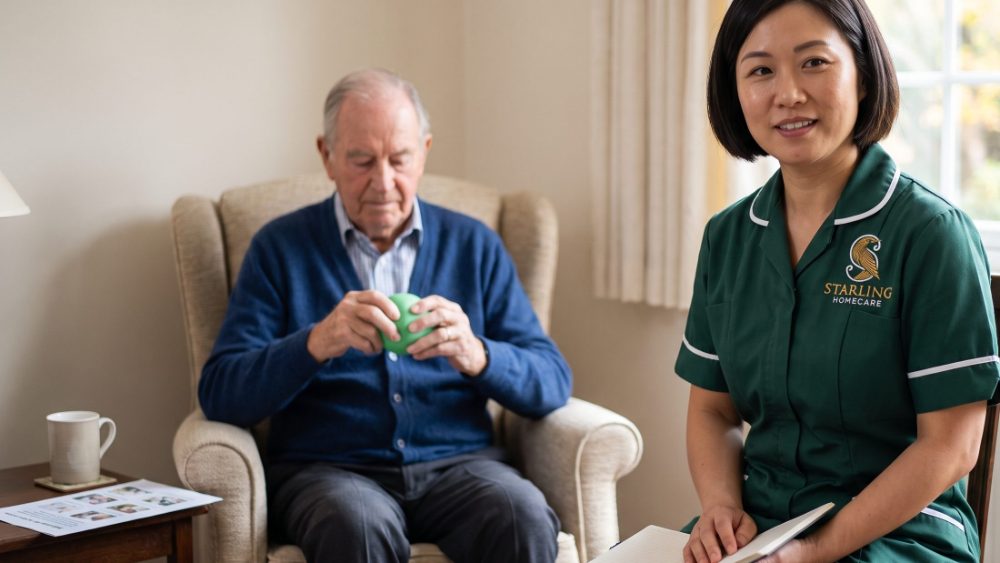
Stroke recovery at home changes at around six months, and it is worth knowing that before you get there. The NHS community stroke team is commissioned to support people up to six months from the date of the stroke. The six-month review is the point at which that specialist input formally winds down.
Families almost always read the review as a finish line. It is not. It is a handover, and often a quiet one.
What follows is the part nobody prepares you for, and it is also the part where care at home earns its place.
What the NHS community stroke service actually covers
In East and North Hertfordshire, Hertfordshire Community NHS Trust runs the community stroke service for adults aged 18 and over, providing specialist rehabilitation up to six months following the stroke.
The early supported discharge part of it takes people who can transfer with the assistance of one person, with equipment if needed, and who are within six weeks of the stroke. The point of it is to get rehabilitation happening in the person's own home rather than on a ward.
The team is genuinely multidisciplinary: occupational therapists, physiotherapists, speech and language therapists, neuropsychologists and rehabilitation assistants. Six-month reviews are then provided for all stroke survivors in East and North Hertfordshire, in partnership with the Stroke Association.
One honest caveat. That service covers east and north Hertfordshire. If you are in St Albans, Harpenden, Hemel Hempstead or Berkhamsted, you are in west Hertfordshire and the arrangements are commissioned differently, so ask the stroke team directly which service you sit under rather than assuming.
The six-month review is a milestone, not a finish line
Recovery does not stop when the service does.
That is not our opinion. It is the reason the review exists at all: to look at what is still needed once the intensive phase is over. Nobody schedules a review of something that has finished.
But a review is a conversation, not a rota. The therapists who came three times a week stop coming, and the household has to absorb what they were doing. In our experience, that is the moment families ring us, not the moment they come out of hospital.
What families find hardest in month seven
Three things, and none of them is the obvious one.
The exercises stop happening. Not through unwillingness. The therapist was the structure, and when the structure goes, so does the daily practice, usually within a fortnight.
Fatigue gets misread as decline. Post-stroke tiredness is not ordinary tiredness and it does not follow effort in a way that makes sense. Families read a flat week as the recovery going backwards, when it is often just a flat week.
The caring spouse quietly takes on a therapy role they were never trained for. Prompting, supervising, correcting, encouraging. It is exhausting, it changes the relationship, and it is the single most common thing we are called about.
Our guide to home care after hospital in Hertfordshire covers the first weeks. This is what happens six months later.
Where care at home fits after the therapy stops
Not as a replacement for the therapists. As the thing that keeps their work going.
The useful role is holding the routine. Being there at the times when the practice is meant to happen, so it happens. Prompting rather than doing, because a stroke that has left someone slower has not necessarily left them incapable, and doing a task for someone who could still manage it takes something back.
Practical help with the tasks that one weak side makes disproportionately hard: fastenings, cutting food, getting in and out of a low chair, carrying anything and a hot drink at the same time.
Attention to falls, because a changed gait and a changed sense of where your body is in space are exactly the conditions falls happen in. Our guide to preventing falls at home sets out the practical checks, and they matter more here than almost anywhere.
And time. A husband or a daughter who gets to stop being the therapist for a few hours a week, and go back to being a husband or a daughter.
Our stroke care at home service is built around that handover point rather than around the acute phase.
What to put in place before the review, not after
The mistake is treating the six-month review as the moment to start thinking about it. By then the therapists have one appointment left.
Six to eight weeks out, do three things. Ask the team plainly what they expect to hand over and to whom. Write down the exercises and timings while the therapist is still there to correct you. And work out, honestly, who in the household is going to hold the routine, and whether that is fair on them.
If the answer to the third one is "my wife, and no", that is the conversation to have before the review rather than three months after it.
Which team is doing the handing over depends on where you live. We have set out which stroke service covers you in Hertfordshire after hospital, with the numbers for the Lister and Watford units, the two community stroke teams and the Stroke Association.
Where we support stroke recovery at home across Hertfordshire
Starling Homecare arranges regulated care at home for people recovering from a stroke across the whole county, including the months after the NHS community stroke service steps back.
Wherever you are in the county, you reach the team that actually covers your area:
- St Albans, 01727 324 127
- Harpenden, 01582 824 830
- Welwyn Hatfield, 01707 714 000
- Hemel Hempstead, 01442 954 137
- Berkhamsted, 01442 954 137
- Tring, 01442 954 137
- Hitchin, 01462 534739
- Hertford, 01920 746779
- Radlett and Shenley, 01923 988 550
Common Questions About Stroke Recovery at Home
Does stroke recovery stop after six months?
No. The commissioned NHS community stroke service in East and North Hertfordshire runs up to six months from the stroke, and the six-month review marks the end of that intensive phase. Recovery itself continues well beyond it, which is exactly why the review looks at what support is still needed rather than closing the case.
Can a home carer do stroke rehabilitation exercises with someone?
A care worker is not a therapist and does not set, change or progress a rehabilitation programme. What a trained care worker can do, as part of a written care plan, is be there at the right times so the programme the therapist set actually gets done, and report back what is and is not working. Anything about the exercises themselves goes to the therapy team.
How much home care do people usually need after a stroke?
Far less than families expect, and aimed at particular points of the day rather than spread evenly. Most people we support after a stroke start with a few visits a week placed where the routine keeps slipping, most often the morning. It is the timing that does the work, not the volume.
Where to start
If the six-month review is coming, treat it as a planning meeting rather than a discharge.
Go in with a written list of what actually happens in a normal week, what has slipped since the therapists reduced, and who is doing the holding. That single page will get you more out of the review than any question we could suggest.
Every situation is different, and nothing here replaces what the stroke team, the GP or the Stroke Association tells you about a specific person. For the practical side around it, our St Albans office is on 01727 324 127 or [email protected].
Service detail checked on 1 September 2026 against Hertfordshire Community NHS Trust and the Stroke Association's Hertfordshire Stroke Recovery Service. Commissioning arrangements change and differ across the county; check with your own stroke team.
Arranging Care Is Simple
Starting care can feel like a big step. We keep it calm and straightforward, and we are here to guide you from your very first call.
1. Talk to us
Get in touch by phone or request a callback. We will listen, answer your questions and help you understand the options, so you can decide what feels right in your own time.
2. A home visit and initial consultation
We arrange a visit to understand your routines, your home and what matters most to you. Together we agree an initial consultation and shape the support that feels right.
3. Your care begins
A small, familiar team starts your care, arriving at the agreed times and staying involved as your needs change. We remain your trusted adviser throughout.
Whenever you are ready, we are here to help.