
Independent, Franchise or Introductory Agency?

The direct answer
Home care in England is delivered through three business models, and the differences matter more than the branding suggests. An independent provider is a locally owned company that employs its carers and is registered with the CQC. A franchise is a local company trading under a national brand, also employing its carers and also CQC registered, but operating within the franchisor’s system. An introductory agency matches families with self-employed carers for a fee and does not provide the care itself, so it is usually not regulated and the family carries the responsibilities. The first two are regulated home care; the third is not.
The three models at a glance
- Independent provider: local ownership, employs its carers, CQC registered, accountable locally.
- Franchise: national brand, local owner, employs its carers, CQC registered, follows the franchisor’s system.
- Introductory agency: introduces self-employed carers, takes a fee, usually unregulated; the family is responsible for cover, plans and often employment.
- Only the first two are “regulated home care” with a registered manager and inspections.
Side by side
| Independent provider | Franchise | Introductory agency | |
|---|---|---|---|
| Who provides the care | The company, through its employed carers | The franchisee company, through its employed carers, under a national brand | The family, through a self-employed carer the agency introduced |
| Who employs the carer | The provider | The franchisee | Usually the carer is self-employed, or the family employs them |
| CQC registered for personal care | Yes, required | Yes, each franchise location is required to register | Usually no; the agency does not provide care |
| Registered manager and inspection | Yes | Yes | No |
| Who writes and holds the care plan | The provider | The franchisee | Often the family or the carer; no regulated plan |
| Cover when the carer is ill or on holiday | The provider arranges it | The franchisee arranges it | The family must find cover, sometimes with the agency’s help |
| Who you complain to | The registered manager, then the CQC or the ombudsman | The franchisee, the franchisor, then the CQC | The carer or the agency; no regulator |
| Who decides how it is run | The owners, locally | The franchisee within the franchisor’s system | The family and the carer |
| Typical cost | Hourly rates published by the provider | Hourly rates set by the franchisee | Lower hourly rate plus an agency fee; employer costs may apply |
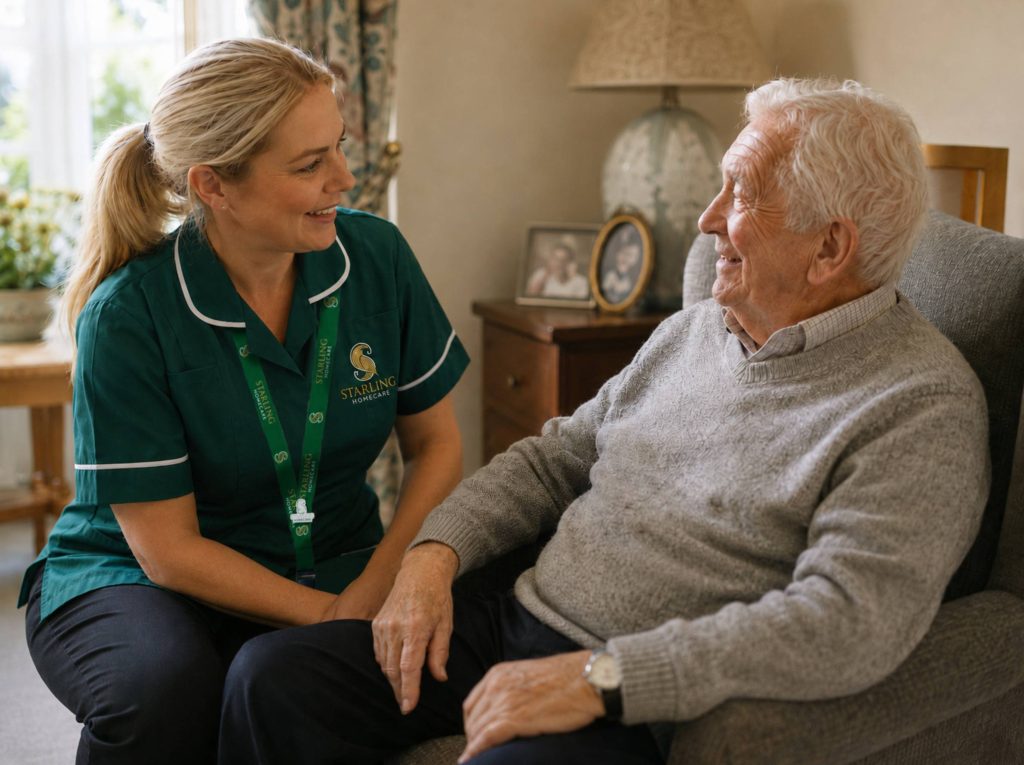
Most home care providers in England are independent: a company, often family owned, operating in one area and employing its own carers. The owners are usually close to the service, sometimes the registered manager or nominated individual themselves, and decisions about pay, visit length and who to take on are made locally. The strengths are local accountability, flexibility and a short line between the family and the person who can fix a problem. The risk is variation: an independent is only as good as the people running it, which is why the signals of a good provider matter. Starling Homecare is an independent, family-run provider, registered with the CQC, based in St Albans.
Franchises
A franchise is a local company that has bought the right to trade under a national brand and must operate within the franchisor’s systems, training and standards. Each franchise location is separately registered with the CQC, so the regulation is the same as for an independent. The strengths are consistent systems and a brand that can be checked across many locations. The risks are that quality still depends on the local owner, that the brand’s national reputation says little about the branch in your town, and that decisions may sit further from the family. Judge the branch, not the brand.
An introductory agency, sometimes called an introduction service or a care platform, matches a family with a self-employed carer and charges a fee for doing so. The agency does not provide the care, so it is normally not registered with the CQC and has no registered manager, no care plan it is accountable for and no inspection. The carer may be excellent, and the hourly rate is often lower, but the family takes on what a regulated provider would otherwise carry: checking the carer’s background, arranging cover when they are ill or on holiday, managing the care, and sometimes the legal position of an employer, with tax, insurance and employment rights. Our guide to regulated live-in care versus an introduction agency and our page on private carers versus regulated care set out those responsibilities in detail.
For most families, regulated home care, whether independent or franchise, is the right choice because the provider carries the responsibility and the regulator looks over its shoulder. Between independent and franchise, the model matters less than the people, so use the six steps and judge what is in front of you. An introductory agency can suit a family that wants one known carer, is comfortable managing the arrangement, has a plan for cover, and understands it is stepping outside regulation. It is not the right route for someone with complex needs, or for a family who cannot be hands-on.

Common questions about home care business models
How can I tell whether a company is a franchise?
Look at the small print on its website or contract: a franchise usually trades as a limited company “trading as” the brand, and its CQC registration names the local company as the provider. Ask directly; there is nothing wrong with being a franchise, and a good one will say so.
Is an introductory agency illegal?
No. Introducing self-employed carers is lawful and some agencies are reputable. The point is that it is not regulated home care: the agency does not provide the care, is not inspected, and the responsibilities sit with the family and the carer.
If I use a self-employed carer, am I their employer?
Possibly. Employment status depends on how the arrangement works in practice, not on what the agency calls it. If you control the hours, the tasks and the pay, HMRC may treat you as the employer, with PAYE, National Insurance, holiday pay, pension and insurance obligations. Take advice before you start.
Where to go next
- Before you speak to any provider, write down four questions. Is it registered with the CQC for personal care, and who is the registered manager? How long have the people running it worked in home care themselves? Is it independent, a franchise or an introductory agency? Who will actually come to the house, and how many different faces will there be?
- Read contracts, notice and switching before signing with any of the three models.
- If the answer you want is an independent, regulated provider, ask us those four questions. Starling Homecare is registered with the CQC, independent and family run, and led by people with more than a decade of running home care in Hertfordshire. Call 01727 324 127 or request a callback and we will answer each question plainly, including the things we do not do.
Arranging Care Is Simple
Starting care can feel like a big step. We keep it calm and straightforward, and we are here from your very first call to help you explore what might feel right, whether that is with us or simply pointing you in the right direction.
1. Talk to us
Get in touch by phone or request a callback. We will listen, answer your questions and help you understand the options, so you can decide in your own time.
2. A home visit and initial consultation
We arrange a visit to understand your routines, your home and what matters most to you. Together we agree an initial consultation and shape the support that feels right.
3. Your care begins
A small, familiar team starts your care, arriving at the agreed times and staying involved as your needs change. We remain your trusted adviser throughout.
Whenever you are ready, we are here to help.