
What Happens in a Home Care Visit

The direct answer
A home care visit is a planned block of time, usually 30 minutes, 45 minutes or an hour, in which a care worker arrives at an agreed time, carries out the tasks in the care plan in the way the person prefers, records what was done and anything noticed, and leaves the person safe and comfortable. The visit has a shape that families can expect: arrival and greeting, the tasks for that time of day, a check on wellbeing and the home, the record, and a proper goodbye. What the carer notices between the tasks, a change in mood, a skipped meal, a new bruise, is often the most valuable part.
A visit at a glance
- Visits are booked in blocks: Starling Homecare’s shortest is 30 minutes and there are no 15-minute visits.
- The carer arrives within an agreed window, knocks, announces themselves and uses the agreed entry method.
- The tasks follow the care plan for that time of day, at the person’s pace.
- The carer checks wellbeing, fluids, food, skin, medication and the safety of the home as they go.
- Every visit is recorded digitally during or immediately after, including anything of concern.
- If something is wrong, the carer acts, calls the office, and the office contacts the family, GP or emergency services as the plan sets out.
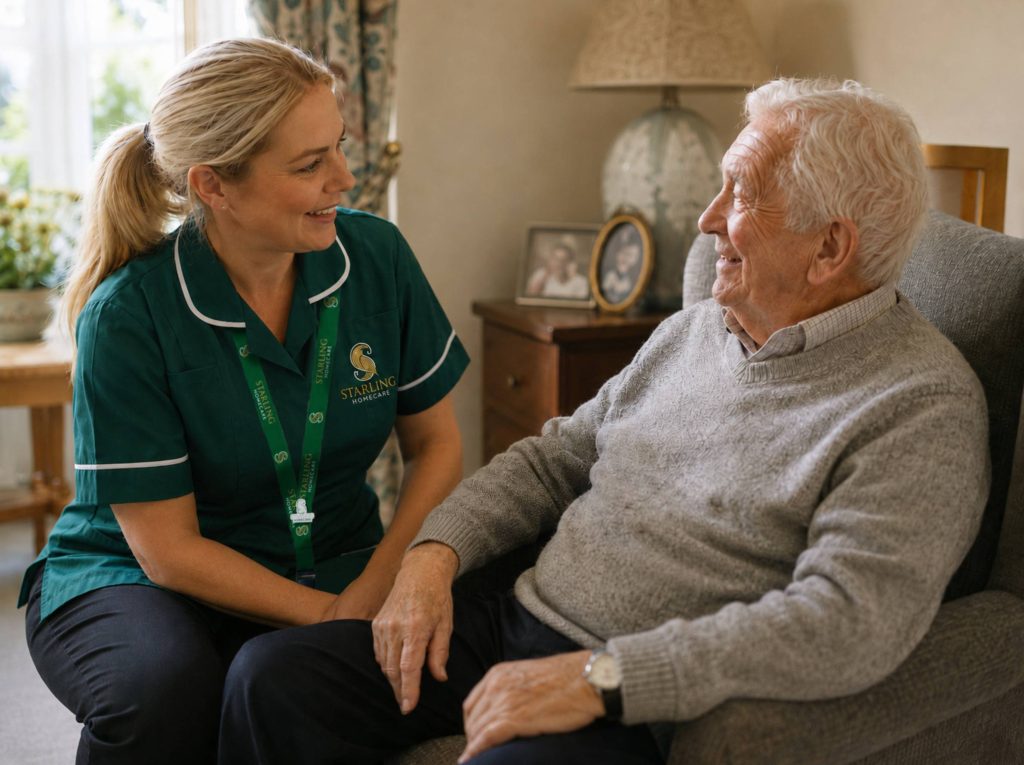
A morning visit
The morning visit is usually the longest and the one that sets up the day. The carer arrives, say between 8.00 and 8.30 as agreed, lets themselves in with the key safe if that is the arrangement, and calls out so the person knows who it is. They help the person out of bed if needed, to the bathroom, and with a wash or shower, dressing and hair, always at the person’s pace and with the door closed. Then breakfast: made the way the person likes it, and the carer makes sure it is eaten and a drink is taken. Medication is prompted or assisted from the blister pack or original packaging and signed for on the medication record. Before leaving, the carer checks the person is settled with what they need within reach, that the kitchen is safe, the heating is right, and the next visit is understood. The whole of this is recorded on the phone before the carer moves on.
Shorter, often 30 minutes. The carer prepares a meal or heats one, sits the person to it, encourages a drink, prompts any midday medication, and checks how the morning has gone. For someone living alone this visit is the one that breaks the day in two and is often more about company and a conversation than the food. The carer notices if breakfast was not eaten, if the person seems confused or unwell, and records it.
An afternoon or social visit
Where the plan includes it, a longer afternoon visit might be a walk, a trip to the shops or an appointment, help with correspondence, or simply time together. These visits matter more than their task list suggests: they keep people active, connected and out of the house.
Usually between 6.00 and 9.00 pm. Supper, evening medication, help to undress and wash, and settling for the night: the right things to hand, the commode in place if used, the lamp on, doors and windows checked, the alarm pendant on. For a person who is unsteady at night, this visit is where the risk of a fall is reduced most. Where night-time support is needed beyond this, overnight care puts a carer in the home through the night.
Timekeeping
Visits are booked at agreed times with a reasonable window around them, because travel between homes varies. A good provider plans its rounds with realistic travel time, tells the family if a carer is running late, and never cuts a visit short to make up time. Starling Homecare uses a digital system that shows the office when each visit starts and ends, so a late visit is visible immediately.
Continuity
Each person should see a small, familiar team rather than a different face each day. Continuity is what makes it possible for a carer to notice that something has changed.
The record
Every visit is recorded: the time, the tasks done, medication, food and fluids, mood, skin, and any concern or change. The record is the provider’s evidence to the CQC, the family’s window into the care, and the basis for every review. With consent, named family members can read it on an app the same day.

Common questions about home care visits
What happens if the carer finds the person unwell or has had a fall?
The carer stays with the person, gives first aid within their training, calls 999 if it is an emergency, and calls the office, which contacts the family and, where appropriate, the GP. The carer does not leave until the person is safe or handed over. A fall is never treated as minor; it is recorded and reported, and the care plan is reviewed.
What if the person does not want the visit that day?
People have the right to refuse care. The carer will gently check why, offer the parts of the visit the person will accept, make sure they are safe and have food, drink and medication to hand, record the refusal and tell the office, which follows up with the family if that is agreed.
How long should a home care visit be?
Long enough to do the tasks without rushing. Starling Homecare’s shortest visit is 30 minutes, because in our experience 15-minute visits do not allow personal care to be done with dignity. Many morning visits are 45 minutes or an hour.
Where to go next
- Read types of home care compared to see how visiting care sits alongside overnight and live-in care.
- Read about our visiting care service and our overnight care.
- To talk about visits in Hertfordshire, call Starling Homecare on 01727 324 127 or request a callback.
Arranging Care Is Simple
Starting care can feel like a big step. We keep it calm and straightforward, and we are here from your very first call to help you explore what might feel right, whether that is with us or simply pointing you in the right direction.
1. Talk to us
Get in touch by phone or request a callback. We will listen, answer your questions and help you understand the options, so you can decide in your own time.
2. A home visit and initial consultation
We arrange a visit to understand your routines, your home and what matters most to you. Together we agree an initial consultation and shape the support that feels right.
3. Your care begins
A small, familiar team starts your care, arriving at the agreed times and staying involved as your needs change. We remain your trusted adviser throughout.
Whenever you are ready, we are here to help.