
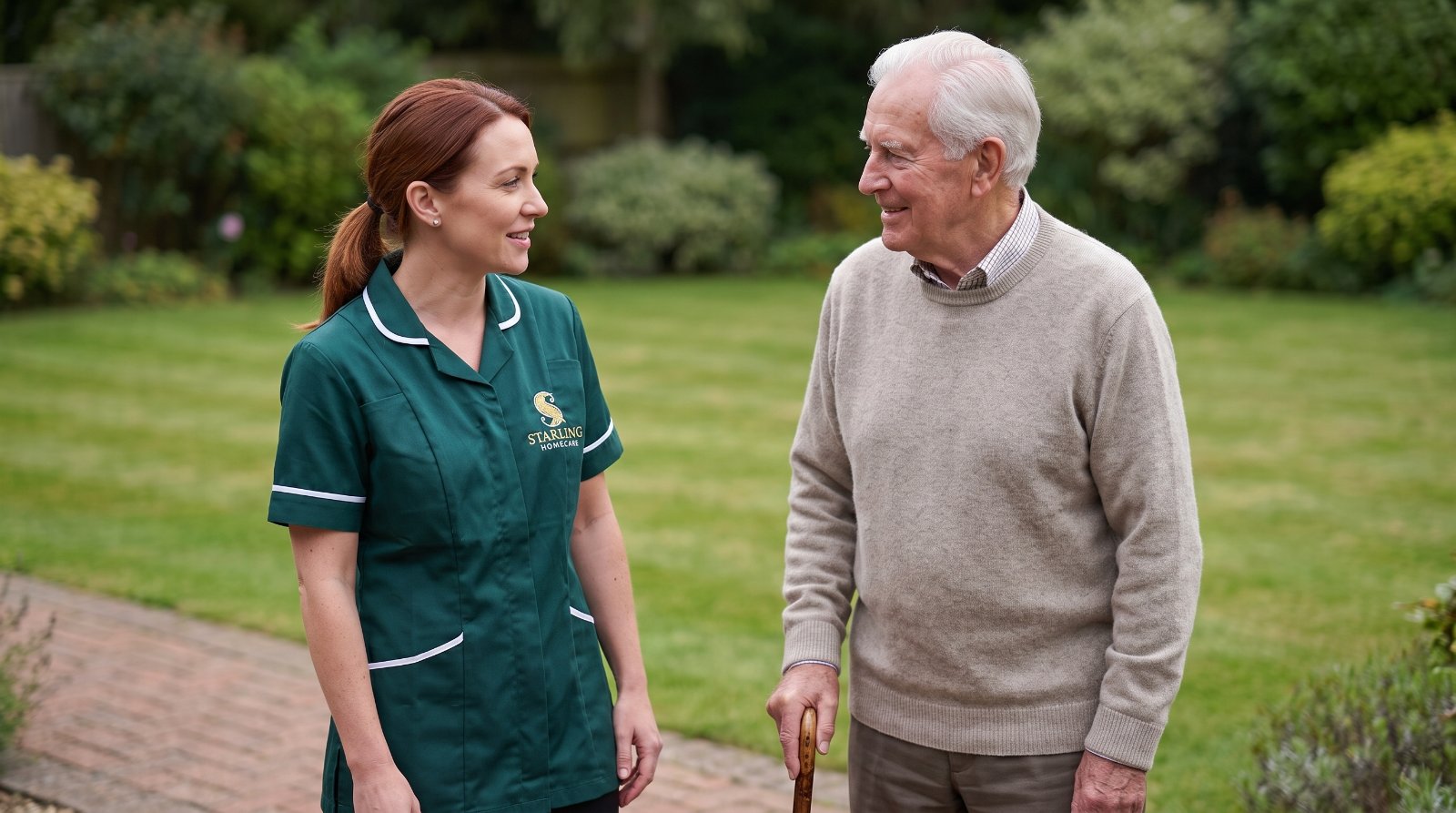
Parkinson's freezing is a sudden feeling that the feet are glued to the floor, often when someone starts to walk, turns or reaches a doorway. At home, what helps most is a calm pause, a simple cue such as counting, and a clear, well lit route. The Parkinson's nurse and a physiotherapist can then tailor that advice.
To talk anything through with someone local, our St Albans team is on 01727 324 127.
What does freezing look like?
Parkinson's UK's guide to freezing describes it as a sudden inability to step forward, even when the person wants to move. An episode can last a few seconds, or 30 seconds or longer. The charity says over half of people with Parkinson's may experience it, most often in advanced Parkinson's.
Families often notice it first in one spot. For example, a parent may walk across the lounge quite well, then stop dead at the kitchen door. That pattern is useful, because it tells you where to start making changes.
Timing matters too. Parkinson's UK says freezing is more likely with late or missed doses. That is one reason we write about why the clock matters so much in Parkinson's care at home.
Why does Parkinson's freezing happen?
The exact cause is not known. However, Parkinson's UK says some researchers think the brain has to pay more attention to walking. So anything that pulls attention away can interrupt it.
Common triggers the charity lists include:
- starting to walk, or turning round
- approaching a doorway or a narrow space
- moving from carpet to tiles
- crowds, rushing, or doing two things at once
- poor lighting
Anxiety, tiredness, poor sleep and low mood can also make freezing more likely. In practice, that means a hurried morning before an appointment is often harder than a quiet afternoon.
What can you do in the moment?
First, stop. Parkinson's UK suggests a simple sequence: stop, think, plan, do. Trying to push through usually adds pressure, and rushing is itself a trigger, so give the person time.
Then try a cue. The charity describes several, and different ones suit different people:
- Shift the weight. Rock gently from side to side onto one leg, then step with the other foot.
- Use a rhythm. Count steps, march "one, two, one, two", hum, or say "ready, steady, go".
- Picture the step. Imagine the movement in detail before making it.
- Use lines on the floor. Strips of tape on the floor give a target to step on or between.
Also, avoid chatting while walking. Parkinson's UK suggests pausing and touching something solid before talking, rather than walking and talking together.
Small changes around the home
Floor strips are one of the most practical ideas for Parkinson's freezing at home. Parkinson's UK suggests contrasting tape 40cm to 55cm long, spaced 35cm to 50cm apart. Place them at changes in flooring and fan them out at corners.
Next, look at the usual route through the house. Move any mats or rugs that cause freezing off the usual route, keep spaces uncluttered and keep lights on in hallways. Poor lighting is a listed trigger, so this matters on dark winter evenings.
Turning deserves care as well. The charity recommends turning slowly in a half circle rather than pivoting on the spot. Flat or low heeled, supportive shoes help, and floppy slippers are best avoided.
Some people use laser cues fitted to a stick, frame or shoes. These project a line to step over. Parkinson's UK notes they may work less well in bright light.
Who should you ask for help?
The specialist or Parkinson's nurse is the starting point. Parkinson's UK suggests keeping notes on when and where freezing happened, what the person was doing, and what got them moving again.
A physiotherapist can teach cueing strategies and advise on walking aids. This is important, because the charity warns that the wrong walking aid can make freezing worse. An occupational therapist can advise on changes at home, and a GP, nurse or specialist can refer.
The NHS guide to Parkinson's treatment also says a care plan should be agreed with the healthcare team and family or carers, then reviewed regularly. Medication questions always belong with the specialist team. Parkinson's UK is clear that medication should never be stopped suddenly.
How a regular carer helps with freezing
A carer who visits regularly learns which cues work for this person. Those cues go into the care plan, so everyone uses the same words and the same rhythm.
Carers also prompt medication at the times the prescriber has set, as explained in what home carers can and cannot do with medication. They keep routes clear, allow time, and note any freezing in the daily record so the family can share it with the nurse.
For a wider view of the decisions families face, our article on whether someone with Parkinson's can live alone may help.
Frequently asked questions
Does Starling Homecare provide Parkinson's care in Hertfordshire?
Yes. Starling Homecare is an independent, family run provider based in St Albans and registered with the Care Quality Commission. We provide Parkinson's care at home in Hertfordshire, through visiting care and live-in care. You can read more on our Parkinson's care page.
Is freezing the same as wearing off?
No. Parkinson's UK says freezing and wearing off are different problems and are treated separately. Freezing can happen during "on" periods as well as "off" periods. Parkinson's UK suggests bringing notes on when it happens to appointments with the specialist or Parkinson's nurse.
Will a walking frame stop freezing?
Not necessarily. Some aids help, but Parkinson's UK warns that the wrong one can make freezing worse. Ask for a physiotherapist's advice before buying a frame or stick.
What if my dad freezes in a shop or a busy street?
Parkinson's UK suggests "pause, look, plan and walk". Step aside out of the flow of people, touch something solid, then count steps to a target. Planning busy trips in short stages also helps.
Does Parkinson's freezing make falls more likely?
It can affect balance, which is why Parkinson's UK pairs its freezing advice with falls prevention tips. Good shoes, slow half circle turns and a clear route all reduce the risk. If falls are happening, tell the GP or Parkinson's nurse. Our page on falls prevention at home explains how support at home can sit alongside that advice.
Starling Homecare supports people with Parkinson's across Hertfordshire through our Parkinson's care at home, with visits from 30 minutes upwards. Our carers do not replace the physiotherapist or the specialist nurse. Instead, they use the cues those professionals recommend, keep medication prompts on time and tell the family promptly when something changes.
Figures and guidance checked on 8 November 2026 against Parkinson's UK's guide to freezing and the NHS.
Arranging Care Is Simple
Starting care can feel like a big step. We keep it calm and straightforward, and we are here to guide you from your very first call.
1. Talk to us
Get in touch by phone or request a callback. We will listen, answer your questions and help you understand the options, so you can decide what feels right in your own time.
2. A home visit and initial consultation
We arrange a visit to understand your routines, your home and what matters most to you. Together we agree an initial consultation and shape the support that feels right.
3. Your care begins
A small, familiar team starts your care, arriving at the agreed times and staying involved as your needs change. We remain your trusted adviser throughout.
Whenever you are ready, we are here to help.