
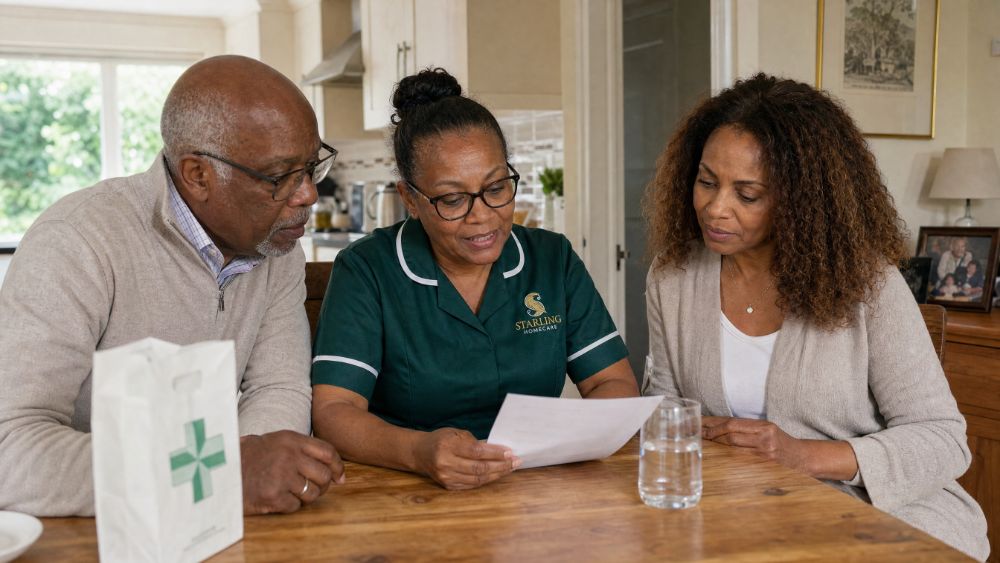
A medication muddle after hospital is best sorted with the pharmacist and GP, starting from the discharge letter. NHS England says community pharmacies must offer the NHS Discharge Medicines Service to people referred from hospital. Do not stop or change anything yourself. If he suddenly becomes confused, the NHS says go to A&E or call 999.
To talk anything through with someone local, our Welwyn Garden City and Hatfield team is on 01707 714 000.
Perhaps you found the old boxes, a new bag from the hospital and a letter that matches neither. It can be unsettling not knowing which tablets are current, especially if you have to head home tonight or are sorting it between work calls. You might also worry when Dad says he has "got it all in hand".
This is a situation our team knows well, and there is a clear, calm way through it.
Why does a medication muddle after hospital happen?
Medicines can be changed in hospital, so the tablets at home may no longer match what Dad should take. The NHS Discharge Medicines Service exists for exactly this moment.
NHS England explains that hospitals refer patients to their community pharmacy when they leave, with information about medicine changes made during the stay. The aim is to prevent harm from medicines and help people avoid going back into hospital.
Age UK also says that before someone leaves hospital, staff should check they have a supply of medicines to take home and understand any new medicines or changes.
What should I do today?
Start with the paperwork and the pharmacist, not the tablets.
- Find the discharge letter or summary and keep it with the medicines.
- Gather every medicine in one place, including anything bought over the counter. The NHS suggests keeping medicines together, and says over-the-counter medicines should not be taken with prescribed ones unless a doctor or pharmacist confirms it is safe.
- Call or visit his usual pharmacy. Ask whether the hospital sent a Discharge Medicines Service referral, and ask them to go through what has changed.
- Do not throw anything away or change a dose until the pharmacist or GP has checked. Age UK warns that suddenly stopping certain medicines can have side effects or make a condition worse.
- Ring the GP surgery if anything is still unclear, or if Dad seems unwell.
Questions to ask the pharmacist or GP
A short list helps, because these conversations can be quick. You could ask:
- "Which of these boxes should Dad still be taking, and which have stopped?"
- "Has any dose or timing changed since he went into hospital?"
- "What should we do with the medicines he no longer needs?"
- "Would a reminder aid or a different pack help him?" The NHS medicines tips for carers suggest asking the pharmacist about reminders, and note that dosette boxes are not always free on the NHS.
- "Could he have a medication review?" Age UK says a structured medication review is a free NHS service, and it may be offered after a hospital admission where medicines could have played a part.
Afterwards, Age UK suggests keeping an up-to-date list of all medicines, including over-the-counter and herbal ones.
How do I raise it with Dad?
Keep it practical and on his side. You could try:
- "The hospital changed a few things. Shall we ask the pharmacist to check it all, so it's one less thing for you?"
- "I'd feel better with a list on my phone. Can we write it together?"
- "Would it help if someone popped in at tablet times for a couple of weeks while you get back on your feet?"
Who can help in Hertfordshire?
The pharmacist and GP are the right people for the medicines themselves. For wider help at home, Hertfordshire County Council has a free advice line.
- 999 or A&E if Dad suddenly becomes confused.
- His community pharmacy, to check the hospital changes against what is at home.
- His GP surgery, for questions about doses or a review.
- HertsHelp on 0300 123 4044, Hertfordshire County Council's free advice service. The council says contacting a care service yourself may be the quickest option.
Our guide to home care after hospital in Hertfordshire explains who does what in the first weeks.
How Starling Homecare can help
Starling Homecare's medication management and support is built for weeks like this one. Once the pharmacist or GP has confirmed what Dad should take, a carer can help him keep to it.
- Medication prompting and support at the right times, from pharmacy labelled packs or dosette boxes.
- A written record of what was taken and when, so missed doses or changes are noticed.
- Help with repeat prescriptions and coordinating deliveries.
- Visiting care from 30 minute visits, with meal preparation and help around the house.
Our carers notice, prompt and pass concerns on. With Dad's agreement, we liaise with his GP, district nurse or pharmacy, and we keep the family informed. Carers do not adjust doses, decide to stop or start a medicine, give injections or carry out clinical tasks. Our page on whether home carers can give medication explains the levels of help, and our Radlett guide covers medication support in the first fortnight after hospital.
If Dad is unsure about having someone in, it can start with someone from our team simply coming round for a chat. It does not have to be formal; it is a conversation to get to know him and what matters to him, and it often breaks the ice. In urgent situations care can usually start within a day or two, and visits can be adjusted as he recovers.
Areas we cover
Starling Homecare's carers visit people at home in St Albans, Harpenden, Hemel Hempstead, Welwyn Garden City and Hatfield, Potters Bar and Cheshunt, and the villages around them. Elsewhere in Hertfordshire, including Berkhamsted, Tring, Radlett and Shenley, Hitchin and Hertford, we arrange live-in care.
For more on the early stages, see our guide for families worried about an elderly parent. Locally, here is how we provide home care in Welwyn Garden City and Hatfield.
Frequently asked questions
What is the NHS Discharge Medicines Service?
NHS England describes it as a service every community pharmacy must provide. When someone leaves hospital, the hospital can refer them to their community pharmacy with details of any medicine changes made during the stay. The aim is to prevent harm from medicines and reduce the chance of going back into hospital. Ask the ward or pharmacist whether a referral was made.
Should I throw away Dad's old tablets after a hospital stay?
Not until a pharmacist or GP has checked them against the discharge letter. Age UK warns that suddenly stopping certain medicines can have side effects or make a condition worse, so it is safer to ask first. Once the current list is confirmed, ask the pharmacist what to do with any medicines Dad no longer needs.
Can I get medication support for Dad in Hatfield quickly?
Yes. Starling Homecare's carers visit people at home across Welwyn Garden City and Hatfield, and in urgent situations care can usually start within a day or two. A carer can prompt Dad at tablet times, keep a written record of what he has taken and, with his agreement, pass any concerns to his GP or pharmacy.
However far you are from your dad, a medication muddle after hospital is something we can help you untangle. Our Welwyn Garden City and Hatfield team is on 01707 714 000. You will be talking to someone who arranges care every day, so you can find out what good support looks like before you decide anything.
Guidance checked on 26 October 2026 against NHS England, the NHS and Age UK.
Arranging Care Is Simple
Starting care can feel like a big step. We keep it calm and straightforward, and we are here to guide you from your very first call.
1. Talk to us
Get in touch by phone or request a callback. We will listen, answer your questions and help you understand the options, so you can decide what feels right in your own time.
2. A home visit and initial consultation
We arrange a visit to understand your routines, your home and what matters most to you. Together we agree an initial consultation and shape the support that feels right.
3. Your care begins
A small, familiar team starts your care, arriving at the agreed times and staying involved as your needs change. We remain your trusted adviser throughout.
Whenever you are ready, we are here to help.