
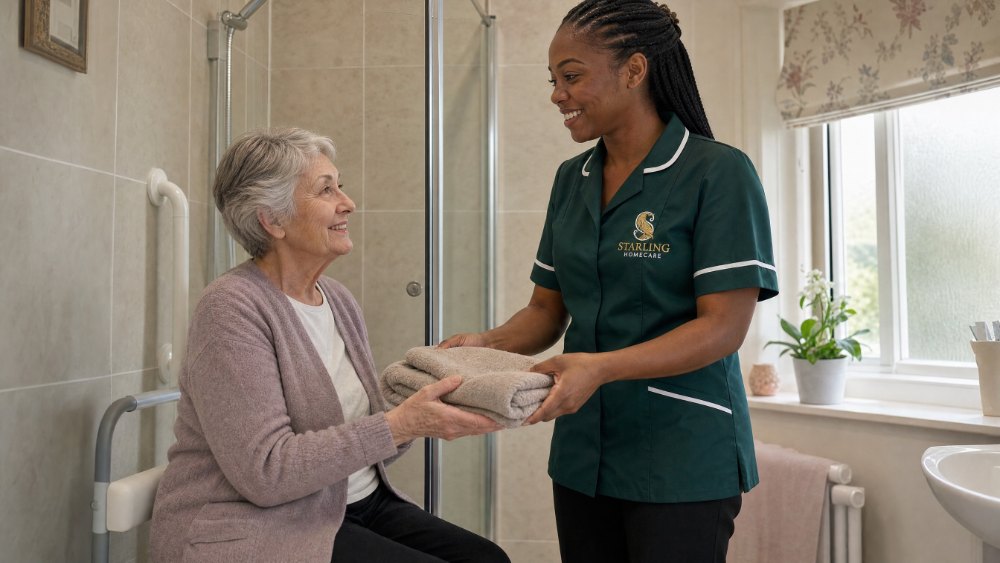
If an elderly parent fell in the bathroom, call 999 if they cannot get up or may have hurt their head, back, neck or hip, as the NHS advises, and do not try to lift them. Otherwise, see the GP. Then ask Hertfordshire County Council for an assessment: aids such as rails or a seat are free if needed.
To talk anything through with someone local, our Berkhamsted team is on 01442 954 137.
You might have had the call from your mum, quietly embarrassed, or noticed she now washes at the sink instead of using the bath. It can be upsetting to picture her alone on a wet floor. It can also feel awkward, because the bathroom is the most private room in the house and the last place either of you wants to talk about.
Bathroom worries are familiar ground for our team, and there is a calm, respectful way through them.
Why do falls happen in the bathroom?
Bathrooms are hard floors, water and getting in and out. The NHS guidance on helping someone keep clean says that, where balance or mobility is limited, the floor should not be slippery and the room should be a comfortable temperature.
It also notes that some people are anxious about deep bath water. So a fall can knock confidence as much as anything else, which is one reason a GP visit matters. Age UK suggests telling the doctor after a fall even if she feels fine.
My elderly parent fell in the bathroom: what should I do this week?
Start with her health, then make washing safer. A short checklist:
- See the GP. The NHS advises seeing a GP after a fall. If she may be hurt or unwell, call 111.
- Ask for a council assessment. The NHS says a needs assessment is free, and equipment and small adaptations are free if she is assessed as needing them.
- Check the basics. The NHS and Age UK suggest a non-slip mat in the bath or shower and fitted handrails, for example by the bath.
- Keep the room warm and the floor dry. The NHS also suggests water that is comfortably warm, as older people particularly feel the cold.
- Think about the lock. The NHS suggests removing locks from the bathroom door. She may want privacy, but others may need to get in in an emergency.
What equipment can make the bathroom safer?
An assessment is the best way to find out what would help her. The NHS guide to helping someone keep clean says social services should be able to provide small aids, including:
- hand rails
- raised toilet seats
- commodes
The NHS adds that bath or shower seats can reduce anxiety, and that a handheld shower can help. For bigger changes, GOV.UK says a Disabled Facilities Grant from the council can help pay for things such as a level access shower.
How do I raise it with Mum?
The NHS says washing is a very private activity, and many people feel self-conscious when undressed in front of others. So it helps to lead with her comfort and her say in things. You could try:
- "Would a seat in the shower make it more comfortable? Then you can take your time."
- "I'd love you to keep doing things your way. Shall we see if a rail would help?"
- "Would you rather someone was just nearby while you have a bath, not in the room?"
If she would rather not talk about it today, that is understandable. A gentle second try often goes better.
Who can help in Hertfordshire?
- Her GP, for checks after the fall and any referral to a falls service.
- HertsHelp on 0300 123 4044, Hertfordshire County Council's free advice service, who can explain how to ask for an assessment.
- The council's home adaptations help. The county council's page on changes to your home says the Hertfordshire Home Safety Service can help make small changes to prevent falls.
How Starling Homecare can help with washing
Accepting a little help in the bathroom is often what lets a parent keep washing in her own home, in her own way. It also means your visits can be about time together, not checking she got out of the bath safely.
Our personal care covers respectful help with bathing, washing, grooming and dressing, at her pace. The shortest personal care visit is 30 minutes, and many people prefer longer visits so nothing feels rushed. We aim for a small, familiar team who get to know her.
Our carers keep walkways clear, notice changes, keep you informed and, with her consent, pass concerns to her GP. Visits can include meal preparation, medication prompting and help around the house too. Carers do not give injections or carry out clinical tasks, and no one can promise to prevent every fall.
If your mum is unsure, we would usually start with someone from our team simply coming round for a chat. It does not have to be formal. It is a conversation to get to know her and what matters to her, and that often breaks the ice. As her needs change, visits can increase. In urgent situations, care can usually start within a day or two. Our guide to personal care at home explains more.
Areas we cover
Starling Homecare's carers visit people at home in St Albans, Harpenden, Hemel Hempstead, Berkhamsted, Tring, Radlett and Shenley, Welwyn Garden City and Hatfield, Potters Bar, Hitchin and Hertford, and we arrange live-in care across Hertfordshire.
For a wider starting point, see our guide for families worried about an elderly parent. Locally, here is how we provide home care in Berkhamsted. If washing had already been slipping, our earlier guide on an elderly parent not washing may help.
Frequently asked questions
What should I do if my elderly parent fell in the bathroom and can't get up?
Call 999. The NHS says to call 999 if someone has fallen and cannot get up, or may have injured their head, back, neck or hip. Keep them comfortable and warm while you wait, and do not try to lift them yourself. Help them up only if they can get up.
Are grab rails and shower seats free in Hertfordshire?
They can be. The NHS says equipment and small adaptations are provided free if someone is assessed as needing them, and the council needs assessment is free. HertsHelp, Hertfordshire County Council's free advice service, on 0300 123 4044, can explain how to ask for one.
Can a carer help my mum wash in Berkhamsted?
Yes. Starling Homecare provides personal care in Berkhamsted, including help with bathing, washing and dressing, from 30 minute visits. We aim for a small, familiar team so she gets to know the people helping her. In urgent situations, care can usually start within a day or two.
Whether your mum lives near Berkhamsted High Street or you are some distance away, a first call is simply a chance to talk it through. Our Berkhamsted team is on 01442 954 137. You will be talking to someone who arranges care every day, so you can find out what good, dignified support looks like before you decide anything.
Guidance checked on 26 October 2026 against NHS: Falls, the NHS guides to keeping clean and household equipment, Age UK, GOV.UK and Hertfordshire County Council.
Arranging Care Is Simple
Starting care can feel like a big step. We keep it calm and straightforward, and we are here to guide you from your very first call.
1. Talk to us
Get in touch by phone or request a callback. We will listen, answer your questions and help you understand the options, so you can decide what feels right in your own time.
2. A home visit and initial consultation
We arrange a visit to understand your routines, your home and what matters most to you. Together we agree an initial consultation and shape the support that feels right.
3. Your care begins
A small, familiar team starts your care, arriving at the agreed times and staying involved as your needs change. We remain your trusted adviser throughout.
Whenever you are ready, we are here to help.