
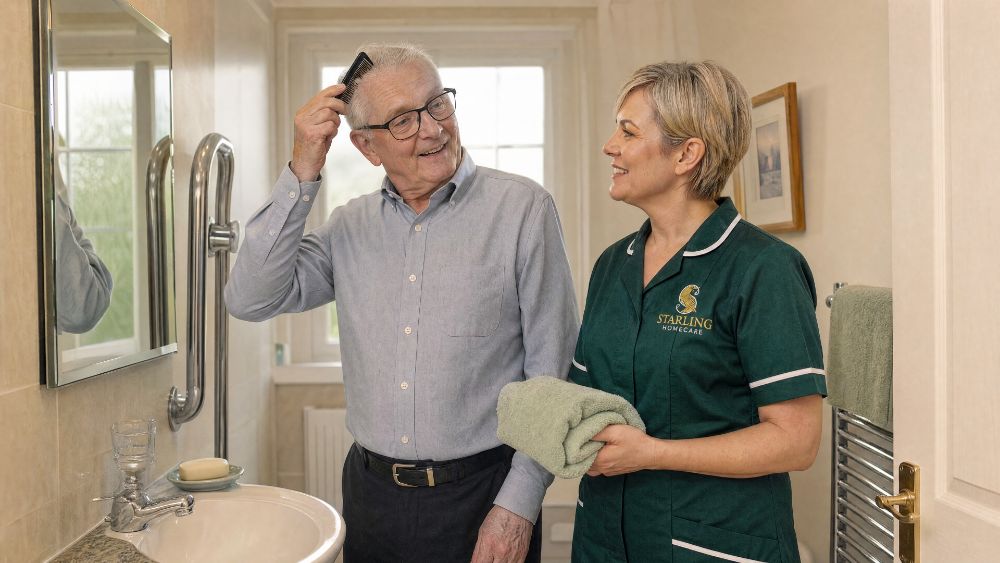
If you have noticed your dad looking scruffier than he used to, it is worth a gentle look at why. An elderly parent not washing or changing clothes as often can have several causes, and the NHS, Age UK and the Alzheimer's Society all describe practical ways to help. Possible reasons include worry about the bath, physical difficulty, low mood and memory changes, and the GP can check for these. If your dad has suddenly become confused, the NHS advice is to go to A&E or call 999.
To talk anything through with someone local, our Hemel Hempstead team is on 01442 954 137.
Perhaps it was the same jumper two visits running, or a stubbly chin on a video call. It can be sad to see in a dad who has always taken pride in looking after himself, and hard to know whether to say anything at all. If you only see him every week or two, you might also be unsure whether this is new or has been building for a while.
This is a path our team has walked with families before, and it can be taken gently, one step at a time.
This guide is about understanding what might be behind it, and responding in a way that protects his dignity and keeps things easy between you.
Elderly parent not washing: what it can mean
As the NHS puts it, for most people washing is a very private activity. Our article on signs an elderly parent needs help at home covers the wider picture. Here are some common reasons around washing.
- The bath has become daunting. The NHS guide to helping someone keep clean notes that some people are anxious about deep bath water, and find overhead showers frightening.
- Physical difficulty. The Alzheimer's Society advises checking for physical problems that make washing or dressing difficult.
- Low mood. Age UK lists feeling tired all the time, losing confidence and not enjoying usual things as signs of low mood or anxiety.
- Memory changes. The Alzheimer's Society explains that someone with memory problems may forget the steps, or believe they have already washed.
There is no need to play detective, and it may be more than one. The GP can check for physical problems, low mood and memory changes. If his forgetfulness has crept up gradually, the NHS advice is to see a GP.
What to do this week
- Look at the bathroom. Is there a rail, a non-slip mat, a towel within reach? Is the shower overhead only?
- Notice the pattern. Is it clothes, shaving, teeth, or everything? Has it changed quickly or slowly?
- Book a GP appointment if you have also noticed low mood, tiredness or memory changes. Go with him if he would like you to.
- Ask about equipment. The NHS says equipment and small adaptations are free if someone is assessed as needing them, and the needs assessment itself is free.
- Small changes. The NHS mentions a handheld shower instead of an overhead one, and bath seats to ease anxiety. The Alzheimer's Society suggests leaving clean clothes out.
How to raise it with your dad
This can be one of the harder conversations to start, because it touches his pride as well as his routine. The NHS asks anyone helping with washing to be sensitive and protect the person's dignity. The same applies to the conversation. You might try words like these, in private:
- "That bath is really deep. Would a seat or a rail make it easier to get in and out?"
- "You've seemed tired lately. Shall we ask the GP whether anything is wearing you down?"
- "Would you rather someone popped in a couple of mornings a week, so you can shower while someone is in the house?"
The Alzheimer's Society also reminds families to respect someone's choice to wash less often than you would. If he waves the subject away, that can be frustrating, and it is fine to leave it and come back to it another time.
If your dad is reluctant to have help, that is understandable, and it can start with someone from our team simply coming round for a chat. It does not have to be formal. It is a conversation to get to know him and find out what matters to him, and that often breaks the ice. We have a lot of experience with these first conversations.
Who to call in Hertfordshire
His GP surgery is the right first call for any health worry behind the change.
HertsHelp, on 0300 123 4044, is Hertfordshire County Council's free advice service. It can help you find a suitable service. The council also offers an assessment, and says having one does not commit you to anything.
If you think your dad can no longer look after himself, the county council lets you report a concern about an adult day or night on 0300 123 4042. If someone is in immediate danger, call 999.
How Starling Homecare can help with washing and personal care
Accepting help with washing is not giving something up. It can be what lets your dad keep his own routine at home, and lets your visits be about the two of you.
Our personal care support includes help with bathing, washing, grooming, shaving, dressing and oral care. It is part of our visiting care, which starts from 30 minute visits, with a small, familiar team. Visits can also include meal preparation, help around the house and companionship.
A carer works at your dad's pace, in the way he prefers, and encourages him to do what he can for himself. Carers also notice changes, keep you informed and, with his consent, pass concerns to his GP. They do not carry out clinical tasks. Our page on what personal care at home includes explains more.
If your dad lives in Hemel Hempstead and you live further away, we would usually start by agreeing the times of day that suit him best. We stay alongside you from that first conversation: visits can increase as his needs change, and overnight or live-in care is available later if needed. In urgent situations, care can usually start within a day or two.
Areas we cover
Starling Homecare's carers visit people at home in St Albans, Harpenden, Hemel Hempstead, Berkhamsted, Tring, Radlett and Shenley, Welwyn Garden City and Hatfield, Potters Bar, Hitchin and Hertford, and we arrange live-in care across Hertfordshire.
If you are just starting to notice changes, our guide for families worried about an elderly parent is a good next read.
For local details, see our home care team in Hemel Hempstead.
Frequently asked questions
How often should an older person wash?
The NHS suggests washing the face and intimate areas every day, and a bath or shower at least twice a week. Teeth should be brushed twice a day.
Can we get a bath seat or grab rail for free?
Possibly. The NHS says equipment and small adaptations are provided free if someone is assessed as needing them. Ask Hertfordshire County Council for a needs assessment. HertsHelp on 0300 123 4044 can point you to the right service.
What if Dad refuses help with washing?
It can begin with an informal chat with our team, so he gets to know someone first. The Alzheimer's Society suggests flexible timing and, if a bath feels too much, a bed bath. If you are worried about his hygiene or health, speak to his GP.
Starling Homecare is a family run, CQC registered provider of care at home. If you are worried about an elderly parent not washing, our Hemel Hempstead team is on 01442 954 137, and you are welcome to call wherever you are in your thinking. You will be speaking to someone who arranges care every day, who can talk through what gentle, regular support could look like for your dad.
Guidance checked on 26 October 2026 against NHS: household gadgets and equipment and Alzheimer's Society: when a person does not want to wash.
Arranging Care Is Simple
Starting care can feel like a big step. We keep it calm and straightforward, and we are here to guide you from your very first call.
1. Talk to us
Get in touch by phone or request a callback. We will listen, answer your questions and help you understand the options, so you can decide what feels right in your own time.
2. A home visit and initial consultation
We arrange a visit to understand your routines, your home and what matters most to you. Together we agree an initial consultation and shape the support that feels right.
3. Your care begins
A small, familiar team starts your care, arriving at the agreed times and staying involved as your needs change. We remain your trusted adviser throughout.
Whenever you are ready, we are here to help.