
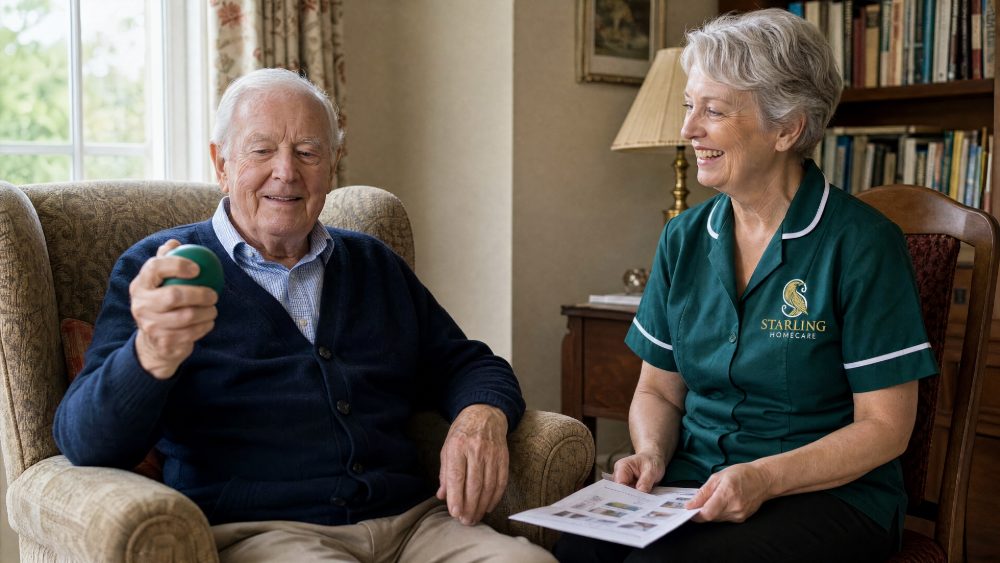
Live-in care after a stroke suits people who need help at unpredictable times across the day and night, especially in the first weeks home from hospital. It is often the right choice when fatigue, continence, communication or night-time needs are more than a husband or wife can manage alone. When needs fall at a few fixed points in the day, visiting care is usually enough.
To talk anything through with someone local, our St Albans head office team is on 01727 324 127.
A stroke can change a household overnight, and the discharge date can arrive before anyone has had time to think. This guide sets out when a live-in arrangement fits, when it does not, and how it works.
World Stroke Day falls on Thursday 29 October. The Stroke Association describes it as a day that focuses on prevention, treatment, recovery and the long-term impact stroke can have on people's lives. Recovery at home, and who helps with it, is a large part of that long-term picture.
Who does what after a stroke: the NHS team and the carer
Clinical rehabilitation stays with the NHS. The NHS stroke recovery page explains that the plan your healthcare team gives you will help you set goals, and that the team continues to support you after discharge by creating a home recovery plan.
Some people qualify for Early Supported Discharge. The Stroke Association says this lets someone leave hospital soon after a stroke and continue to have medical care and therapy at home. It suggests asking the team how long that support will last.
A live-in carer does not replace any of this. We support therapy rather than provide it. Our role is the daily living around it: personal care, meals, medication prompts, company, and helping the person keep up the practice their therapists have set.
For the local NHS and charity services, see our guide to stroke support in Hertfordshire. For what changes at the six-month review, see stroke recovery at home in Hertfordshire.
When live-in care after a stroke is the right fit
Live-in care tends to fit when several of these are true at once.
- Help is needed at unplanned times. Getting to the toilet, help with drinks following any speech and language therapy guidance, or reassurance when words will not come. These needs do not wait for a booked visit.
- Fatigue shapes the day. The Stroke Association says fatigue is very common after stroke and does not seem to get better with rest in the way normal tiredness does. A carer who is there all day can work around the good hours.
- Exercises need regular encouragement. The NHS says rehabilitation exercises are often difficult but help you make progress. Someone on hand can encourage the practice through the day, exactly as the therapists set it.
- Continence has changed. The NHS notes that a recovery plan may include advice, exercises and medicines for bowel or bladder problems. Help with this at night is hard to arrange through visits.
- Communication is affected. A carer who is there every day learns how the person communicates now. Our article on aphasia after stroke at home covers this in more depth.
- A spouse cannot do it alone. Nights can be the hardest part, when one partner is up repeatedly and has no one to hand over to.
When visiting care is enough instead
Live-in care is not always the answer, and we say so when it is not. If the person sleeps through the night, moves safely around the home and needs help mainly with washing, dressing and meals, visits at set times often work well.
Visits can also suit someone with a partner who is well and wants to stay the main carer, with help at the hardest moments of the day. Where someone lives on their own, our guide to living alone after a stroke looks at that question separately.
Needs also change, and the type of care can be reviewed with us, whether strength returns or nights become harder.
How a live-in arrangement works day to day
A live-in carer lives in the home and needs their own bedroom, plus somewhere to rest. That private room matters: it lets the carer be nearby through the night while giving the household its own space.
Carers need proper rest and a daily break, so we plan this into the arrangement from the start. Your relative has a main carer, and a familiar second carer covers the agreed breaks and holidays. The family does not have to organise cover.
Where someone needs frequent help overnight, we talk through the right way to support that safely, as one carer cannot work every hour without rest. The care plan is agreed with the family, and with your agreement we keep in touch with the professionals involved and follow any guidance from the therapy and speech and language teams.
For couples, live-in care can let both partners stay together at home, with support shaped around both people's needs. This often helps where the partner who did not have the stroke has needs of their own.
Support for the partner at home
The Stroke Association reminds families that it is not just the survivor who is affected after a stroke, but anyone supporting them too. It also stresses that it is important to care for yourself while looking after someone else.
A live-in arrangement lets a husband or wife be a partner again, not only a carer. They can sleep, see friends and keep their own appointments.
The Stroke Association's Stroke Support Helpline is on 0303 3033 100, open Monday to Friday 9am to 5pm and Saturday 10am to 1pm. For any change in health, contact the GP or NHS 111, and call 999 in an emergency.
How our live-in stroke care works in Hertfordshire
Our live-in care service is built around familiar carers, a care plan agreed with the family and a local team who know the person. Our stroke care page explains how we support recovery, from exercises set by therapists to patience with communication.
Live-in care is from £255 a day, and from £295 a day for couples. Visiting care is from £34 a visit. These are starting rates, and a price is agreed after an assessment. Our guide to live-in care in Hertfordshire covers funding and first steps.
We are a CQC-regulated home care provider, and our head office team in St Albans supports families across the county. You can reach them on 01727 324 127 or at stalbans@starlinghomecare.co.uk, and the towns we cover are listed on our areas we cover page.
Common questions about live-in care after a stroke
Can a live-in carer do stroke rehabilitation exercises?
A live-in carer can encourage and support the exercises set by the NHS therapists, but does not design or change them. The rehabilitation plan comes from the healthcare team. The carer helps the person keep up the practice day to day.
Does a live-in carer need their own room?
Yes. A live-in carer needs their own bedroom and somewhere to take proper rest and breaks. A spare room usually works best.
How long do people usually have live-in care after a stroke?
There is no set length. The NHS says recovery takes days or weeks for some people and months or years for others. The care can be reviewed with us as recovery progresses.
Can live-in care start straight from hospital?
It may be possible, depending on your situation and on matching a suitable carer, so it helps to plan it before discharge. The Stroke Association says the hospital stroke team should involve you and the person who has had a stroke in decisions about leaving hospital, so it is worth raising live-in care with the ward early.
Choosing care after a stroke is a decision made under pressure, and it is fine for the first plan to change. What matters most is that the person comes home to steady, familiar support, and that the people who love them are not left to carry every hour alone.
Details checked against NHS and Stroke Association pages on 19 October 2026. Our prices are starting rates, checked on the same date.
Arranging Care Is Simple
Starting care can feel like a big step. We keep it calm and straightforward, and we are here to guide you from your very first call.
1. Talk to us
Get in touch by phone or request a callback. We will listen, answer your questions and help you understand the options, so you can decide what feels right in your own time.
2. A home visit and initial consultation
We arrange a visit to understand your routines, your home and what matters most to you. Together we agree an initial consultation and shape the support that feels right.
3. Your care begins
A small, familiar team starts your care, arriving at the agreed times and staying involved as your needs change. We remain your trusted adviser throughout.
Whenever you are ready, we are here to help.