
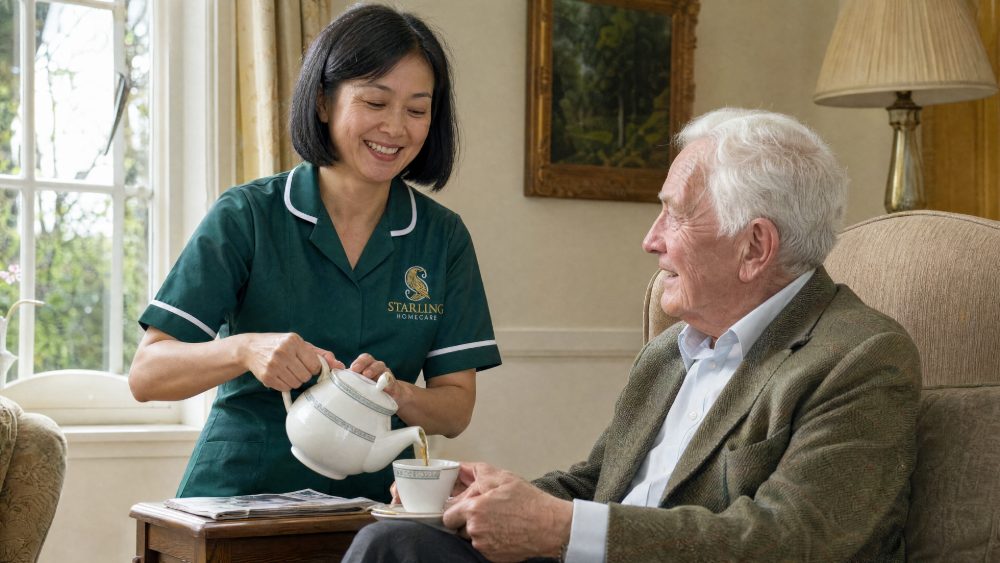
Aphasia after stroke is a difficulty with language, not with intelligence. The person usually knows what they want to say, and may understand more than they can show, but the words will not come, or come out wrong. This guide explains what aphasia is, what tends to help at home, and how families and carers can keep conversation going while therapy and recovery continue.
Starling Homecare is an independent, family-run provider of care at home across Hertfordshire, regulated by the Care Quality Commission. The details below come from the Stroke Association and the NHS, checked on 29 September 2026, and they do not replace the advice of a speech and language therapist.
What aphasia after stroke is
The Stroke Association describes aphasia as a communication difficulty that affects language, and says it happens when the parts of the brain that control language are damaged. It can affect understanding speech, speaking, reading, writing or using numbers, and different people are affected in different combinations. Around one in three people in the UK have aphasia after a stroke.
It can sit alongside other effects. Dysarthria is weakness in the muscles used for speech, and apraxia of speech is difficulty coordinating those muscles. Both can make speech hard to follow without affecting understanding, which is one reason a speech and language therapist assesses each person individually.
Six ways family and friends can help
The Stroke Association gives six pieces of advice for families. Get involved, and ask the person what helps, going to their speech and language therapy sessions if you can. Work together, and include them in conversations and introductions. Be patient, because communication difficulties affect relationships. Support their independence as communication improves. Make time to be together, including in ways that need very little conversation. And get support for yourself, through a Stroke Support Group or the Stroke Support Helpline on 0303 3033 100.
Its five rules for a good conversation are simple enough to remember at the kitchen table: show respect, give each other time, listen, show care, and never assume.
Small changes to the conversation itself
The same source suggests some practical adjustments. Reduce distractions and background noise, so turn the television down before you start. Choose moments when energy and concentration are good. Keep a pen, paper and visual aids to hand. Allow silences, and ask clarifying questions rather than finishing sentences. If the person is stuck on a word, help them spell it, draw it or describe it.
None of this is difficult, but it is easy to forget when you are tired or in a hurry. A note on the fridge listing what works for this person is often more useful than any leaflet.
How our care at home supports someone with aphasia
Recovery from a stroke runs on repetition, and the days between therapy sessions matter. Our carers visit at set times, so they get to know how a person communicates: the gestures they use, the topics they enjoy and the times of day they find easiest. We can prompt the exercises the therapist has set, allow the extra time a conversation needs and note what worked, so the family and the therapist hear about it. The NHS says people should expect a review of their progress after about six months, and if that has not happened, it is worth contacting the stroke team.
We support people after a stroke with visiting, overnight and live-in care, and our carers work around the NHS therapy programme. Our guide to stroke support in Hertfordshire explains which services cover which stage, and our stroke care page sets out what we provide. Visiting care starts from £34 an hour, VAT exempt, with the price agreed after an assessment.
Where we support people after a stroke in Hertfordshire
Our carers support people after a stroke across all ten of the areas we cover. In addition, each has its own local team and number.
- St Albans: 01727 324 127
- Harpenden: 01582 824 830
- Welwyn Hatfield: 01707 714 000
- Potters Bar: 01707 714 000
- Hemel Hempstead: 01442 954 137
- Berkhamsted: 01442 954 137
- Tring: 01442 954 137
- Hitchin: 01462 534739
- Hertford: 01920 746779
- Radlett and Shenley: 01923 988 550
Common questions about aphasia after stroke
Does Starling Homecare provide care for people with aphasia after a stroke?
Yes. We provide visiting, overnight and live-in care for people recovering from a stroke across Hertfordshire, including support with communication between therapy sessions. Our carers work alongside the NHS therapy programme rather than replacing it.
Can someone with aphasia understand what I say?
Often, yes, although it varies. Aphasia can affect understanding, speaking, reading and writing in different combinations, so ask the speech and language therapist how much this person understands, and speak to them as the adult they are.
Who can I call for support as a family carer?
The Stroke Association's Stroke Support Helpline is on 0303 3033 100, and Stroke Support Groups are available for families. Your GP or the stroke team can also tell you what is available locally.
Arranging Care Is Simple
Starting care can feel like a big step. We keep it calm and straightforward, and we are here to guide you from your very first call.
1. Talk to us
Get in touch by phone or request a callback. We will listen, answer your questions and help you understand the options, so you can decide what feels right in your own time.
2. A home visit and initial consultation
We arrange a visit to understand your routines, your home and what matters most to you. Together we agree an initial consultation and shape the support that feels right.
3. Your care begins
A small, familiar team starts your care, arriving at the agreed times and staying involved as your needs change. We remain your trusted adviser throughout.
Whenever you are ready, we are here to help.