
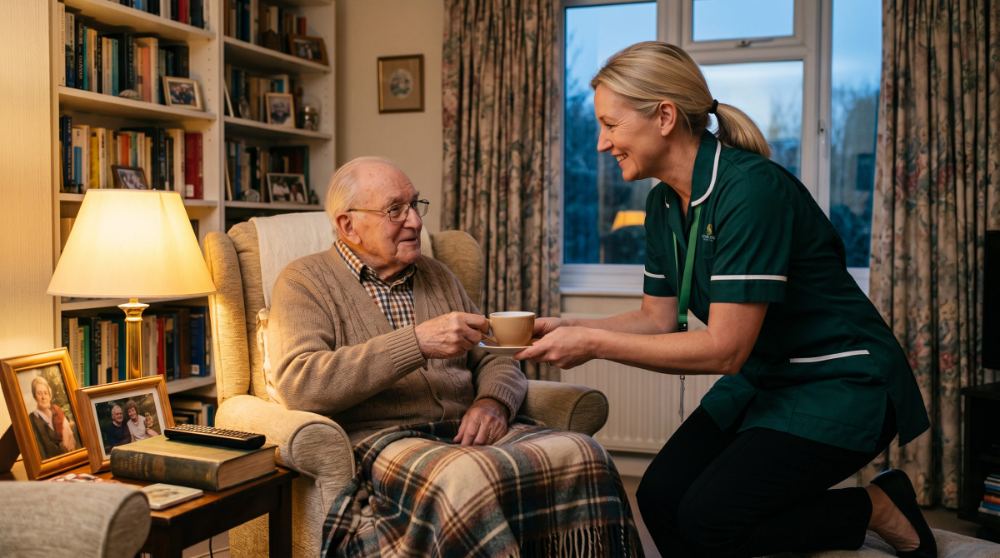
Live-in care in Hertfordshire means a trained carer lives in your relative's home and supports them through the day. It lets your relative carry on living in their own home rather than leave it. It is available right across the county, and for many families the hardest part is not the care itself but working out where to begin.
If the care system leaves you baffled, you are not imagining it. Baroness Louise Casey leads the government's independent commission into adult social care. Giving evidence to Parliament's Health and Social Care Committee on 24 June 2026, she described a system so complicated that some families are "literally applying for funding to employ navigators".
Her commission intends to set out clearer entitlements in its first recommendations later this year. Reform takes time, though, and a family weighing up round-the-clock support needs answers now. So here is a plain map of how live-in care works in Hertfordshire today: what it involves, what it costs, and who to speak to first.
What is live-in care, and who does it suit?
Live-in care is one-to-one support from a carer who lives in the home. They help with personal care, medication, meals, housekeeping and company, with reassurance close by at night. Because the carer is there through the day, support follows the person's own routine instead of fixed visit times. You can read more about our live-in care service and what a typical arrangement includes.
It tends to suit people who need help at unpredictable moments, or several times a day. In our experience that includes people living with dementia, couples who want to stay together, and anyone coming home after a hospital stay who needs steady support while they recover.
There does need to be a spare room for the carer. Both sides also need a little patience in the first week or two while everyone settles. Beyond that, most Hertfordshire homes adapt to live-in care with less fuss than families expect.
How does live-in care work across Hertfordshire?
We provide live-in care throughout the county. Our local teams cover St Albans, Harpenden, Radlett and Shenley, Hemel Hempstead, Berkhamsted, Tring, Hitchin, Hertford and Welwyn Hatfield. We match the carer to the person, not just to the rota: temperament, interests and experience all count.
One carer cannot work every hour without rest, so we plan live-in care as a small, consistent team. Your relative has a main carer, and a familiar second carer covers the agreed breaks. Careful handovers keep it feeling like support rather than a stream of strangers.
Whoever you consider, check they are registered with the Care Quality Commission, which regulates and inspects home care in England. We are a family-run, CQC-registered provider, and we would give any family the same advice about us: look the registration up before going further.
What does live-in care cost, and who pays?
Our live-in care starts from £255 a day. Regulated home care is exempt from VAT, so there is nothing to add on top. The exact figure depends on the level of support someone needs. We agree it after an assessment, never by guessing over the phone. There is a fuller breakdown in our guide to live-in care costs in Hertfordshire.
Who pays is where families most often get lost, and it is exactly the muddle Baroness Casey described. In England, someone with savings and assets above £23,250 usually funds their own care. Below that, Hertfordshire County Council may contribute after a care needs assessment and a financial assessment.
Where someone's needs are primarily health-related, NHS continuing healthcare can meet the full cost, though the bar is high. Our care funding guide walks through the assessments and thresholds in plain English.
Who should you speak to first in Hertfordshire?
You do not have to start with a provider. HertsHelp, the county's free advice service, will talk through local options on 0300 123 4044. Hertfordshire County Council can arrange a care needs assessment whether or not the council ends up paying anything. Asking for an assessment commits you to nothing.
If the family is self-funding, you can also come straight to a regulated provider. A good one asks questions before offering answers: what a typical day looks like, what is getting harder, what matters to the person. Only then does the conversation turn to care.
Two things are worth checking early. First, check that the provider employs its carers rather than simply introducing self-employed ones. That changes who is accountable for the care. Second, how breaks and cover are handled, since a live-in arrangement is only as dependable as its second carer.
Common Questions About Live-In Care in Hertfordshire
Is live-in care available across the whole of Hertfordshire?
Yes. We support families in St Albans, Harpenden, Radlett and Shenley, Hemel Hempstead, Berkhamsted, Tring, Hitchin, Hertford and Welwyn Hatfield, plus the villages around them. Each area has its own local team and telephone number, so the advice you get stays local.
How quickly can live-in care start?
Once we have assessed the person and matched a carer, live-in care can often begin within a week or two. Where a hospital discharge or family emergency makes things urgent it can sometimes be quicker. A proper assessment always comes first.
What happens when the live-in carer takes a break?
We plan breaks into the arrangement from the start. A second, familiar carer covers days off and holidays, handing over routines and notes carefully so nothing slips. You should never have to arrange cover yourself.
Baroness Casey's commission may well make the national system clearer in time. Until then, no family in Hertfordshire should need a navigator to work out whether their mum can stay in her own home. If you would like clear answers about live-in care in Hertfordshire, our team at the St Albans head office is on 01727 324 127. You can also email [email protected]. Take your time; the decision should move at your family's pace, not ours.
Arranging Care Is Simple
Starting care can feel like a big step. We keep it calm and straightforward, and we are here to guide you from your very first call.
1. Talk to us
Get in touch by phone or request a callback. We will listen, answer your questions and help you understand the options, so you can decide what feels right in your own time.
2. A home visit and initial consultation
We arrange a visit to understand your routines, your home and what matters most to you. Together we agree an initial consultation and shape the support that feels right.
3. Your care begins
A small, familiar team starts your care, arriving at the agreed times and staying involved as your needs change. We remain your trusted adviser throughout.
Whenever you are ready, we are here to help.