
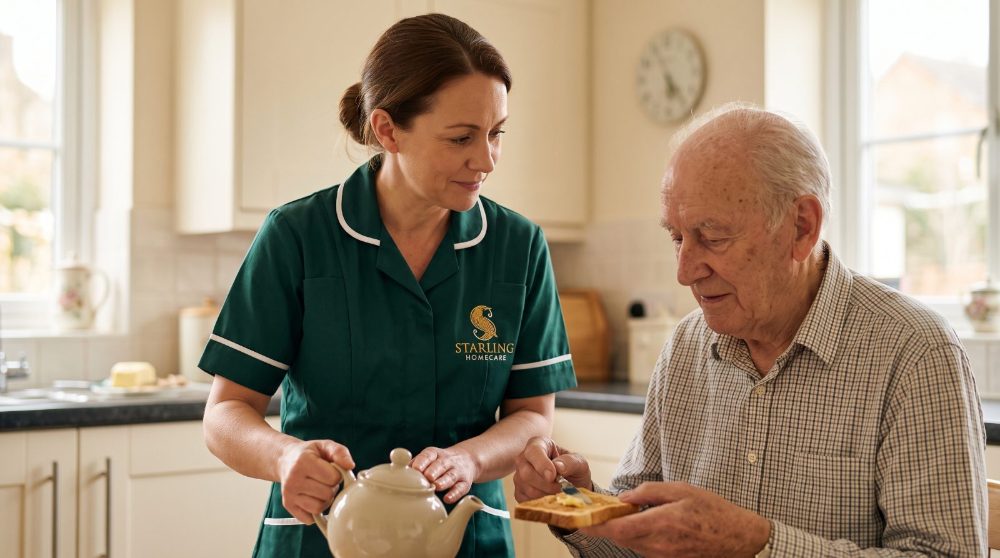
Dementia care at home in Hertford helps a person live well after a diagnosis, in the place they know best. With the right support, many people continue living safely and with dignity in their own home for a long time after a dementia or Alzheimer's diagnosis.
The early period after a diagnosis is often the hardest for a family. There is worry about the future, and uncertainty about what help is available and when to ask for it.
This guide is here to steady that. We explain what care at home involves, the local support around you, and how it can be shaped gently around the person, not the other way around.
Can a person with dementia stay living at home?
Yes. For most people, staying in their own home is not only possible but genuinely helpful, especially in the earlier stages.
Familiar rooms, routines and belongings carry meaning. They can reduce confusion and anxiety, and help a person hold on to a sense of who they are.
Home care supports that, bringing the right help to the person as needs change. If you are the one doing the caring, our guide to caring for someone with dementia at home offers practical, day to day help.
What Jon Snow's story showed about living with Alzheimer's
In June 2026, the broadcaster Jon Snow shared that he is living with Alzheimer's disease, having been diagnosed in 2023. He spoke openly in a Channel 4 documentary, made in association with the Alzheimer's Society, ending with a simple message: you have got to go on, and that is what he is trying to do.
His honesty matters because it challenges a common fear, that a diagnosis is the end of a life well lived. It is not.
Alzheimer's disease is the most common cause of dementia and affects around two in three people living with the condition. Nearly one million people in the UK are living with dementia today, according to Alzheimer's Research UK, and many are getting on with life at home, with support around them.
Jon Snow has also spoken, over the years, about caring for his own mother and the search for the right care at the right time. That is a feeling families we support in Hertford will recognise, and it is exactly where thoughtful home care can help.
What does dementia care at home in Hertford involve?
Good dementia care at home is quiet and practical. It is built around the person's day, their preferences and the things that still bring them pleasure.
In our experience, the support that helps most often includes a mix of the following:
- A steady daily routine, with gentle prompts for meals, drinks and medication.
- Help with personal care, washing and dressing, offered patiently and with dignity.
- Companionship and conversation, and time spent on familiar hobbies, music or photographs.
- A calm eye on safety at home, without taking away independence.
- Reassurance and a break for family carers, who need looking after too.
The aim is not to do everything for a person. It is to support what they can still do, and to step in kindly where it helps.
Local dementia support in and around Hertford
Hertford has genuine local support, and home care works best alongside it, not instead of it. Knowing what is nearby can make the early weeks feel less lonely.
Hertswise, the countywide dementia service, runs a dementia hub in Hertford with group activities for people living with memory loss and their carers, reachable through a single point of contact. Memory Support Hertfordshire, delivered by Age UK Hertfordshire, offers local information and a directory of memory cafes and groups.
Because we provide home care across Hertford and the surrounding towns, including Ware, Hoddesdon and Bengeo, we can help a family fit these local groups around a person's week, and get them there when going alone feels daunting.
How we approach dementia care at Starling
Starling Homecare is an independent, family run provider, registered with and regulated by the Care Quality Commission. That registration shapes our dementia and Alzheimer's care: it means our carers are employed, trained and supervised by us, with a registered manager accountable for the care given.
We keep carers consistent, so a person sees familiar faces rather than a rota of strangers. With dementia, that continuity is not a nicety. It is part of what keeps a person calm and understood.
Every person we support has a care plan shaped with them and their family, and we adjust it as things change. We do not pretend that dementia is simple, because it is not. We do promise to be steady, honest and there.
Common Questions About Dementia Care at Home in Hertford
Can a person with dementia stay living at home?
In most cases, yes, particularly in the earlier stages and often well beyond. Familiar surroundings can ease confusion, and home care brings support to the person as their needs change. Every situation is different, so the right level of help is decided with the family over time.
When should you get help with dementia care at home?
There is no single right moment, but common signs are missed medication, less eating and drinking, unsteadiness, or a family carer becoming exhausted. Bringing in a little help early often works better than waiting for a crisis. Even a few hours a week can steady a routine and give everyone breathing space.
How do you arrange dementia care at home in Hertford?
It usually starts with a conversation and an unhurried assessment of what would help. We talk with the person and their family, agree a care plan, and match carers who suit them. If you are in Hertford or a nearby town, our Hertford team can talk it through whenever you are ready.
A diagnosis changes things, but it does not have to mean giving up the home and the life a person values. With patient support, many people live well with dementia care at home in Hertford for a long time yet. Our Hertford team is here on 01920 746779 or at [email protected], whenever a calm conversation would help.
Arranging Care Is Simple
Starting care can feel like a big step. We keep it calm and straightforward, and we are here to guide you from your very first call.
1. Talk to us
Get in touch by phone or request a callback. We will listen, answer your questions and help you understand the options, so you can decide what feels right in your own time.
2. A home visit and initial consultation
We arrange a visit to understand your routines, your home and what matters most to you. Together we agree an initial consultation and shape the support that feels right.
3. Your care begins
A small, familiar team starts your care, arriving at the agreed times and staying involved as your needs change. We remain your trusted adviser throughout.
Whenever you are ready, we are here to help.