
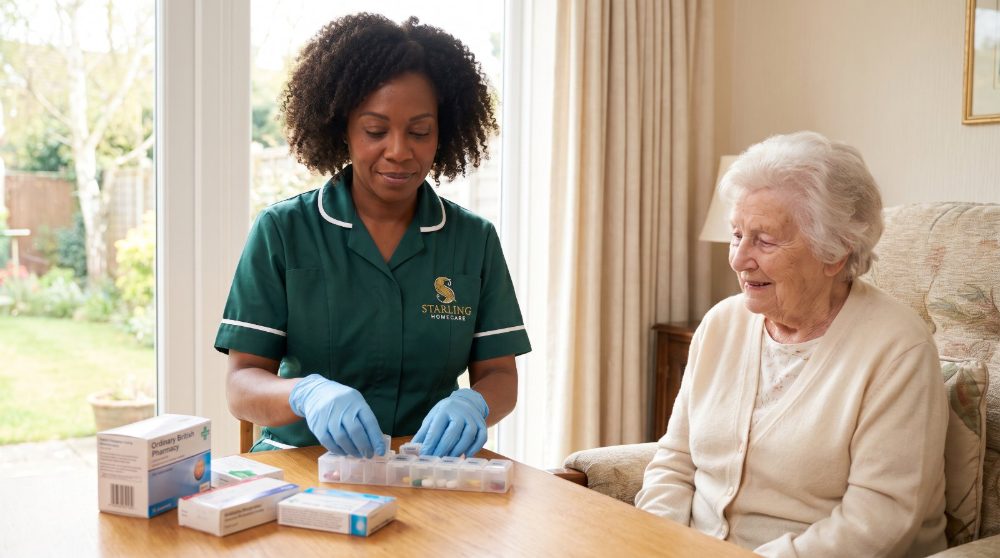
A medication review in Harpenden is a proper conversation with a clinician about every medicine your relative takes. The question it asks is whether each one is still doing more good than harm. It is not an administrative check, and for an older person with a long list of medicines it is one of the most useful appointments available.
The NHS calls the fullest version a structured medication review. This guide explains how a medication review in Harpenden works, who the NHS prioritises for one, and what you can do beforehand so the appointment is worth the trip.
Medicine lists rarely grow by decision. They grow by addition: a tablet started after a hospital stay, another after a diagnosis, a third to settle the side effect of the second.
Each one made sense at the time. Whether the list as a whole still makes sense is a different question, and it needs a different conversation.
Families usually notice this first. You may have found yourself looking at the boxes on a kitchen worktop, wondering what half of them are for. That instinct is worth acting on.
What is a structured medication review?
NHS England describes a structured medication review as an evidence-based and comprehensive review of a person's medication, taking all aspects of their health into account. Clinicians and patients work as equal partners to weigh the benefits, the risks and the alternatives.
The person's own needs, preferences and circumstances should lead the conversation. That is the part families most often do not realise they are entitled to.
The problem it exists to catch is what NHS England calls problematic polypharmacy. That is where, for someone taking several medicines, the potential for harm outweighs the benefit. It also covers two other cases: where the person does not fully understand the regime, and where the practicalities have become unmanageable or distressing.
That last point is the one we see most in people's homes. A medicine can be entirely correct on paper and still be failing. Nobody can open the packet, or the dose falls at an impossible time of day.
Who is offered a medication review in Harpenden?
Primary care networks organise these reviews. They are groups of GP practices working together, and in Harpenden that network is Harpenden Health PCN, which began in 2019. It brings together three practices: Davenport House Surgery, The Elms Medical Practice and The Village Surgery.
Between them they care for more than 45,000 patients. The network's team includes clinical pharmacists, care coordinators and social prescribing link workers alongside GPs and nurses. Clinical pharmacists in primary care usually lead structured medication reviews.
NHS England asks networks to identify the people most likely to benefit. The priority groups include care home residents, people with learning disabilities, and people with complex and problematic polypharmacy, specifically those taking ten or more medicines.
They also include people taking medicines commonly associated with medication errors. Networks also prioritise people who are severely frail, isolated or housebound, and those who have had recent hospital admissions or falls. So are people taking potentially addictive pain medication.
If your relative sits in one of those groups and nobody has offered a review, it is entirely reasonable to ask the practice for one. A GP or a pharmacist can also refer someone because of a specific concern rather than a category.
What happens in the appointment?
A medication review in Harpenden follows the same national framework as anywhere else in England. The NHS Specialist Pharmacy Service sets out seven steps, and updated them in February 2026. It is worth knowing the shape of it, because it tells you what the clinician is trying to get to.
The first steps are about the person rather than the drugs. Assess the patient, which means checking what your relative actually takes and how it fits the daily routine. Then agree goals for what the review should achieve.
The middle steps identify potentially inappropriate medicines and weigh the individual risks and benefits of each one, against that person's circumstances and what matters to them.
The final steps begin with agreeing actions. That means deciding whether to stop, reduce, continue or start a medicine, and explaining why. The last two are communicating that to everyone who needs to know, then monitoring and reviewing regularly with someone clearly accountable.
Nobody should change a medicine without explaining why. If a clinician stops or reduces one, ask what to expect and who is watching for it.
How to prepare for a medication review
Preparation is what turns a fifteen-minute appointment into a useful one. Five things make the most difference.
Bring the medicines themselves, not only the printed list. The NHS advice is explicit about this, and the boxes tell a story the list does not, including which packets nobody has opened.
Write down what your relative genuinely takes, including anything bought over the counter or left over from a repeat nobody ever cancelled. Honesty here is more useful than tidiness.
Note the practical problems. Packets nobody can open, tablets that are hard to swallow, doses your relative misses because the time is impractical: these are proper clinical information, not complaints.
Take questions in. The Choosing Wisely UK questions are a good frame. What are the benefits, what are the risks, what are the alternatives, and what happens if I do nothing?
And say who else needs to know the outcome. With consent, the practice can share the summary with the community pharmacist, social care teams and care staff. That is what stops a change getting lost between services.
What a care team notices between reviews
A review is a snapshot. The weeks in between are where the real evidence sits, and that is usually where a home care team can help.
Our carers see medicines in the ordinary run of a week. They notice which doses run late and which packets stay untouched. Sleep or appetite may shift after a new medicine starts, and they see that too. We record what we see and share it with the family, and our medication management support is built around exactly that kind of observation.
We are careful about the line here. Our carers prompt or administer medication exactly as the care plan sets out. We do not make decisions about medicines, change a dose or advise on prescribing. That is the clinician's job, and it should stay there.
What we can do is make sure the pattern reaches the appointment. Our medication support at home explains how that works day to day. Families using home care in Harpenden often find the observation is the most valuable part of it.
Common Questions About Medication Reviews in Harpenden
How often should an older person have a medication review?
There is no single national interval that applies to everyone. NHS guidance asks primary care networks to prioritise the people most likely to benefit. The final step of the review framework is to monitor, review and adjust regularly, with a named person accountable.
The practical answer is to ask the practice what interval they have set. Request a review sooner if something changes, particularly after a hospital stay or a fall.
Can a family member or carer attend a medication review?
Yes, with the person's agreement. Someone who sees the medicines being taken day to day often has information nobody else in the room has. If you cannot attend, write your observations down and send them in beforehand, so they reach the clinician rather than surfacing afterwards.
What is the difference between a medication review and a repeat prescription check?
A repeat prescription check largely asks whether the practice should keep issuing the prescription. A structured medication review is a much fuller conversation about whether each medicine is still right for the person. That includes whether to reduce or stop anything. The two are not interchangeable, and it is worth being clear which one the practice has actually offered.
If a medication review in Harpenden is coming up, our local team can help get the everyday picture in front of the right people. You can reach us on 01582 824 830 or at [email protected]. Starling Homecare is registered with the Care Quality Commission, and we are glad to talk through what support at home would and would not involve, before you arrange anything.
Arranging Care Is Simple
Starting care can feel like a big step. We keep it calm and straightforward, and we are here to guide you from your very first call.
1. Talk to us
Get in touch by phone or request a callback. We will listen, answer your questions and help you understand the options, so you can decide what feels right in your own time.
2. A home visit and initial consultation
We arrange a visit to understand your routines, your home and what matters most to you. Together we agree an initial consultation and shape the support that feels right.
3. Your care begins
A small, familiar team starts your care, arriving at the agreed times and staying involved as your needs change. We remain your trusted adviser throughout.
Whenever you are ready, we are here to help.