
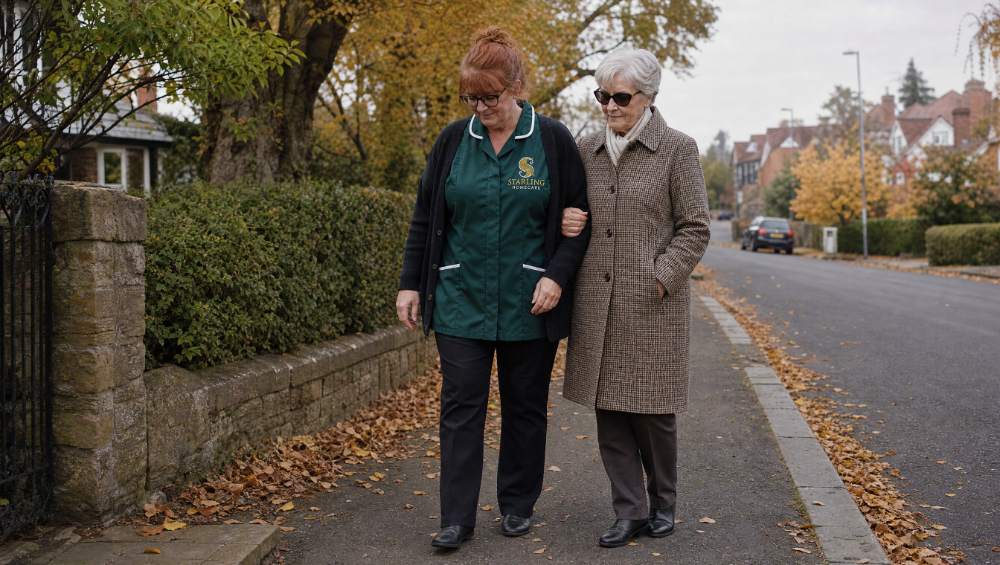
Sighted guiding means your parent holds your arm just above the elbow and walks about half a step behind you, so they can feel where you are going. You talk them through kerbs, steps and doors before you reach them, and you never push or pull.
To talk anything through with someone local, our Harpenden team is on 01582 824 830.
When a parent's sight changes, walks to the shops or the surgery can start to feel risky. However, a few simple habits can give you both confidence again. If you are also looking at the house itself, our guide to making a home safer for someone with macular degeneration covers lighting, contrast and clutter.
Why does sighted guiding help?
Done well, it lets your parent stay in charge of their own body. They are not being steered. Instead, they read your movement through your arm, so a pause or a turn tells them something is coming.
It also gives a shared language. Once you both know the method, outings take less effort and less worry. That matters, because staying out and about is part of staying well.
How do you start guiding someone?
The Guide Dogs guide to guiding sets out the basics clearly. First, let your parent know you are there and offer help. Then ask where they want to go, and whether they would like your arm or would rather rest a hand on your shoulder.
Next, stand at their side. They hold your arm just above the elbow, with a relaxed grip. Then walk on, with your parent about half a step behind. If they have a guide dog, approach from the side away from the dog.
How do you manage kerbs, stairs and narrow spaces?
Narrow or busy spaces
Move your guiding arm behind you, towards the middle of your back. That tells your parent to step in behind you, so you walk in single file. Slow down and describe what is ahead.
Kerbs and crossings
Say whether the kerb goes up or down. Then pause before stepping, so your parent can prepare. If you part after crossing, describe where they are.
Stairs and steps
Say whether the steps go up or down, and make sure their free hand is on the handrail side. Going up, pause so they find the first step, and say when you reach the top. Going down, wait until they have found the handrail and the top edge. Then walk one step ahead and say when you reach the bottom.
What about doors, chairs and getting into a car?
For doors, say whether the door opens towards or away from you, and which side it is on. Open it with your guiding arm, walk through, and let your parent hold it as they follow.
For a chair, describe it first, including whether it has arms or a table in front. Then put your guiding hand on the back of the chair. Your parent slides a hand down your arm to find it, and sits when ready.
For a car, put your guiding hand on the door handle and say which way the car faces. As your parent gets in, show them where the top of the door frame is with your hand.
How should you describe the way ahead?
Use clear words such as "left" or "straight ahead", never "over there". Also warn about hazards at head height, and changes underfoot such as gravel or a slope. However, do not overload your parent with detail.
Finally, never leave without saying so. Before you step away, check they know where they are and that they are somewhere safe. Otherwise, they may be left talking to an empty space.
Where can families learn sighted guiding in Hertfordshire?
Guide Dogs runs free online sighted guiding sessions. Its one hour introduction is live, led by its own staff and open to anyone over 18. It also runs a separate session for friends and family guiding a loved one. Guide Dogs also describes a volunteer guiding service for people with sight loss.
For your parent's own skills, Hertfordshire County Council has vision rehabilitation specialists. They offer white cane training and help with getting around safely. You can reach the council's sensory team on 0300 123 4042. Herts Vision Loss, a county charity, also runs social clubs, events and minibus trips, on 01707 324680.
How does guiding fit into care at home?
If a carer will be walking with your parent, it helps if everyone guides the same way. So agree your parent's preferred method, and write it into the plan for what happens on each home care visit. For example, note whether they prefer an arm or a shoulder, and which side.
Guiding often sits inside wider support. Our sight loss care at home covers help around the house, with post and with appointments. Our companionship care covers outings, from a walk through Batford to a coffee in town.
Frequently asked questions
Does Starling Homecare provide sight loss care at home?
Yes. Starling Homecare is an independent, family run home care provider based in St Albans and registered with the Care Quality Commission. We support people living with sight loss with visiting care in St Albans, Harpenden, Hemel Hempstead, Welwyn Garden City and Hatfield, Potters Bar and Cheshunt, and with live-in care across Hertfordshire.
Should I take my parent's arm, or should they take mine?
They take yours. Guide Dogs advises that the person holds your arm just above the elbow. That way they feel your movements, and you never need to push or pull.
What if my parent has a guide dog?
Approach from the side away from the dog. Never feed, distract or take hold of the dog's lead or harness. Only the owner should direct the dog.
Is sighted guiding the same as mobility training?
No. Guiding is something you do together. Mobility training, such as learning to use a white cane, is something your parent learns for themselves, and in Hertfordshire the council's vision rehabilitation specialists provide it.
How long does it take to learn?
The basics are quick. Guide Dogs' introductory session lasts one hour. After that, practice on familiar routes builds confidence for both of you.
Starling Homecare is an independent, family run home care provider, registered with the Care Quality Commission, with a local team in Harpenden. We offer visiting care from 30 minute visits, companionship, help with appointments and live-in care. Where sight loss is part of the picture, visits can be planned around the routines and guiding method your parent prefers. You can find out more about our home care in Harpenden.
Figures and guidance checked on 12 November 2026 against Guide Dogs, Hertfordshire County Council sensory services and Herts Vision Loss.
Arranging Care Is Simple
Starting care can feel like a big step. We keep it calm and straightforward, and we are here to guide you from your very first call.
1. Talk to us
Get in touch by phone or request a callback. We will listen, answer your questions and help you understand the options, so you can decide what feels right in your own time.
2. A home visit and initial consultation
We arrange a visit to understand your routines, your home and what matters most to you. Together we agree an initial consultation and shape the support that feels right.
3. Your care begins
A small, familiar team starts your care, arriving at the agreed times and staying involved as your needs change. We remain your trusted adviser throughout.
Whenever you are ready, we are here to help.