
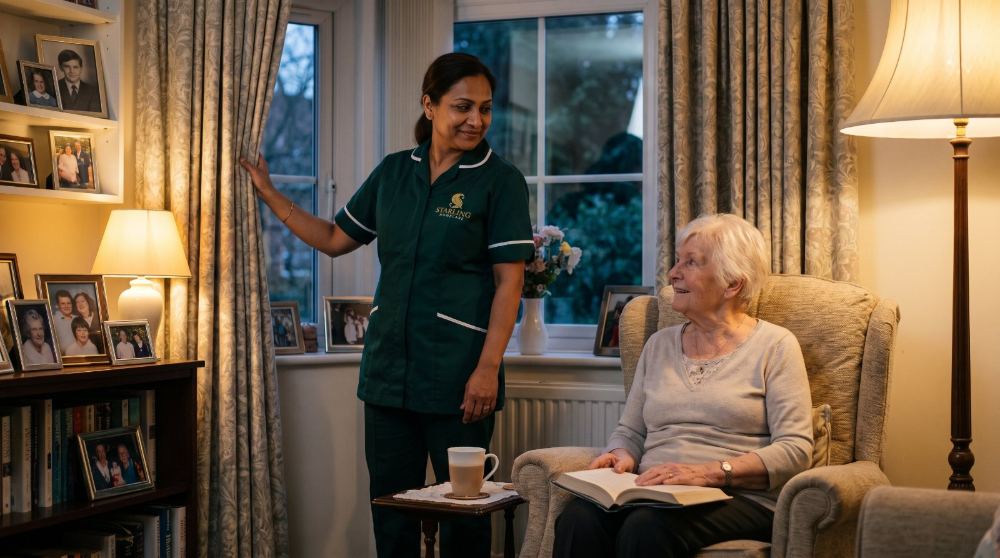
Overnight care in Hitchin ranges from an evening visit to settle someone for the night, through a carer sleeping in the home, up to full 24 hour live-in support. The right arrangement depends on what your family's nights actually look like, and it usually starts smaller than people expect.
For many families, the days are manageable. A morning visit, lunch left ready, a neighbour who pops in. It is the hours after dark that carry the worry.
If you have found yourself lying awake listening for the phone, this guide walks through the night-time options, how to judge the level of support that is needed, and how care at night is arranged in Hitchin and the villages around it.
Why nights are often the turning point
In our experience, families rarely contact us about the daytime first. They get in touch because someone fell on the way to the bathroom at two in the morning, or because a parent has started waking confused, or because the relative doing the caring is worn down by months of broken sleep.
Night raises risk in a way daylight does not. The house is dark, help feels further away, and a small stumble can go unnoticed until morning.
None of this means someone has to leave the home they love. It usually means the nights need cover, in the same way the days already have it.
What are the options for overnight care in Hitchin?
Night-time support comes in levels, and it helps to see them as a ladder rather than one big decision.
An evening settling visit is the lightest step. A carer comes late in the day to help with washing, medication and getting comfortably to bed. For some people, the bedtime routine is the only risky part of the night, and this is enough.
A sleeping night means a carer sleeps in the home and is on hand if something happens. It suits someone who rarely wakes, but who is not safe alone in the house overnight.
A waking night means the carer stays awake and alert right through. This is the right level when someone wakes regularly, needs the toilet or medication during the night, or would be at risk if left unattended even briefly.
Beyond that sits 24 hour care, most often provided as live-in care, where one carer lives in the home so day and night support comes from the same familiar person. Our guide to live-in care in Hitchin explains how that arrangement works in detail.
How do you know how much night-time cover is needed?
Start with a week of honest notes. How many nights were disturbed, what happened each time, and what could have gone wrong if nobody had been there.
A pattern usually appears. If disturbances are rare but the risk of being alone is real, a sleeping night is often enough. If most nights involve getting up, a waking night earns its place.
Nothing has to be fixed from day one. Families arranging overnight care in Hitchin often begin with two or three covered nights a week and adjust. As a care provider regulated by the Care Quality Commission, we review the arrangement as needs change rather than letting it drift.
Night-time care when someone is living with dementia
Dementia often makes evenings and nights the hardest part of the day. The Alzheimer's Society describes this as sundowning: a person may become more confused, restless or unsettled from late afternoon onwards, and the disorientation can carry on into the night.
A consistent overnight carer helps in practical ways. The same face brings calm that a rota of strangers cannot, the evening routine stays predictable, and gentle reassurance replaces confrontation when someone wakes unsure of where they are.
Small details matter too, like curtains closed before dusk and soft lighting left on. These are the habits a good carer builds into every night without being asked.
Overnight care across Hitchin and the villages
We provide overnight care in Hitchin itself and in the villages nearby, including Walsworth, Charlton, Gosmore, Offley and Ickleford. Our home care team in Hitchin is local, so the carer arriving at dusk is not travelling in from the other side of the county.
That matters at night more than at any other time. Reliability is the whole point of night cover, and a local, CQC regulated team is how it is delivered.
If you would like to talk through what your family's nights look like, our Hitchin team is on 01462 534739, or you can email [email protected].
Common Questions About Overnight Care in Hitchin
Can overnight care in Hitchin start with just a few nights a week?
Yes. Many families begin with two or three covered nights, often chosen so the relative who usually helps can catch up on sleep. The arrangement can grow if needs increase, and it can reduce again after a period of illness or recovery has passed.
Does the same carer come each night?
We keep the team around each person deliberately small, and at night familiarity matters even more than it does by day. A known face at three in the morning is reassurance in itself. Introductions always happen before the first night, so nobody wakes to a stranger.
When does overnight care become 24 hour or live-in care?
Usually when the days become as demanding as the nights. If separate daytime visits and night cover are both stretching, one live-in carer can be simpler, more consistent and often more settling than a patchwork of arrangements. It is a conversation to have openly at a care review rather than a line anyone should cross alone.
Nights are usually the hardest part of caring for someone, and the part families put up with for longest. If broken sleep has become normal in your house, it is worth knowing that cover exists at every level, because the right help at night changes the days as well.
Arranging Care Is Simple
Starting care can feel like a big step. We keep it calm and straightforward, and we are here to guide you from your very first call.
1. Talk to us
Get in touch by phone or request a callback. We will listen, answer your questions and help you understand the options, so you can decide what feels right in your own time.
2. A home visit and initial consultation
We arrange a visit to understand your routines, your home and what matters most to you. Together we agree an initial consultation and shape the support that feels right.
3. Your care begins
A small, familiar team starts your care, arriving at the agreed times and staying involved as your needs change. We remain your trusted adviser throughout.
Whenever you are ready, we are here to help.