
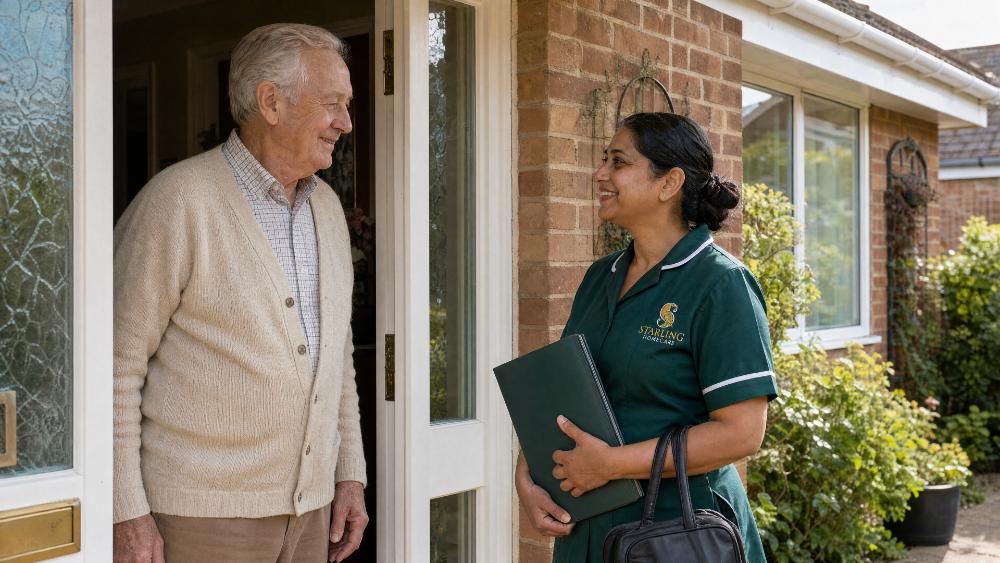
Discharge to assess means your relative leaves hospital as soon as they are medically ready, with short-term support if needed, and their longer-term care needs are assessed later, once they have had time to recover. In practice, most people go home first, and the bigger decisions about ongoing care are made there rather than on a busy ward.
To talk anything through with someone local, our St Albans team is on 01727 324 127.
What discharge to assess means in plain terms
National guidance from the Department of Health and Social Care and NHS England sets out the approach. Short-term care is provided where needed. Then a person's longer-term needs are assessed once they have reached a point of recovery and stability.
The thinking is simple. A hospital bed is a poor place to judge how someone will manage their own stairs, kitchen or bathroom. So the guidance says it is best practice to carry out those assessments in the person's home.
For a family, this can feel fast. One day the ward is talking about discharge, and the next your parent is home. If you want a fuller picture of the first weeks, our guide to home care after hospital in Hertfordshire explains who does what, and when.
The four discharge pathways
Hospital teams sort discharges into four pathways. You may hear these numbers on the ward, so it helps to know what they mean. The summary below follows the hospital discharge and community support guidance.
- Pathway 0: home, with no new or additional health or social care needs.
- Pathway 1: home, with new or additional health or social care needs.
- Pathway 2: to a community bed with dedicated recovery support.
- Pathway 3: to a new residential or nursing home. The guidance says this should be used only in exceptional circumstances.
The guidance expects the vast majority of people to go home. So for most families, the real question is what support will be in place there.
Who pays for short-term support?
This is often the first worry. According to the national guidance, intermediate care from the council, including reablement, is free for up to six weeks. Age UK says the same, adding that care beyond that period may cost money.
Locally, Hertfordshire County Council says you might have to pay towards some things, worked out for each person. However, it also says it will tell you first if you need to pay anything. So it is worth asking directly, before your relative leaves, which parts of the plan are free and for how long.
How Hertfordshire organises help after hospital
Hertfordshire County Council has social care teams working in all NHS hospitals. They can talk about equipment, help with meals, and home visits to help people get back on their feet. As your relative recovers, the council says it will slowly reduce that support.
Then, once your relative is settled at home, any long-term needs are assessed. The council's coming out of hospital page also links to a leaving hospital booklet for families. For independent advice, HertsHelp is on 0300 123 4044.
What families can ask before discharge to assess begins
You have a part to play. The guidance says people should be asked who they want involved in decisions, and that unpaid carers and family should be included. Since 2022, NHS trusts have had a legal duty to involve patients and carers in discharge planning.
These questions are worth taking to the ward:
- Which pathway is planned, and why?
- What support will start on day one, and who is providing it?
- Which parts are free, and when will that end?
- Who is our contact if something goes wrong after discharge?
- When and where will the longer-term assessment happen?
- Has NHS Continuing Healthcare been considered?
The guidance also says your relative should be given contact details for someone they can talk to about their discharge. Also, if you are doing a lot of the caring, ask for a carer's assessment of your own.
What if the preferred option is not available?
Sometimes the support a family hopes for is not available that week. In that case, the guidance says an available, suitable alternative should be offered for the short term. It also states that people do not have a legal right to stay in a hospital bed once they no longer need hospital care.
This is where planning helps. If you know the likely gaps, for example evenings or the first few nights, you can decide early how they will be covered.
Frequently asked questions
Is discharge to assess the same as reablement?
Not quite. Discharge to assess is the overall approach of going home first and being assessed later. Reablement is one type of short-term support that may be part of it, focused on rebuilding everyday skills.
How long does the short-term support last?
National guidance says council intermediate care, including reablement, is free for up to six weeks. It is typically delivered over a six week period, so ask the team when it will end and what happens next.
Can we arrange private care alongside it?
Yes. Some families add private visits to cover times the short-term service does not, such as evenings or company during the day. Let the hospital and council teams know, so everyone works from the same plan.
How we help families after discharge
Across Hertfordshire, our post-hospital care at home can sit alongside the short-term support your relative is offered, or follow on once it ends. That might mean visits from 30 minutes upwards, help with personal care, medication prompting, or overnight care for the first unsettled nights. We are a family run provider registered with the Care Quality Commission.
Figures and guidance checked on 25 October 2026 against Age UK and the GOV.UK hospital discharge and community support guidance.
Arranging Care Is Simple
Starting care can feel like a big step. We keep it calm and straightforward, and we are here to guide you from your very first call.
1. Talk to us
Get in touch by phone or request a callback. We will listen, answer your questions and help you understand the options, so you can decide what feels right in your own time.
2. A home visit and initial consultation
We arrange a visit to understand your routines, your home and what matters most to you. Together we agree an initial consultation and shape the support that feels right.
3. Your care begins
A small, familiar team starts your care, arriving at the agreed times and staying involved as your needs change. We remain your trusted adviser throughout.
Whenever you are ready, we are here to help.