
Coming home after a brain injury is often harder than families expect. The hospital team steps back, the house goes quiet, and the real work of recovery begins in ordinary daily life.
If you are supporting someone through this in St Albans, Harpenden, Welwyn Garden City or Hatfield, this guide sets out what usually changes in the first weeks at home, and where practical support helps most.
What families notice first
The physical injuries are usually the part everyone prepares for. What catches families out is the rest.
Fatigue is the most common. Brain injury fatigue is not ordinary tiredness and it does not respond to willpower or an early night. An ordinary morning can use up the whole day.
Fatigue also makes everything else worse. Forgetfulness, irritability and distraction all sharpen when someone is running on empty, which is why difficult afternoons so often follow busy mornings.
Families frequently spot it first. Many people push on rather than give in to it, so you may see the change in their face before they notice it themselves.
Secondly, there is starting things. Many people know exactly what needs doing and cannot begin. It looks like reluctance from the outside. It is not. The part of the system that normally says "start now" has been interrupted by the injury.
That said, low mood, pain and fatigue can all look similar. If difficulty starting persists, it is worth raising with the GP or rehabilitation team rather than only working around it at home.
Coming home after a brain injury: the changes nobody warns you about
Mood and patience often change after a brain injury, and families feel this quickly. Irritability and low mood are common, and they are part of the injury rather than a change of character.
However, noise and busyness can also become hard work. A room with the television on and two conversations running may be genuinely overwhelming when it never used to be.
The injury can also affect insight. Someone may not fully recognise what has changed, which is difficult to sit with when you can see it clearly.
None of this means recovery has stalled. It means the injury is affecting things that do not show up on a scan or in a physiotherapy session.
Why coming home after a brain injury feels different from hospital
In hospital, structure comes from other people. At home, it has to be rebuilt, and usually by a family member who is exhausted themselves.
Memory and orientation may also be affected, so familiar faces matter. This is why we keep teams small and consistent in our brain injury care at home service, so nobody has to explain themselves from the beginning each visit.
Coming home after a brain injury: what helps in the first weeks
First, keep the day predictable. The same order of doing things means less has to be held in mind.
Plan around energy rather than the clock. Put the demanding tasks where the good hours are, and protect proper rest between them.
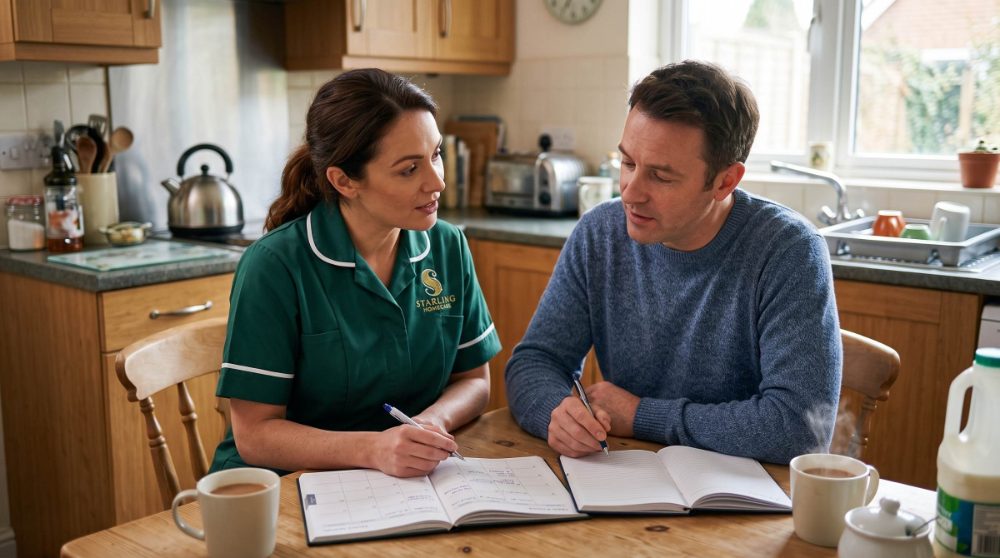
In addition, write things down together. A shared diary or planner on the kitchen table carries the load that memory cannot.
Break tasks into steps and stay alongside rather than taking over. Independence rebuilds through doing, not through being done for.
Small changes at home that make a difference
Keep the layout familiar. Moving furniture to make space can leave someone disorientated in their own hallway.
Reduce competing noise during conversations and meals. One thing at a time is easier to process.
Leave visible prompts where they are needed. A calendar on the wall and labels on cupboards carry information so memory does not have to.
Keep a simple record of how the days are going. Patterns in fatigue and mood are useful when you next see the rehabilitation team.
What a Starling Homecare carer actually does in this situation
For many families, personal care comes first: help with washing and dressing, paced to the day rather than rushed through.
Beyond that, much of the work is quieter. Prompting through a task step by step. Keeping a routine steady. Preparing meals. Getting someone back out to the shops or a group when confidence has gone.
Carers also give the family carer a genuine break, which is often the thing that keeps everything else working. In practice, support ranges from short daily visits to longer sessions, overnight cover or full live-in care.
Looking after the family carer
Families carry an enormous amount after a brain injury, usually without being asked. Respite is not a luxury in this situation, it is what keeps the arrangement sustainable.
The strain also builds rather than fades. Relatives often report high levels of anxiety and low mood in the years after an injury, and the capacity to keep coping tends to decrease over time rather than improve.
Consequently, the best moment to arrange support is usually before you reach the end of your reserves, not after. Even a few hours of reliable cover each week protects the person doing the caring.
If you are also managing someone’s money or decisions, our guide to arranging care with power of attorney explains what you can and cannot decide.
Where to get specialist help locally
Treatment and rehabilitation belong to NHS and specialist teams, not to us. Families in east and north Hertfordshire can be referred to the NHS neuro rehabilitation service at the Danesbury Neurological Centre in Welwyn.
Headway, the brain injury association, is the national charity for information and family support, and there is an active Headway group in Hertfordshire.
Where we support people coming home after a brain injury across Hertfordshire
Starling Homecare arranges regulated care at home after a brain injury across the whole county. The team you speak to is the one that covers your town.
Wherever you are in the county, you reach the team that actually covers your area:
- St Albans, 01727 324 127
- Harpenden, 01582 824 830
- Welwyn Hatfield, 01707 714 000
- Hemel Hempstead, 01442 954 137
- Berkhamsted, 01442 954 137
- Tring, 01442 954 137
- Hitchin, 01462 534739
- Hertford, 01920 746779
- Radlett and Shenley, 01923 988 550
Common questions about coming home after a brain injury
Does Starling Homecare support people coming home after a brain injury?
Yes. Starling Homecare is a family-run, CQC-registered homecare provider and support at home after an acquired brain injury is one of the things we do, across St Albans, Harpenden, Welwyn Hatfield, Hemel Hempstead and the rest of Hertfordshire. We work alongside the NHS community neuro rehabilitation team and any case manager involved, rather than in place of them, and every plan is built around the individual because no two brain injuries are the same.
How long does recovery take after a brain injury?
There is no standard timeline. Recovery often continues for months or years, and it rarely runs in a straight line. Good days and difficult days can sit side by side for a long time.
Can care start straight after coming home after a brain injury?
Usually yes. The weeks after discharge are often the hardest, so support can be put in quickly and stepped back as confidence returns.
Do you support younger adults after a brain injury?
Yes. Brain injury frequently affects working-age people, so support is shaped around work, children and independence rather than an older person’s routine.
Which areas do you cover?
We provide visiting care across St Albans, Harpenden, Hemel Hempstead and Welwyn Hatfield, including Welwyn Garden City and Hatfield, and live-in care across the whole of Hertfordshire.
Which NHS service helps after coming home after a brain injury in Hertfordshire?
It depends on where you live. In east and north Hertfordshire, the neuro community rehabilitation team at the Danesbury Neurological Centre in Welwyn includes a specialist acquired brain injury service, reached through a GP or hospital referral on 0300 123 7571. In west Hertfordshire, which includes St Albans, Harpenden and Hemel Hempstead, Central London Community Healthcare NHS Trust runs community neuro rehabilitation through the Hertfordshire single point of access on 03000 200 656. Ask specifically what the team offers for acquired brain injury.
How is care paid for after a brain injury?
There are three main routes. Where someone has ongoing health needs, they may qualify for NHS Continuing Healthcare, which the NHS arranges and funds in full, including at home. Where there is a personal injury claim, a case manager usually arranges the care and the settlement or an interim payment funds it. Otherwise, families fund care privately or through a council care needs assessment. Our guides to NHS Continuing Healthcare and care funding explain each route.
How do you manage fatigue after coming home after a brain injury?
Headway describes fatigue after brain injury as an extreme tiredness that sleep and rest do not relieve, and there is no cure for it. However, pacing helps. Plan the week around energy rather than the clock, put demanding tasks early in the day, and build rest in before it is needed. Learn the early signs, such as yawning, a fuzzy head or irritability, and set realistic targets for a day rather than catching up on a good one. In practice, this is how we time and shape care visits.
Is there a Headway group near me in Hertfordshire?
Yes. Headway Hertfordshire is the county's brain injury charity, based in Hitchin and reached on 0300 330 1455. It runs peer support groups in St Albans, Borehamwood, Hemel Hempstead, Hertford, Letchworth, Stevenage, Watford and Welwyn, most of them fortnightly, along with carers' support and counselling. Headway UK also issues a free Brain Injury Identity Card to adults with a verifiable brain injury.
If someone in your family is coming home after a brain injury and you are not sure what support would help, talk it through with someone who arranges care every day. Call our St Albans office on 01727 324 127.
Sources checked on 8 September 2026: Headway on fatigue and the effects of brain injury, Hertfordshire Community NHS Trust, Central London Community Healthcare NHS Trust, Headway Hertfordshire and NHS Continuing Healthcare. This is general information, not medical or legal advice.
Arranging Care Is Simple
Starting care can feel like a big step. We keep it calm and straightforward, and we are here to guide you from your very first call.
1. Talk to us
Get in touch by phone or request a callback. We will listen, answer your questions and help you understand the options, so you can decide what feels right in your own time.
2. A home visit and initial consultation
We arrange a visit to understand your routines, your home and what matters most to you. Together we agree an initial consultation and shape the support that feels right.
3. Your care begins
A small, familiar team starts your care, arriving at the agreed times and staying involved as your needs change. We remain your trusted adviser throughout.
Whenever you are ready, we are here to help.