
You have suggested a little help, gently and perhaps more than once, and the answer is still a firm no. When elderly parents refuse help, Age UK suggests listening first, agreeing small steps and expecting more than one conversation. Age UK says adults with mental capacity have the right to make choices other people might think are unwise, and the NHS explains that under the Mental Capacity Act a person is assumed to have capacity unless it is proved otherwise. If your parent is in immediate danger, call 999.
To talk anything through with someone local, our Radlett and Shenley team is on 01923 988 550.
It can be frustrating to hear "I'm fine" when you can see things getting harder. You might feel torn between respecting your mum or dad's wishes and worrying about what happens if nothing changes, and a brother or sister who sees it differently can add to that. Holding both at once is part of caring about a parent, and it usually takes time rather than one big conversation.
A parent who says no is familiar ground for us, and there are calm, practical ways through it.
Why do elderly parents refuse help?
Every family is different. Age UK says an older person may not want to admit there is a problem, may worry about becoming a burden, may find it a matter of pride, or may simply see things differently to the way you do.
Our article on talking about help at home when a parent says they are fine covers that first conversation in more detail.
What to try this week
Age UK's advice on disagreeing with an older person's choices suggests these steps:
- Listen first, rather than starting with solutions.
- Ask open questions, such as "What did you have to eat yesterday?"
- Listen without judging, and focus on their feelings and concerns.
- Agree small steps, rather than trying to win the argument.
- Expect more than one conversation, and take a break if things get heated.
How to raise it without a row
Age UK suggests staying calm, choosing a place to talk where you will not be interrupted, and letting them know you are concerned. You could try:
- "I worry about you on your own in the evenings. Would you let someone pop in for a cup of tea, just so I sleep better?"
- "You'd tell me if I was struggling. I'm only doing the same for you."
- "What would make staying in this house easier for you?"
A first step: an informal chat with our team
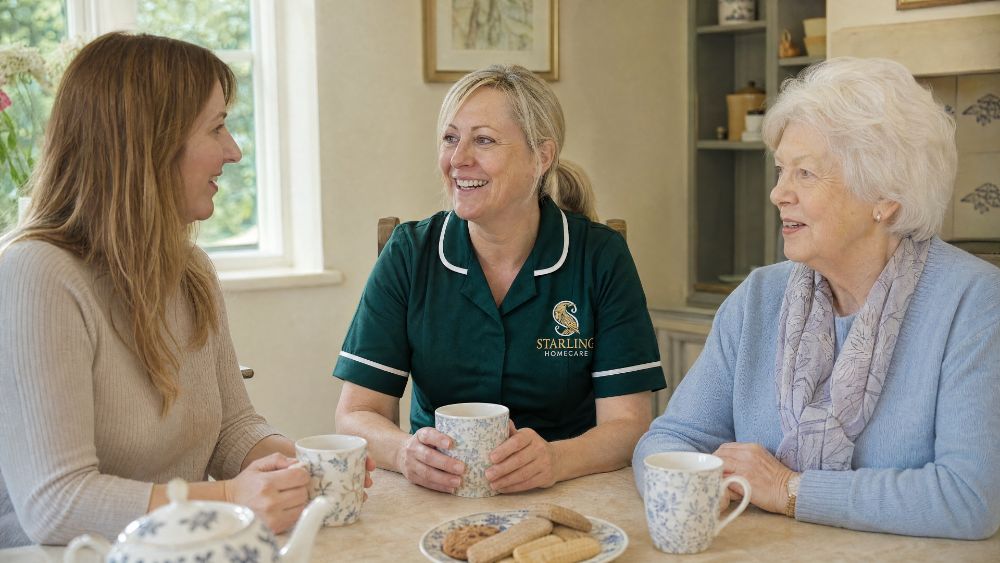
When a parent is unsure about help, it can start with someone from Starling simply coming round for a chat. It does not have to be formal.
It is a conversation to get to know your mum or dad and find out what matters to them: their routine, their interests, the things they would like to keep doing and the things that have become a chore. Often, that is what breaks the ice.
This is something our team has a lot of experience with.
When elderly parents refuse help: their right to decide
The NHS guide to the Mental Capacity Act sets out principles that are useful for families to know:
- A person is assumed to have capacity unless it is shown otherwise.
- People should be helped to make their own decisions wherever possible.
- Making an unwise decision does not, on its own, mean someone lacks capacity.
Age UK says that if you have raised your concerns clearly and calmly and your parent still says no, you must try to accept that it is their decision. That can be hard to hear when you are the one lying awake worrying, and it does not stop you coming back to it another day.
When to worry about capacity
The NHS explains that a person may be unable to make a particular decision if they cannot understand the information, remember it long enough, weigh it up, or communicate their choice. Capacity is about one decision at a time, and it can change over time.
The NHS says that if you are worried about an older relative who is becoming increasingly forgetful, you should speak to a GP. Also, if you believe your parent cannot make their own decisions and is at risk, Age UK advises contacting the adult safeguarding team at their local council.
Who to call in Hertfordshire
- 999 if someone is in immediate danger.
- Their GP, if you are worried they are becoming increasingly forgetful.
- HertsHelp on 0300 123 4044, Hertfordshire County Council's free advice service.
- Hertfordshire adult safeguarding, on 0300 123 4042 day or night, or through the council's report a concern page.
- Age UK Advice Line on 0800 678 1602, free, 8am to 7pm, every day of the year.
How Starling Homecare can help
Help at home is about supporting your parent to keep living their own way. It also means your visits can be spent as their son or daughter, rather than checking on them. Support can start small, and can include:
- Companionship care: friendly conversation, walks in the local community or a trip to the shops.
- Visiting care in St Albans, Harpenden, Hemel Hempstead, Welwyn Hatfield, Potters Bar and Cheshunt, from 30 minute visits, at the times of day that suit them.
- Meal preparation and help around the house, such as shopping and light household tasks.
- Personal care and medication prompting, if and when they are wanted.
- Respite, to give a family carer a break.
In practice, a carer gets to know your parent, encourages them, notices changes, keeps the family informed and passes concerns to the GP where needed. Carers do not carry out clinical tasks. We would usually begin with that informal chat. In Radlett and Shenley we arrange live-in care, and in St Albans, Harpenden, Hemel Hempstead, Welwyn Hatfield, Potters Bar and Cheshunt we also provide short visits built around what your parent enjoys. As needs change, visits can increase, and overnight or live-in care is there later if it is ever needed. Our guide to the signs an elderly parent needs help at home explains what to look out for.
Areas we cover
Starling Homecare's carers visit people at home in St Albans, Harpenden, Hemel Hempstead, Welwyn Garden City and Hatfield, Potters Bar and Cheshunt, and the villages around them. Elsewhere in Hertfordshire, including Berkhamsted, Tring, Radlett and Shenley, Hitchin and Hertford, we arrange live-in care.
For more on the early stages, see our guide for families worried about an elderly parent. Locally, here is how we arrange live-in care in Radlett and Shenley.
Frequently asked questions
Can I make my parent accept care?
The NHS explains that adults are assumed to be able to make their own decisions, and that an unwise decision does not on its own mean someone lacks capacity. Age UK suggests agreeing small steps and expecting more than one conversation.
What happens at an informal chat with Starling?
Someone from our team comes round for a conversation, to get to know your parent and find out what matters to them. It does not have to be formal.
Does a council assessment commit them to anything?
No. Hertfordshire County Council describes an assessment as a conversation about their situation, and having one does not commit them to anything. HertsHelp, the council's free advice service, can help you find a suitable care provider.
If your parents live in Shenley or Radlett and are not sure about help, a relaxed chat at home is often a good place to begin, and so is a phone call of your own. Our Radlett and Shenley team is on 01923 988 550. You will be talking to someone who arranges care every day, so you can find out what good support looks like before you decide anything.
Guidance checked on 26 October 2026 against the NHS Mental Capacity Act guide, Age UK and Hertfordshire County Council.
Arranging Care Is Simple
Starting care can feel like a big step. We keep it calm and straightforward, and we are here to guide you from your very first call.
1. Talk to us
Get in touch by phone or request a callback. We will listen, answer your questions and help you understand the options, so you can decide what feels right in your own time.
2. A home visit and initial consultation
We arrange a visit to understand your routines, your home and what matters most to you. Together we agree an initial consultation and shape the support that feels right.
3. Your care begins
A small, familiar team starts your care, arriving at the agreed times and staying involved as your needs change. We remain your trusted adviser throughout.
Whenever you are ready, we are here to help.