
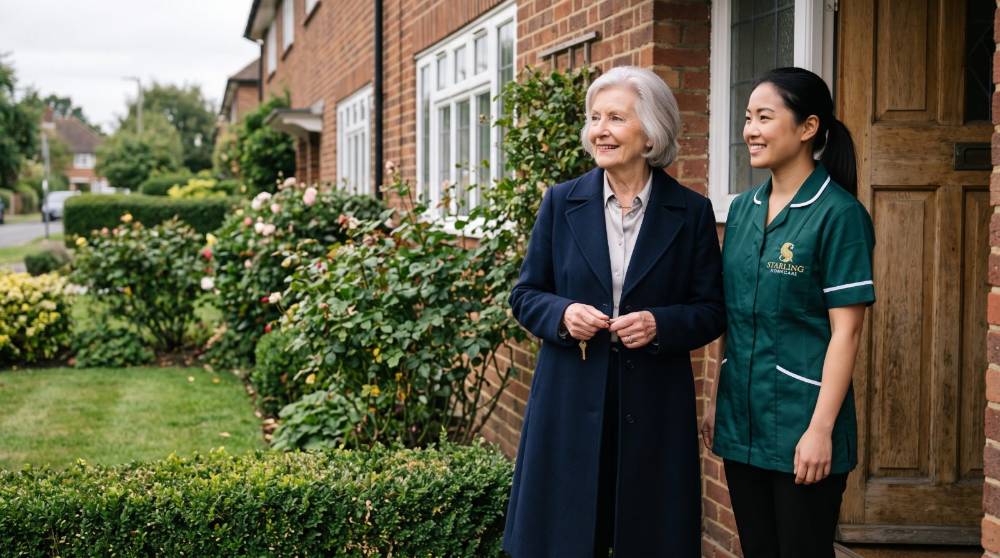
Extra care housing in Welwyn Garden City means moving to a flat of your own, with your own front door, in a scheme where care staff are on site. Care at home means the same support coming to the house you already live in. Both are built to protect independence. The real difference is whether the person moves, and that is a bigger question than it first looks, because it decides what happens to the house, the garden, the neighbours and the routine that holds a week together.
Ground was broken this summer on a new extra care scheme in the town, which is why the question is being asked in the borough more than usual. It is worth understanding properly before anyone decides.
What extra care housing in Welwyn Garden City actually is
Hertfordshire County Council describes extra care housing as more support than sheltered housing and more independence than a residential care home. You live in your own flat, with the privacy of your own front door, but have care available if you need it. The care can be increased or reduced as things change, for example after a spell in hospital.
That is a different arrangement from a care home. In a care home, the accommodation and the care come as one package and daily life is organised around the building. In extra care, the flat is a home in the ordinary sense, and the care is arranged around the person living in it. If you are weighing a care home rather than a housing scheme, we cover that separately in our guide to home care or a care home in Welwyn Garden City and Hatfield.
It is also different from sheltered housing, which the council describes as your own small flat or room with the use of a communal area, managed by staff available at certain times, usually with a personal or community alarm. Sheltered housing is about security and company. Extra care adds a care team on site.
In Hertfordshire it is called flexicare, which is worth knowing
Hertfordshire County Council uses the term flexicare housing for what most of the country calls extra care. Families searching the council website for extra care sometimes conclude Hertfordshire does not offer it. It does. If you are looking through council pages or asking about an assessment, flexicare is the word that will find the right service.
What is being built, and when
First Garden Cities Homes has begun work on Brian Ellis House, which will provide 51 extra care homes for social rent. It is named after Brian Ellis, the housing association first Vice Chair. The scheme has been brought together by First Garden Cities Homes with Welwyn Hatfield Borough Council, Hertfordshire County Council, Homes England, Hill Partnerships and KSA Architects, and a golden brick ceremony was held on site in July.
Completion is expected in early 2028.
That last detail matters more than the announcement does. If you are weighing options for someone this autumn, a scheme finishing in early 2028 is not an answer to the question in front of you. It is worth knowing about, and worth putting on the list if the need is some years away, but a family deciding now will be choosing between what already exists and care in the home they have.
The schemes already here
Welwyn Garden City has an established extra care scheme in Woodside House on Bridge Road, close to the town centre. It has around 110 flats and bungalows in studio, one bedroom and two bedroom sizes, and offers extra care support in partnership with Hertfordshire County Council. There is management staff on site, a mobile warden service for out of hours emergencies and a Careline alarm, alongside a lift, a residents lounge, laundry and garden.
In Welwyn village, Swan Field Court is a small extra care scheme of ten flats, eight one bedroom and two two bedroom, providing specialist support for older people living with dementia, with care staff on site 24 hours a day. Places there are decided jointly between the housing association and the county council specialist mental health team for older people, so it is not a scheme you simply apply to.
In Hatfield, Hollier Court sits just off French Horn Lane with 57 one and two bedroom flats, as a sheltered scheme rather than an extra care one.
That is a real but limited local supply, which is part of why the new building matters, and why waiting lists are a practical consideration rather than a theoretical one.
When a move is the better answer
We arrange care at home every day, so we are not a neutral party. Even so, there are situations where extra care housing is plainly the better fit, and it does nobody any good to pretend otherwise.
A move is often the stronger option when the house itself has become the problem. Stairs that cannot be adapted, a bathroom that will not take a level access shower, a garden that has turned from a pleasure into a worry. When loneliness is the main difficulty, a scheme with a communal lounge and neighbours at a similar stage of life can do something an hour of visiting care cannot. And when someone needs staff physically present at three in the morning rather than reachable, an extra care scheme with round the clock staffing answers that directly.
When staying put is the better answer
Equally, there are situations where moving solves less than it appears to.
If the difficulty is with specific tasks rather than the building, washing and dressing, medication, meals, getting out, then care can be brought in without anyone leaving home. If the person is deeply rooted where they are, near the shops they know and the people who call in, a move can cost them the very network that was holding them steady. If a couple are involved, and one has care needs the other does not, a move is a decision for two people, not one. And if the need is likely to be temporary, after an operation or a fall, arranging support for a few months is usually wiser than making a permanent change during a difficult period.
There is also a plain practical point. Extra care places are limited and are not available on demand, whereas care at home can usually start within days.
How you would actually get a place
Extra care and sheltered housing in Hertfordshire are arranged through a council assessment. The council will talk through the person needs and daily life, agree whether sheltered or flexicare housing is suitable, and work out what the person may need to pay. Schemes are inspected by the Care Quality Commission, as regulated home care providers are.
For free, independent advice on paying for care, HertsHelp can be reached on 0300 123 4044, Monday, Tuesday, Thursday and Friday from 9am to 5pm, Wednesday from 9am to 7pm, and at weekends from 10am to 4pm. Our own care funding guide sets out how private funding works alongside it.
If you would find it useful to talk the choice through with someone who arranges care in Welwyn Garden City and Hatfield every week, our Welwyn Hatfield team is on 01707 714 000. We provide care at home rather than housing, so if a move is the right answer for your family we will say so. Our visiting care starts from £34 an hour and is exempt from VAT, which is often the comparison people are trying to make when they first pick up the phone.
Common Questions About Extra Care Housing in Welwyn Garden City
Is extra care housing the same as a care home?
No. In extra care housing you have your own flat and your own front door, and the care is arranged around you. In a care home the accommodation and care come together as one package. Hertfordshire County Council describes extra care as offering more independence than a residential care home and more support than sheltered housing.
What is flexicare housing?
It is Hertfordshire County Council term for extra care housing. The two mean the same thing, and flexicare is the word to use when looking at council information or asking for an assessment.
When will the new extra care scheme in Welwyn Garden City open?
Brian Ellis House, which will provide 51 extra care homes for social rent, is expected to be completed in early 2028.
Can I stay in my own home instead?
Usually, yes. Where the difficulty is with particular tasks rather than the house itself, visiting or live-in care gives the same support without a move.
How do I arrange extra care housing in Hertfordshire?
Through an assessment with Hertfordshire County Council, which agrees whether sheltered or flexicare housing suits and what you may need to pay. HertsHelp on 0300 123 4044 gives free advice on care costs.
Arranging Care Is Simple
Starting care can feel like a big step. We keep it calm and straightforward, and we are here to guide you from your very first call.
1. Talk to us
Get in touch by phone or request a callback. We will listen, answer your questions and help you understand the options, so you can decide what feels right in your own time.
2. A home visit and initial consultation
We arrange a visit to understand your routines, your home and what matters most to you. Together we agree an initial consultation and shape the support that feels right.
3. Your care begins
A small, familiar team starts your care, arriving at the agreed times and staying involved as your needs change. We remain your trusted adviser throughout.
Whenever you are ready, we are here to help.