
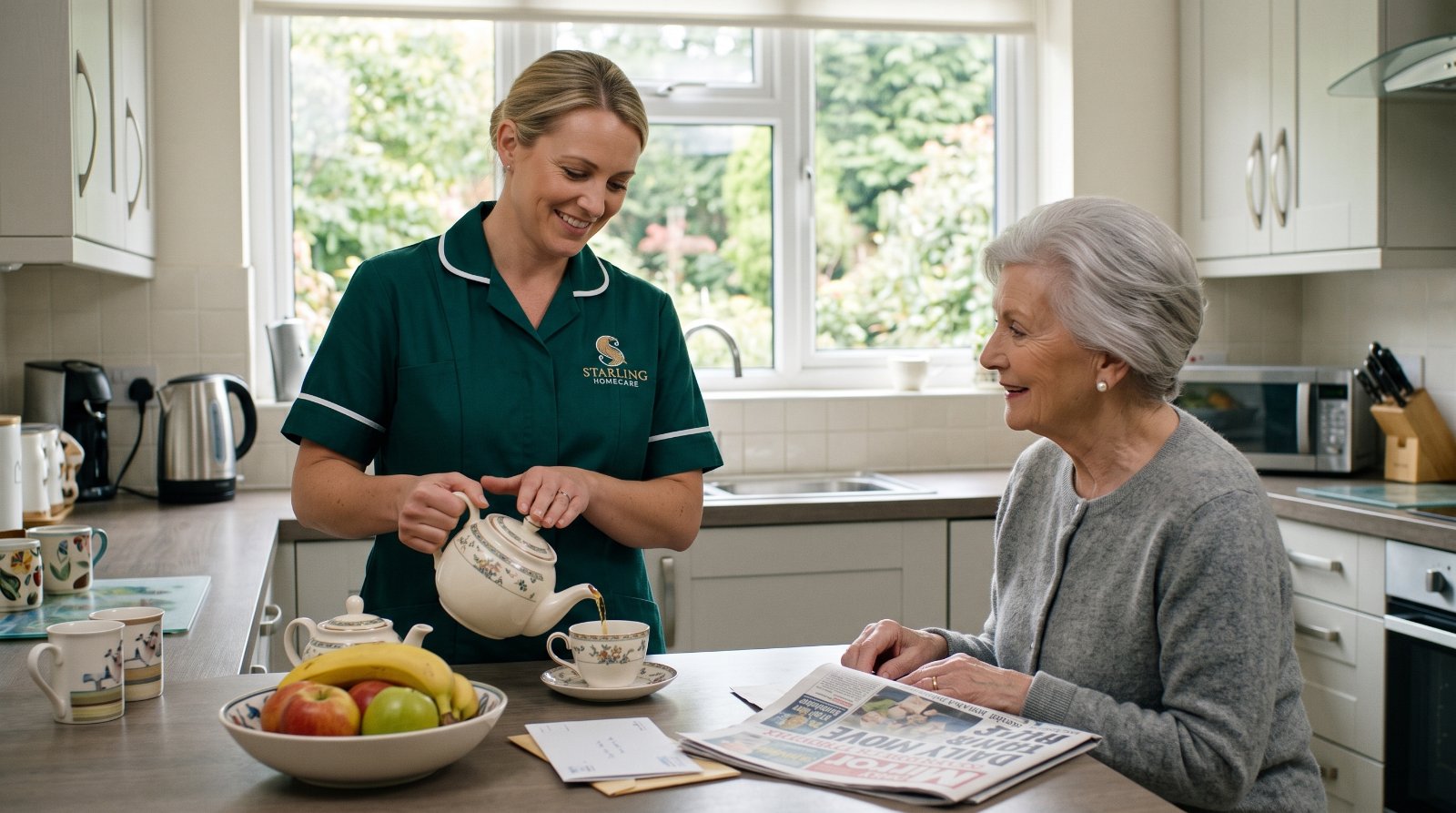
Home care in Welwyn Garden City means a trained carer coming to someone in their own home to help with the ordinary parts of the day: washing and dressing, meals, medicines, and getting out and about. It is not a step towards moving out. For most families it is what stops moving out being the only option.
Almost nobody plans this. Families arrive at it sideways, after a fall, or a hospital letter, or a quiet run of weeks where a parent stops cooking properly and the food in the fridge starts going out of date.
If that is roughly where you are, the useful thing to know first is that help at home is not one fixed thing. It scales. Three short morning visits a week is a real and common arrangement, and it is where a great many families across Welwyn Garden City and Hatfield begin.
What home care in Welwyn Garden City usually covers
Hertfordshire County Council describes care at home as a carer visiting to help with things like washing and dressing, getting in and out of bed or on and off the toilet, making a meal or a drink, and taking medication. You will also see it called domiciliary care, which is the same thing in more formal language.
Built around one person, a visit usually includes some mix of:
- Personal care. Washing, dressing and continence support, done at their pace and in their own bathroom rather than a strange one.
- Medication support. Prompting or administering, with a written record left after every visit.
- Meals and drinks. Preparing something proper, and where it helps, sitting with them while they eat it.
- Keeping the house running. Laundry, beds, the shopping, the small jobs that quietly stop happening first.
- Company, and someone laying eyes on them. Often the part families value most when they live an hour away.
What it does not include is anything clinical that belongs to a district nurse or a GP. A good carer knows exactly where that line sits and rings the right person rather than improvising.
How much help do you actually need at the start
Families almost always overestimate what they should be arranging, then underestimate how long the gap has been growing. Both are normal.
A practical way through it is to stop thinking in hours and start thinking in moments. Which parts of the day go wrong? If mornings are the problem, because getting washed and dressed has become slow and unsafe, then a morning visit fixes the thing that is actually broken. If the difficulty is evenings, when tiredness makes stairs and cooking risky, an evening call does more than a longer visit at the wrong time.
Starting small has a second advantage. It gives everyone, including the person receiving the care, a chance to get used to someone new in the house before anything bigger is decided. Support can be added as needs change, and it usually is.
What you are entitled to expect from a care agency
This matters more than most families realise when they are comparing providers, and Hertfordshire County Council sets it out plainly. A care agency helping you at home should give you a copy of your care plan saying what the carer will do, keep a daily record of when they visited and what they did, and tell you about changes, for example if a carer will be late or a different carer is coming.
The carer themselves should show identification when they arrive, know your needs and what help to give, do things the way you want them done, and provide receipts for any shopping.
Behind that sits regulation. A home care agency in England is registered with and inspected by the Care Quality Commission, which is who you can raise concerns with if the agency does not put something right. If you want to go further before choosing, our guide on questions to ask a home care provider sets out what to ask and what a straight answer sounds like.
Arranging home care in Welwyn Garden City and Hatfield
There are two routes, and they are not exclusive.
The first is to contact a care service directly, which is usually the quicker option. The second is to ask Hertfordshire County Council for an assessment of needs. That assessment is free, everyone has the right to one, and having it commits you to nothing. If care is then arranged through the council, a separate financial assessment works out whether you contribute towards the cost.
For families who want to talk it through with someone independent first, HertsHelp is the county's free advice service, on 0300 123 4044. Welwyn Hatfield Borough Council also runs an online health and wellbeing directory covering support for older people across the borough, which is a reasonable place to see what else exists locally alongside paid care.
Geography matters here in a way it does not everywhere. Welwyn Garden City, Hatfield, Welwyn and Brookmans Park sit close together but are quite different places to arrange care in, and travel time between visits is what decides whether a carer arrives calm and on time or twelve minutes late and apologising. It is a fair question to ask any provider: where are your other clients, and who covers this round when my regular carer is on leave?
When home care is not the right answer
Sometimes it is not, and it is worth saying so. Where needs are high overnight as well as through the day, a rota of visits stops making sense and either live-in care in Welwyn Garden City or a residential setting becomes the more honest conversation. Where someone is genuinely unsafe alone between visits, more visits is rarely the fix.
Being told that early by someone who arranges care every day is more useful than being sold a package that quietly fails three months later.
Questions families in Welwyn Garden City and Hatfield ask
How quickly can home care start?
For straightforward visiting care, days rather than weeks, once we have met the person and agreed what the visits need to do. What takes the time is doing the assessment properly and matching the right carer, not the paperwork.
Will it be the same carer each time?
It should be a small, named team rather than whoever is free that morning. Continuity is the difference between a carer who notices that someone is quieter than usual and one who does not know what usual looks like. Ask any provider directly how many different carers a person typically sees in a month.
Does my parent have to accept help if they do not want it?
No, and pushing rarely works. What often does work is starting with the least personal task, the shopping or the housework rather than washing, and letting trust build from there. Many people who refused care outright a month earlier ask for more of it once they have met the carer.
What does home care cost in Welwyn Garden City?
It depends on the pattern of visits rather than a single headline rate, and the honest answer needs a conversation about what the days actually look like. Our care funding guide explains what you might be entitled to, including attendance allowance and council funding, before you spend anything privately.
Where to start
If you are weighing this up for someone in Welwyn Garden City, Hatfield, Welwyn or Brookmans Park, the first useful step is usually a conversation rather than a decision. It often helps to talk it through with someone who arranges care every day, so you know what good support looks like and what it should cost before you commit to anything.
You can read more about how we work locally on our Welwyn Hatfield home care page, or about the everyday help itself on our personal care service page.
Arranging Care Is Simple
Starting care can feel like a big step. We keep it calm and straightforward, and we are here to guide you from your very first call.
1. Talk to us
Get in touch by phone or request a callback. We will listen, answer your questions and help you understand the options, so you can decide what feels right in your own time.
2. A home visit and initial consultation
We arrange a visit to understand your routines, your home and what matters most to you. Together we agree an initial consultation and shape the support that feels right.
3. Your care begins
A small, familiar team starts your care, arriving at the agreed times and staying involved as your needs change. We remain your trusted adviser throughout.
Whenever you are ready, we are here to help.