
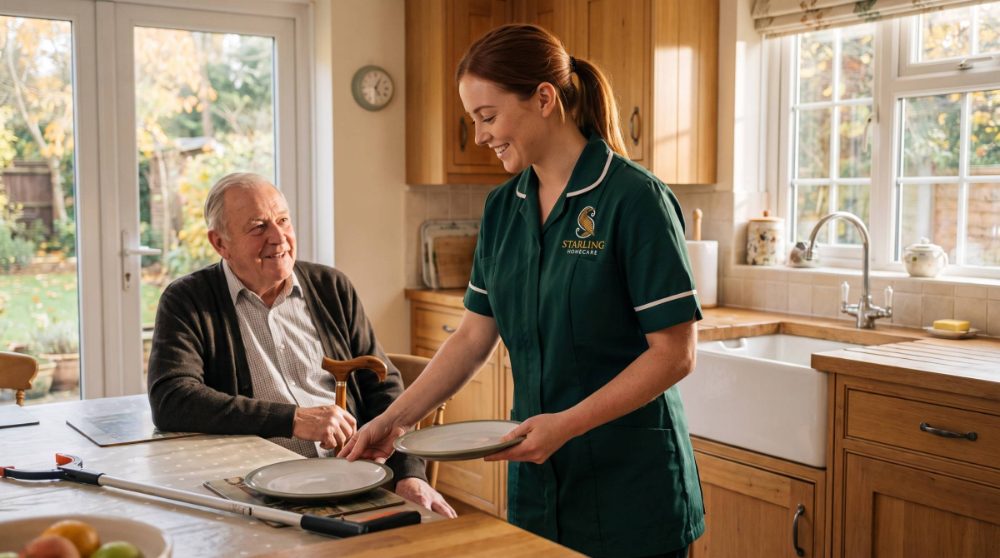
Planned surgery is the one hospital admission that gives you notice, and almost nobody uses it. A hip or knee replacement is booked weeks ahead. The help at home is usually arranged in the forty-eight hours after discharge, in a rush, by someone who has just driven back from the ward.
The NHS is explicit about this. Its own advice is to organise help with cooking, shopping and cleaning before your operation date, not after it.
If you or a parent has a date in the diary in Welwyn Garden City or Hatfield, that sentence is the whole article.
What the NHS actually tells you to sort out first
Worth reading properly rather than skimming, because the list is short and specific.
NHS guidance on preparing for a hip replacement says to arrange for a family member or friend to collect you, because hospitals do not routinely provide transport. If you live alone, it says to arrange for someone to stay with you overnight after discharge and for a few days afterwards, and to do that before your operation date.
It also suggests borrowing, hiring or buying equipment in advance: a raised toilet seat, a hand-held grabber for picking things up.
Most people are referred to a joint school session before surgery, covering what to expect and how to prepare. Go, and take the person who will actually be doing the helping.
The bit that gets underestimated
If things go well you are usually home one to three days after the operation. That speed is a good thing clinically and a shock domestically.
A physiotherapist or occupational therapist will go through daily activities and a home exercise programme before you leave. Stitches or clips come out at around ten days.
So the demanding period is not the hospital stay. It is roughly the fortnight after it, when someone is sore, tired, on painkillers, doing exercises that matter, and cannot easily carry a cup of tea and use a stick at the same time.
This is where planned surgery differs from an emergency admission. Our guide to home care after hospital in Welwyn Garden City and Hatfield covers the unplanned version, where nothing could be arranged in advance. This one you can prepare for properly.
What to put in place, and when
Four to six weeks before. Work out honestly who is doing what. If the answer is a spouse who is themselves in their eighties, or a daughter using annual leave, say so out loud now rather than discovering it later.
Two to three weeks before. Sort the house. Clear the routes you will use with a stick or a frame. Move what you use daily to waist height. Get the equipment. Put a chair where you will need to stop.
One to two weeks before. Book any paid help so it starts on the day you come home, not the day you realise you need it. Providers are booking ahead, and the week you want is usually somebody else's week too.
The day itself. Have the transport confirmed, the fridge stocked and the first night covered.
Where paid help fits, and how little of it you need
Less than people expect, and placed rather than spread.
For most planned joint surgery, what works is a short visit at the hardest point of the day for two to three weeks. Usually the morning: getting up, washing, dressing, breakfast, and making sure the exercises actually happen rather than being intended.
What post-hospital care at home involves is mostly practical. It is not nursing, and for a straightforward recovery it should not need to be.
What it buys, more than anything, is that the person recovering is not managing alone between physiotherapy appointments, and that whoever would otherwise be doing all of it gets to keep their job and their sleep.
We are an independent, family run provider registered with the Care Quality Commission. Our Welwyn Hatfield team covers Welwyn Garden City, Hatfield, Welwyn and Brookmans Park from our Welwyn Hatfield office on 01707 714 000 or [email protected].
Common Questions About Post-Operative Care at Home
How long do people need help at home after a hip or knee replacement?
It varies with age, general health and how the surgery went, and your own team will give you the realistic picture. In our experience most people arranging private help book two to three weeks of short daily visits and then taper, rather than a long package. The aim is to cover the period when the exercises and the getting about are hardest, then step back.
Can I arrange care before the operation, or do I have to wait for discharge?
You can and should arrange it beforehand. The NHS advice is explicit about organising help before your operation date. Practically, booking ahead also means you get the visit times you want rather than whatever is left, and the carer can meet the person before they go in, which makes the first morning home far easier.
Is post-operative care the same as care after an emergency admission?
No, and the difference is mostly preparation. Planned surgery lets you set the house up, meet the carer and agree the routine in advance, so the first day home is calm. An emergency admission gives you none of that, which is why it needs a different plan and often more help at the start.
Where to start
Take the date out of the diary and work backwards from it.
Write down the four weeks before and the three weeks after, and put a name against every morning in the fortnight following discharge. Where a morning has no name against it, that is what needs arranging, and now is when it is easy to arrange.
Every recovery is different, and nothing here replaces what your surgeon, physiotherapist or GP tells you about your own operation. For the practical side around it, our Welwyn Hatfield line is 01707 714 000.
NHS guidance on preparing for and recovering from joint replacement checked on 2 September 2026 at nhs.uk, linked above. Timings vary by person and procedure; your own team's advice takes precedence.
Arranging Care Is Simple
Starting care can feel like a big step. We keep it calm and straightforward, and we are here to guide you from your very first call.
1. Talk to us
Get in touch by phone or request a callback. We will listen, answer your questions and help you understand the options, so you can decide what feels right in your own time.
2. A home visit and initial consultation
We arrange a visit to understand your routines, your home and what matters most to you. Together we agree an initial consultation and shape the support that feels right.
3. Your care begins
A small, familiar team starts your care, arriving at the agreed times and staying involved as your needs change. We remain your trusted adviser throughout.
Whenever you are ready, we are here to help.