
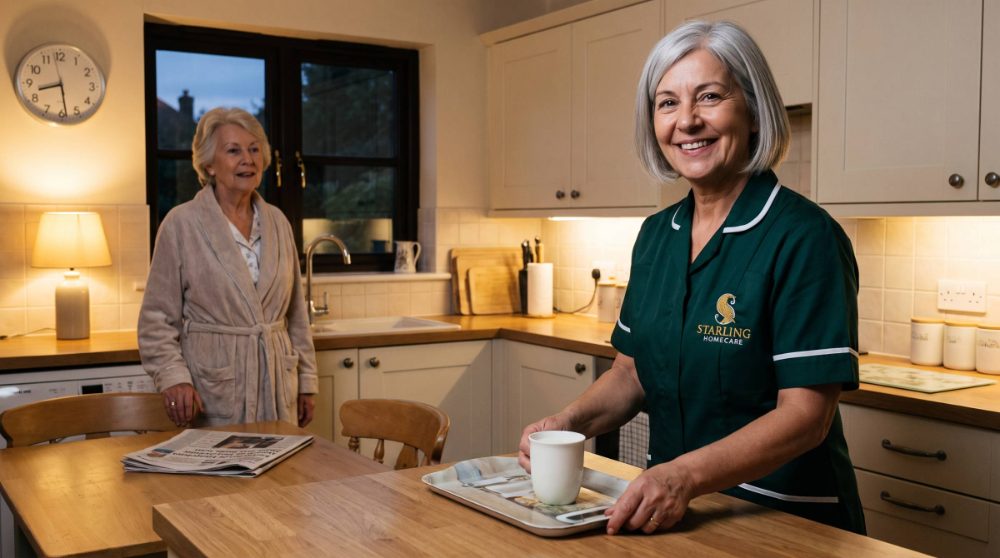
Overnight care in Welwyn village turns on a question that does not come up in the same way in the garden city. Not what is open at night, but who is near enough to get there.
Welwyn Garden City sits about a mile south. That mile does very little in daylight. At two in the morning it does quite a lot, because the thing that matters after dark is not distance to a service. It is distance to a person.
If you are weighing up night cover for someone in the village, in Digswell, Mardley Heath or Oaklands, that is the question worth starting from.
The night question in a village is a distance question
In the garden city, the housing is close and deliberately so. A neighbour is seconds away, most streets are lit, and someone is usually within earshot.
Welwyn village and the settlements around it are not built that way. Houses sit further apart, some of the lanes are unlit, and the four places in the parish are separated by real distance rather than by a road name.
Add to that the pattern we see most: the adult child lives a drive away rather than a walk away. Half an hour on a good night, longer in fog or when the A1(M) is closed.
None of that is a problem while everything is fine. It becomes the whole problem the first time it is not.
What "someone is there" actually means at three in the morning
Families use that phrase to mean several different things, and they are not equivalent.
Someone is contactable. A phone by the bed and a number that will be answered. This is the most common arrangement and the weakest, because it depends on the person being able to reach the phone and willing to use it at three in the morning, and most people are not.
Someone would notice. A daily check, a call at nine, a neighbour who looks out for the lights. Useful, and it finds a problem in the morning rather than at the time.
Someone is in the house. Which is what overnight care is, and the only one of the three that removes the wait.
The gap between those three is the whole decision, and it widens the further you are from other people. Our guide to overnight care in Welwyn Garden City looks at the same night from the services side; this is the same night from the geography side.
The three ways families cover a night, and where each breaks
A family member sleeps over. It works, and it works for about three weeks. Then the person doing it starts making mistakes at their own job, and nobody says anything because it feels ungrateful to.
A community alarm. Genuinely worth having, and it does what it says. What it cannot do is get someone up off the floor, settle someone who is distressed and awake at two, or notice that the night went badly if nobody pressed the button.
Nothing, and hope. More common than anyone admits, and usually held together by a daughter lying awake in another town.
Each of these breaks in a specific way, and the useful exercise is working out which way yours would break rather than whether it might.
How to decide whether you need it yet
Ask three questions about the last two months, and answer them honestly.
Has there been a night that went wrong? Not a fall necessarily. Getting up and not going back to bed, wandering, confusion after dark, or simply not coping.
Is anyone in the family lying awake because of it? That is a cost, and it is usually the cost that has been running longest.
And if something happened at two in the morning, how long would it actually be before anyone knew? Put a number on it. In the village, that number is often three or four hours, and seeing it written down tends to settle the question.
There is a real choice inside overnight care too, between a carer who sleeps and is there if needed and one who stays awake through the night. What live-in and overnight care involves covers the difference, and which one fits depends far more on how the nights are actually going than on how much help is needed by day.
We are an independent, family run provider registered with the Care Quality Commission, and our Welwyn Hatfield team covers the village, Digswell and the wider borough from our Welwyn Hatfield office on 01707 714 000 or [email protected].
Common Questions About Overnight Care in Welwyn Village
Is overnight care only for people who need help during the night?
No. A good deal of it is for people who need very little help but should not be alone, or for households where the family carer is not sleeping. The measure is not how many times someone needs help at night. It is what would happen if they did.
Can we start with one or two nights a week?
Yes, and most families here do. A couple of nights a week is often enough to break the pattern, because it gives whoever has been covering the nights two reliable nights of proper sleep, which changes what they can manage for the rest of the week.
Does a night carer need a spare room?
For a waking night, no, though somewhere to sit is only fair. For a sleeping night, yes, a proper bed is needed. Village houses tend to have the room, which is one of the few things that is easier here than in a smaller garden city house.
Where to start
Do the three questions above, this week, before anything else.
Most families arrive at overnight care after a bad night rather than before one, and the decision made at seven in the morning after a bad night is rarely the calm one. Working it out while nothing is wrong is a much better version of the same conversation.
Every situation is different, and nothing here replaces what a GP or a district nurse says about a specific person. If it helps to talk the nights through with someone who arranges them every week, our Welwyn Hatfield line is 01707 714 000.
Local detail checked on 1 September 2026. Welwyn is a village and civil parish that also takes in Digswell, Mardley Heath and Oaklands, with Welwyn Garden City about a mile to the south; parish population 8,425 at the 2011 census.
Arranging Care Is Simple
Starting care can feel like a big step. We keep it calm and straightforward, and we are here to guide you from your very first call.
1. Talk to us
Get in touch by phone or request a callback. We will listen, answer your questions and help you understand the options, so you can decide what feels right in your own time.
2. A home visit and initial consultation
We arrange a visit to understand your routines, your home and what matters most to you. Together we agree an initial consultation and shape the support that feels right.
3. Your care begins
A small, familiar team starts your care, arriving at the agreed times and staying involved as your needs change. We remain your trusted adviser throughout.
Whenever you are ready, we are here to help.