
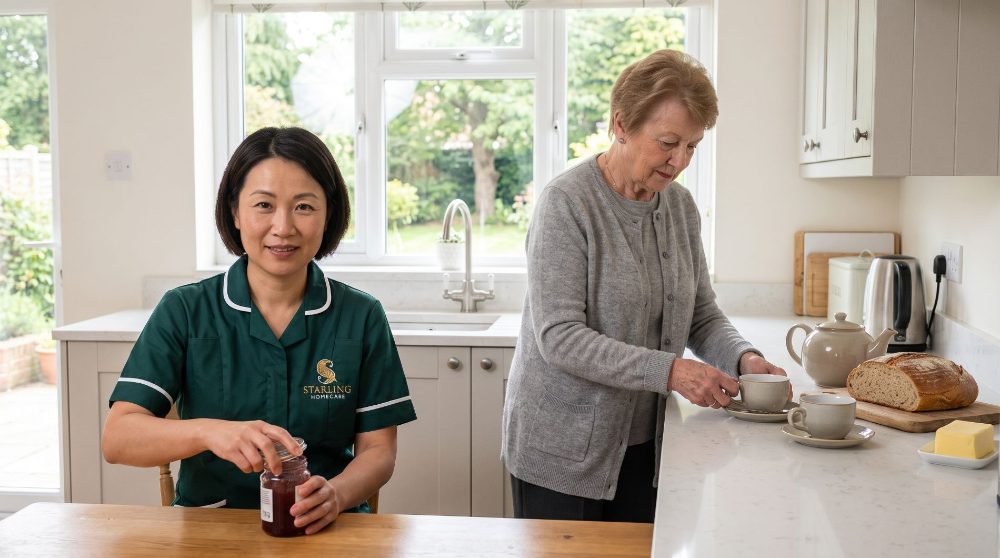
Arthritis rarely announces itself, and helping someone with arthritis at home starts with noticing what has changed. Families usually notice it in the jobs that have quietly stopped getting done: the jars left in the cupboard, the bath that has not been used in months, the meals that have become simpler, the toenails nobody can reach.
The pain is the symptom. The shrinking list is the problem. Starling Homecare is a family run, CQC registered provider, and arthritis is one of the conditions our carers support across Hertfordshire every day.
This piece is for the person doing the noticing, usually a son, daughter or husband. They can see that things are getting harder and are not sure what to do about it. Arthritis is the most common reason people we support need a hand in the morning. It is also the condition most often dismissed, by the person who has it, as nothing worth bothering anyone about.
What actually stops happening first
Nobody wakes up and decides to stop bathing. It goes quietly, one task at a time, and each one has a reason that sounds sensible on its own.
The bath goes first in a lot of houses, because getting out of it is harder than getting in. Then the fiddly things: buttons, shoelaces, jar lids, the small key in the back door. Anything overhead goes next, so the top cupboards empty and stay empty. Cooking narrows to what can be done standing at one spot, which is usually toast and tins.
Ask about specific jobs rather than asking how someone is managing. When did you last have a bath rather than a wash. Who opens the jars. Show me how you get up the stairs. The answers are concrete and they are hard to bat away.
The 30 minute rule worth knowing
The NHS says a GP may suspect osteoarthritis if someone is 45 or older, has joint pain that gets worse the more they use the joint, and has stiffness that is not there in the mornings or lasts less than 30 minutes. It most often affects the knees, hips and the small joints of the hands.
The important part is the exception. The NHS notes that prolonged joint stiffness in the morning can be a sign of rheumatoid arthritis instead, which is a different condition with a different treatment route. So if someone is stiff for an hour or more every morning, that is a GP appointment rather than a wait and see.
The NHS also says X-rays and blood tests are not usually necessary to diagnose osteoarthritis, which is worth knowing because people often delay going to the GP expecting an ordeal of tests. Most of the time it is a conversation and an examination of the joints.
Two things the diagnosis does not mean
It does not mean everything is downhill from here. The NHS is clear that osteoarthritis is a long term condition that cannot be cured, but that it does not necessarily get worse over time and can sometimes gradually improve. Families often plan for a decline that does not arrive.
Helping someone with arthritis at home also does not mean doing everything for them. Movement is part of the treatment rather than a risk to be eliminated. Someone helped into a chair and left there gets worse faster. Someone helped with the four things they cannot do, and left to do the rest, does better.
That is the balance a carer has to hold. It is the hard part for families, because doing it yourself is quicker and watching someone struggle with a cardigan is uncomfortable.
Helping someone with arthritis at home: how we shape support around the day
The first thing we look at is the clock. Stiffness is worst on waking, so a visit at half past seven does more good than the same visit at eleven. An unhurried morning, with washing, dressing, breakfast and medicines taken on time, sets up the rest of the day.
The second is aim. Help lands on the tasks the joints genuinely cannot manage and stops there. If someone can dress their top half and not their feet, that is what the care plan says. Our arthritis and mobility care at home page sets out what that looks like in practice.
The third is the flare. Arthritis is not a steady line, and a bad fortnight needs more help than a good one. Support that can step up quickly and step back afterwards is what keeps a flare from turning into a permanent arrangement, or into a hospital admission.
The conversations worth having early
Ask about the stairs before there is a fall rather than after. If the bedroom and the only bathroom are upstairs, that is the question the whole house turns on, and there are usually more options than people think.
Ask about money early too. The NHS guidance on living with osteoarthritis points out that people need advice on financial support as well as help with reduced mobility, and Attendance Allowance is not means tested. Our guide to Attendance Allowance explains who qualifies.
And if a hip or knee replacement is on the horizon, arrange the help before the operation rather than after it. Our post-hospital and rehabilitation care covers those weeks, and recovery at home goes better when the support is already familiar.
Where we support people with arthritis
Our carers support people living with arthritis across all ten of the areas we cover. Each has its own local team and its own number.
- St Albans: 01727 324 127
- Harpenden: 01582 824 830
- Welwyn Hatfield: 01707 714 000
- Potters Bar: 01707 714 000
- Radlett and Shenley: 01923 988 550
- Hemel Hempstead: 01442 954 137
- Berkhamsted: 01442 954 137
- Tring: 01442 954 137
- Hitchin: 01462 534739
- Hertford: 01920 746779
Common questions about helping someone with arthritis at home
Does Starling Homecare support people with arthritis at home in Hertfordshire?
Yes. Starling Homecare is a family run, CQC registered home care provider, and helping someone with arthritis at home is one of the things our carers do most. Visits are usually built around the stiff hours of the morning, and support can increase during a flare and reduce again afterwards.
How do you know if it is arthritis or just getting older?
The NHS says a GP may suspect osteoarthritis where someone is 45 or older, has joint pain that gets worse the more they use the joint, and has morning stiffness that is absent or lasts less than 30 minutes. Stiffness lasting longer than that each morning can point to rheumatoid arthritis instead, so it is worth seeing a GP rather than assuming it is age.
What help do people with arthritis actually need at home?
Most often: an unhurried morning routine, help with the tasks that need grip or reach, safe support on the stairs, medicines taken on time, and the housework and laundry that joints no longer forgive. The aim is to take on the jobs that have stopped happening rather than the ones the person can still do.
A little help, aimed well
If you have read this recognising the emptied top cupboards and the unused bath, the useful next step is not a big decision. It is a conversation about which four or five jobs have quietly gone, and whether a couple of visits a week would bring them back.
Our head office is on 01727 324 127, or you can use the number for your own area above.
Condition information on this page was checked on 14 September 2026 against the NHS osteoarthritis guidance.
Arranging Care Is Simple
Starting care can feel like a big step. We keep it calm and straightforward, and we are here to guide you from your very first call.
1. Talk to us
Get in touch by phone or request a callback. We will listen, answer your questions and help you understand the options, so you can decide what feels right in your own time.
2. A home visit and initial consultation
We arrange a visit to understand your routines, your home and what matters most to you. Together we agree an initial consultation and shape the support that feels right.
3. Your care begins
A small, familiar team starts your care, arriving at the agreed times and staying involved as your needs change. We remain your trusted adviser throughout.
Whenever you are ready, we are here to help.