
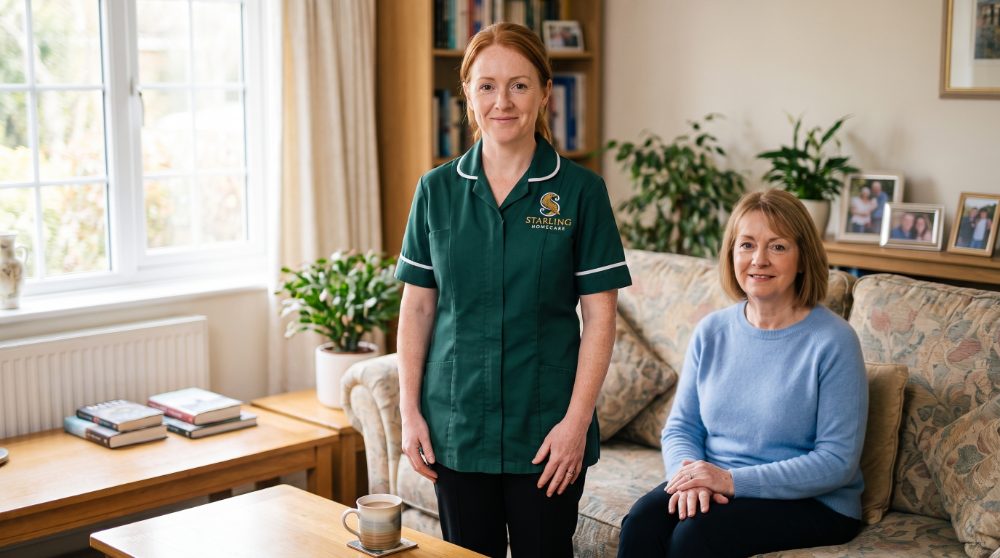
Functional tremor is uncontrollable shaking, usually of an arm or a leg, caused by a problem with how the nervous system is working rather than by an underlying disease. It is the commonest functional movement disorder, and it is sometimes mistaken for Parkinson's or essential tremor. Unlike Parkinson's, it is potentially reversible. This guide explains what it is, how a neurologist recognises it, what helps, and how Starling Homecare supports people with it at home in Hertfordshire.
Families usually arrive with a worry rather than a diagnosis. A parent's hand has started shaking, sometimes violently, and then it stops for no clear reason. The fear is often Parkinson's. A diagnosis of functional tremor is, for many, a relief and a puzzle at the same time.
The clinical detail below comes from the patient guide at neurosymptoms.org, written by Professor Jon Stone, a consultant neurologist, and read on 23 September 2026. It describes the condition. It does not diagnose it, and the diagnosis belongs with a neurologist.
What functional tremor is
The guide describes functional tremor as shaking caused by the nervous system not working properly, not by damage or disease. It often starts suddenly. It can follow an injury or pain in the limb, a side effect of medication, a faint, a fright or a panic attack. It can also amplify a mild tremor someone already had.
The tremor comes and goes. It may become violent, and it changes speed. Some people also feel a shaking inside that nobody else can see, which the guide says is common. And you do not need to be stressed to have it. In fact, it is often most noticeable when the person is relaxed.
How a neurologist recognises functional tremor
Functional tremor is diagnosed on positive signs, usually by a neurologist. The guide lists what they look for. The tremor stops or changes rhythm when the person copies a movement with the other hand, which is called the entrainment test. The person may find it hard to tap a rhythm with the good hand. The tremor has times when it is absent, and it varies in speed. And it often gets much worse when someone holds the limb still.
Those signs matter because they separate functional tremor from Parkinson's and essential tremor. If Parkinson's is the question, our guide to Parkinson's support in Hertfordshire sets out that pathway. For the wider picture, our overview of FND symptoms places tremor alongside the other functional symptoms.
What helps with functional tremor
The guide is honest that there is no magic treatment. However, the tremor can improve or go away. The starting point is understanding the diagnosis, which the guide says can have a big effect on its own.
After that, the guide describes physiotherapy techniques credited to Glenn Nielsen. One is to make a deliberate tremor over the top of the functional one, then slow it down. Another is to break the rhythm by copying someone else's tapping. Progressive muscle relaxation and working with a mirror can help too, and so can keeping a bouncing foot flat. If these do not work alone, the guide suggests someone may need to show you how.
Treating anxiety, where it is present, is part of the picture for some people. The guide also mentions hypnosis and self-hypnosis. Our guide to FND treatment explains how physiotherapy, occupational therapy and psychological therapy fit together.
Living with functional tremor day to day
The practical difficulty is the unpredictability. A cup of tea, buttoning a shirt or signing a form can be fine one hour and impossible the next. The guide notes that symptoms vary with tiredness, pain and paying attention to the movement. So a household that makes a fuss of the shaking can, without meaning to, make it worse.
In our experience, the calmest homes do best. The person does the task, help is there if it is needed, and nobody stares at the hand. Our guide to supporting someone with FND at home covers that balance in more detail.
How Starling Homecare supports people with functional tremor at home
Starling Homecare is an independent, family-run provider regulated by the Care Quality Commission. We provide visiting, overnight and live-in care across Hertfordshire for people with FND, including functional tremor. Our approach follows the rehabilitation principle: the person does as much as they can, and the carer makes the rest possible.
That means help with the tasks a bad hour makes unsafe, such as hot drinks or cooking. It also means getting to physiotherapy appointments, practising the techniques the physiotherapist set, and keeping the day steady. For who provides treatment locally, our guide to FND support in Hertfordshire sets out which service covers your town. The service itself is described on our FND care at home page.
Where we support people with FND across Hertfordshire
Each of our areas has its own local team and number, so call the one nearest you:
- St Albans: 01727 324 127
- Harpenden: 01582 824 830
- Welwyn Hatfield: 01707 714 000
- Potters Bar: 01707 714 000
- Hemel Hempstead: 01442 954 137
- Berkhamsted: 01442 954 137
- Tring: 01442 954 137
- Hitchin: 01462 534739
- Hertford: 01920 746779
- Radlett and Shenley: 01923 988 550
Common questions about functional tremor
Does Starling Homecare provide care at home for someone with functional tremor in Hertfordshire?
Yes. We provide visiting, overnight and live-in care across Hertfordshire for people with FND, including functional tremor. The care supports the rehabilitation plan, so the person keeps doing what they can and the carer helps with the rest.
Is functional tremor the same as Parkinson's?
No. The patient guide says functional tremor is sometimes mistaken for Parkinson's or essential tremor, but it is caused by how the nervous system is working, not by disease. Unlike Parkinson's, it is potentially reversible. A neurologist makes the diagnosis using specific signs.
Can functional tremor get better?
Yes. The guide says it can improve or go away, although there is no magic treatment. Understanding the diagnosis, physiotherapy techniques and, for some people, treating anxiety are the main routes.
Functional tremor is real, common and often treatable, and it usually starts with the right explanation. If you would like to talk about care at home for someone in Hertfordshire who has it, our St Albans office is on 01727 324 127. The functional tremor page at neurosymptoms.org is the source for this guide and is worth reading in full.
Arranging Care Is Simple
Starting care can feel like a big step. We keep it calm and straightforward, and we are here to guide you from your very first call.
1. Talk to us
Get in touch by phone or request a callback. We will listen, answer your questions and help you understand the options, so you can decide what feels right in your own time.
2. A home visit and initial consultation
We arrange a visit to understand your routines, your home and what matters most to you. Together we agree an initial consultation and shape the support that feels right.
3. Your care begins
A small, familiar team starts your care, arriving at the agreed times and staying involved as your needs change. We remain your trusted adviser throughout.
Whenever you are ready, we are here to help.