
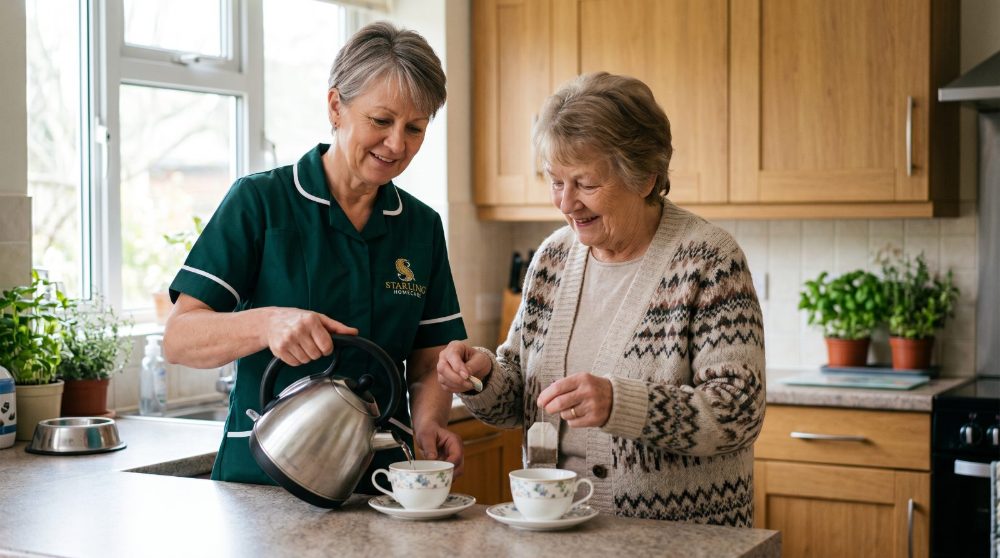
Macular degeneration home safety comes down to a few practical changes: bright, even lighting without glare, strong colour contrast, clear floors and a kitchen set up so things can be found easily. Because the condition affects central vision, most of these changes help a person keep doing things for themselves rather than doing less.
To talk anything through with someone local, our Hertford team is on 01920 746779.
Changes for macular degeneration home safety tend to work best when they are made early, before a fall or a scare. Sight loss charities note that people with sight loss are more likely to fall, and that half of all falls happen at home. If a fall has already happened, our guide to what to do in the first week after a first fall covers the next steps.
Why does macular degeneration change what feels safe at home?
Age-related macular degeneration, or AMD, affects the middle of the vision. The NHS explains that it can make things like reading and recognising faces difficult, although it does not cause total blindness.
The NHS guide to AMD symptoms also lists straight lines looking wavy and sensitivity to bright light. So a step edge, a dark rug or a sunny window can all look different from how they used to.
How should lighting be set up?
Brighter lighting is not always better, because glare makes things harder to see. The Macular Society's lighting guide suggests:
- Several lights in a room rather than one bright ceiling light, so there are no dark corners.
- Similar light levels between rooms, so the eyes do not have to adjust at each doorway.
- A task lamp in front of the person, below eye level and shaded, aimed at what they are doing.
- Some background light left on while the task lamp is in use, to reduce glare and tiredness.
- Well lit halls and stairs, with the hall light left on at night.
- Blinds to control bright daylight, and shades so no bare bulb shines into the eyes.
How can contrast make a home easier to use?
When detail is hard to see, contrast does the work instead. The Macular Society recommends painting door and window frames a different colour from the walls, or walls a different colour from the floor. Light switches in a contrasting colour stand out too.
Stairs deserve particular attention. The sight charities' advice site suggests contrasting edging on steps. Also, the RNIB recommends better lighting at the top and bottom of the stairs and fixing any loose stair carpet.
Macular degeneration home safety: reducing trips and falls
Most trip hazards are ordinary things in the wrong place. For example, a bag on the floor, a trailing flex or a door left half open. Keeping items in set places means the person can rely on memory and touch as well as sight.
In the bathroom, non-slip flooring helps. Then there is the wider picture: the charities advise regular eye tests and telling the GP about any falls, because they can check balance. You can read more about our falls prevention support.
Making the kitchen and everyday tasks safer
The kitchen is where many people with AMD want to stay independent. The Macular Society's daily living guide has simple ideas:
- Coloured chopping boards for different foods, and bright cups for drinks.
- A liquid level indicator that signals when a cup is nearly full.
- Brightly coloured tape around the handles of utensils.
- Raised bump-on stickers on the oven or washing machine settings used most, available from the RNIB.
- Talking scales and timers, and a tray to carry cups.
Medicines need a careful approach. The Macular Society notes that sensory teams can suggest techniques for taking them. Any change to how medicines are supplied is a question for the pharmacist or GP.
Who can help with home safety in Hertfordshire?
First, the eye specialist. The NHS says to ask about a referral to a low-vision clinic, which can suggest magnifiers and lighting changes. If sight keeps getting worse, the specialist can also certify it so the person can register.
Hertfordshire County Council Sensory Services has vision rehabilitation specialists who can check lighting and layout, provide equipment and teach mobility skills. The team is on 0300 123 4042. The local charity Herts Vision Loss also helps with sight loss registration.
For advice by phone, the Macular Society helpline is 0300 3030 111 and the RNIB helpline is 0303 123 9999.
Frequently asked questions
Is a brighter bulb always the answer?
Not on its own. Glare from a bare or very bright bulb can make things harder to see. Shaded lamps placed close to the task, plus steady background light, usually help more.
When should we get urgent help for someone with AMD?
The NHS says to get an urgent optician appointment or call NHS 111 if vision suddenly gets worse, or a dark shadow moves across it. If vision gets worse in other ways or there are new symptoms, the NHS says to contact the eye specialist, ideally on the same day.
Can someone come and look at the house?
Yes. Hertfordshire County Council's vision rehabilitation specialists can check lighting and layout as part of their support. Start with the council's adult care assessment, or ring Sensory Services.
Mum says she sees things that are not there. Is that part of AMD?
The NHS lists seeing things that are not there as a possible symptom of AMD. It is still worth mentioning to her optician or GP, so they can check it properly.
Starling Homecare is an independent, family run home care provider registered with the Care Quality Commission, with a local team supporting families in Hertford, Ware and Bengeo. Through our sight loss care at home, carers can help with personal care, prompt medicines and offer companionship. You can read more about our home care in Hertford.
Figures and guidance checked on 2 November 2026 against the NHS and Hertfordshire County Council.
Arranging Care Is Simple
Starting care can feel like a big step. We keep it calm and straightforward, and we are here to guide you from your very first call.
1. Talk to us
Get in touch by phone or request a callback. We will listen, answer your questions and help you understand the options, so you can decide what feels right in your own time.
2. A home visit and initial consultation
We arrange a visit to understand your routines, your home and what matters most to you. Together we agree an initial consultation and shape the support that feels right.
3. Your care begins
A small, familiar team starts your care, arriving at the agreed times and staying involved as your needs change. We remain your trusted adviser throughout.
Whenever you are ready, we are here to help.