
An elderly parent not drinking enough can become dehydrated, and the NHS says older adults are more at risk. Encourage drinks through the day and watch for the signs. Call 999 or go to A&E if they seem confused, are sleepier than normal or hard to wake, have difficulty breathing, or have blue, grey or pale skin.
To talk anything through with someone local, our Hitchin team is on 01462 534739.
It might have been the same full glass on the side table all afternoon, or a cup of tea left to go cold. You might feel uneasy that you cannot see what she drinks on the days you are not there. You might be fitting calls around work, or have a brother or sister further away. Then it can be hard to know whether this is a passing thing or something to act on.
This is something our team knows well, and there are simple, practical steps you can take from today.
Elderly parent not drinking enough: what are the signs?
The NHS lists the common signs of dehydration. Some are easy to spot on a visit or even a phone call.
- feeling thirsty, or having a dry mouth, lips and tongue
- headache, or feeling dizzy or light-headed
- dark yellow, strong-smelling pee, or peeing less often than usual
- feeling tired
- sunken eyes
The NHS dehydration page also says it can happen more easily if someone relies on other people to get them drinks, has been sick or had diarrhoea, has a high temperature, or takes medicines that make them pee more.
When is it urgent?
The NHS gives clear thresholds, so you do not have to judge this alone.
- Call 999 or go to A&E if she has blue, grey, pale or blotchy skin, lips or tongue, skin that feels cold, difficulty breathing or lots of quick breaths, is confused, or is sleepier than normal or difficult to wake.
- Ask for an urgent GP appointment or contact NHS 111 if she is unusually tired, feels dizzy when she stands up and it does not go away, has dark yellow pee or is peeing less than normal, or is breathing quickly or has a fast heart rate.
What helps day to day?
Small habits can do more than reminders on the phone. Here is a simple plan, drawing on NHS guidance.
Today
- Put a drink she likes within reach of her chair and bed.
- Remember that tea and coffee count. The NHS guide to water and drinks says water, lower-fat milk and lower-sugar drinks, including tea and coffee, all count.
This week
- Aim for a steady amount across the day. The NHS says the government recommends 6 to 8 cups or glasses of fluid a day as a guide.
- Agree a few regular drink times, such as with each meal and mid-afternoon.
- If she gets up in the night for the toilet, the NHS suggests drinking less in the hours before bed while still drinking enough during the day. The GP can help with any bladder problems.
This month
- Ask the GP or pharmacist whether any of her medicines affect how much she needs to drink. Do not stop or change a medicine yourself; Age UK warns that suddenly stopping certain medicines can cause problems.
- Think about who could offer a drink on the days you cannot be there.
How do I raise it with Mum?
Make it about sharing a drink, not about being told off. You could try:
- "Shall I put the kettle on? I'm gasping."
- "I've brought some of that squash you like. Let's leave a glass by your chair."
- "Let's have a cup of tea together before I go."
Who can help in Hitchin and Hertfordshire?
Her GP and NHS 111 are there for health worries. For help at home, Hertfordshire County Council has a free advice service.
- 999 or A&E for the emergency signs above.
- Her GP surgery or NHS 111 for the urgent signs, or if you are worried about her drinking.
- HertsHelp on 0300 123 4044, Hertfordshire County Council's free advice service.
How Starling Homecare can help
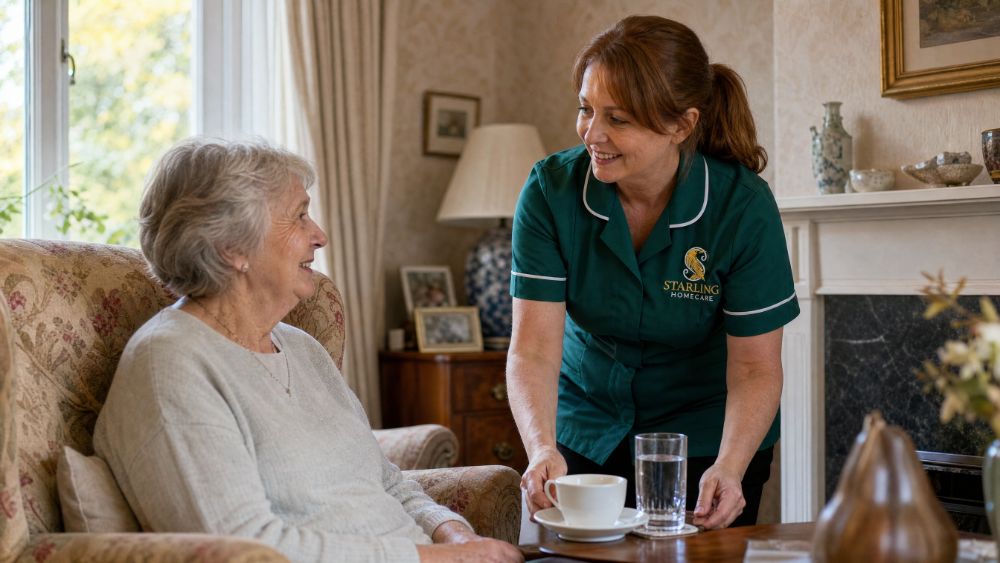
Someone popping in through the day means drinks are offered at the times you cannot be there. It also means your calls with Mum can be about her news, not a quiz about the kettle.
Starling Homecare's later life care includes:
- Hydration support and meal preparation.
- Visiting care in St Albans, Harpenden, Hemel Hempstead, Welwyn Hatfield, Potters Bar and Cheshunt, from 30 minute visits, at the times of day that suit her.
- Wellbeing checks and medication prompts.
- Companionship, because a cup of tea is easier with company.
A carer notices changes, encourages her, keeps the family informed and passes concerns to the GP where needed. Carers do not give injections or carry out clinical tasks. When a parent is unsure about help, it can start with someone from our team simply coming round for a chat. It does not have to be formal, and it often breaks the ice. As needs change, visits can increase. Our article on an elderly parent not eating covers mealtimes.
Areas we cover
Starling Homecare's carers visit people at home in St Albans, Harpenden, Hemel Hempstead, Welwyn Garden City and Hatfield, Potters Bar and Cheshunt, and the villages around them. Elsewhere in Hertfordshire, including Berkhamsted, Tring, Radlett and Shenley, Hitchin and Hertford, we arrange live-in care.
For more on the early stages, see our guide for families worried about an elderly parent. Locally, here is how we arrange live-in care in Hitchin.
Frequently asked questions
How much should an elderly person drink a day?
The NHS says the government recommends 6 to 8 cups or glasses of fluid a day as a guide, and that water, lower-fat milk and lower-sugar drinks, including tea and coffee, all count. The NHS dehydration page also says to drink enough during the day for pee to be a pale colour. Ask the GP if a health condition affects this.
When is dehydration in an elderly person an emergency?
The NHS says call 999 or go to A&E if someone is confused, sleepier than normal or hard to wake, has difficulty breathing, has skin that feels cold, or has blue, grey, pale or blotchy skin, lips or tongue. These can be signs of shock. Less severe signs need an urgent GP appointment or NHS 111.
Can someone check Mum is drinking enough in Hitchin?
Yes. Starling Homecare arranges live-in care in Hitchin, and our later life care includes hydration support, meal preparation and wellbeing checks. Visiting care, from 30 minute visits, is offered in St Albans, Harpenden, Hemel Hempstead, Welwyn Hatfield, Potters Bar and Cheshunt. A carer keeps the family informed and passes concerns to the GP where needed. In urgent situations care can usually start within a day or two.
If you are worried about an elderly parent not drinking enough and you cannot be there every day, our Hitchin team is on 01462 534739. You will be talking to someone who arranges care every day, so you can find out what good support looks like before you decide anything.
Guidance checked on 26 October 2026 against the NHS, Age UK and Hertfordshire County Council.
Arranging Care Is Simple
Starting care can feel like a big step. We keep it calm and straightforward, and we are here to guide you from your very first call.
1. Talk to us
Get in touch by phone or request a callback. We will listen, answer your questions and help you understand the options, so you can decide what feels right in your own time.
2. A home visit and initial consultation
We arrange a visit to understand your routines, your home and what matters most to you. Together we agree an initial consultation and shape the support that feels right.
3. Your care begins
A small, familiar team starts your care, arriving at the agreed times and staying involved as your needs change. We remain your trusted adviser throughout.
Whenever you are ready, we are here to help.