
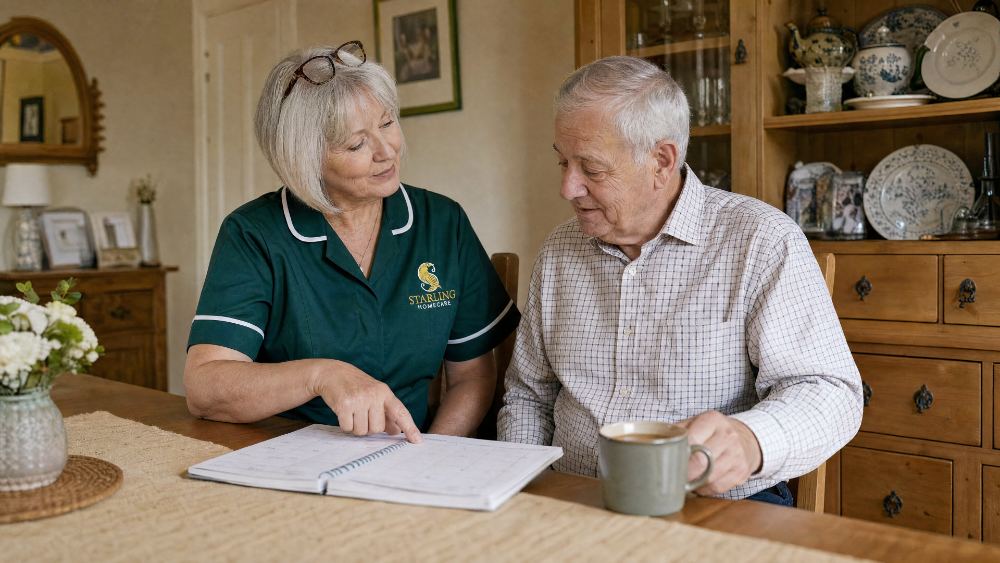
Help after a stroke at home usually comes from four places: the NHS stroke and therapy team, your GP, the council's adult care service and charities such as the Stroke Association. Private care at home can then fill the everyday gaps, such as washing, dressing, meals and company, that therapy does not cover.
To talk anything through with someone local, our St Albans team is on 01727 324 127.
The first weeks home can feel like a blur of names and leaflets. So this guide sets out who does what, and what you can ask each of them. For the detail of which NHS team covers each Hertfordshire town, see our guide to stroke support in Hertfordshire after hospital.
Who plans the help after a stroke at home?
According to the NHS guide to recovering from a stroke, when someone is discharged from hospital, the healthcare team continues to support them and makes a recovery plan for home. They should also make sure the right equipment is in place, with training in how to use it.
It helps to ask for that plan in writing. Then everyone, including family and any carers, works from the same page.
Questions worth asking before discharge
- Who will contact us after discharge, and when?
- Which therapy will happen at home, and which at a clinic?
- What equipment is being arranged, and who shows us how to use it?
- Who do we call if something changes in the first week?
What does the NHS community stroke team do?
In East and North Hertfordshire, the Hertfordshire Community NHS Trust community stroke service provides specialist rehabilitation for adults. It can take place at home, in clinics, in groups or online.
The team includes physiotherapists, occupational therapists, speech and language therapists, nurses, psychologists and rehabilitation assistants. Support lasts for up to six months after a stroke.
Early Supported Discharge and other pathways
The service has three routes, depending on need:
- Early Supported Discharge is for mild to moderate stroke, usually within the first six weeks.
- Supported Discharge is for moderate to severe stroke with more complex needs.
- Disability Management gives short-term specialist support to people living with the effects of a severe stroke, who usually have no active rehabilitation goals.
Families can also self-refer if the person has been known to the service in the last 12 months. West Hertfordshire is covered differently, which our stroke support guide explains.
What can the GP and the six-month review add?
In East and North Hertfordshire, GPs can also refer to the community stroke service.
The NHS says you should get a review of progress after about six months. In East and North Hertfordshire, these reviews are delivered with the Stroke Association. It is a good moment to raise anything that is still hard. Our article on stroke recovery at home after the six-month review looks at what often changes next.
What help can the council give after a stroke?
Hertfordshire County Council can assess care and support needs at home. According to its page on getting adult social care, you ask for an assessment online.
Someone then talks with your relative about daily life at home and outside. This usually takes between 30 minutes and two hours. If care and support are needed, a financial assessment follows to see whether they pay towards it.
Ask early, even if you expect to arrange care privately. The assessment gives you a clear record of what is needed.
Where do charities fit in?
The Stroke Association runs a Stroke Support Helpline on 0303 3033 100. It is open Monday to Friday, 9am to 5pm, and Saturday, 10am to 1pm.
It also offers an online community, support groups and help for family members. Caring is tiring, and the NHS advises carers to make sure they get the support and help they need.
Where does care at home fit?
Therapists work on recovery, which is only part of the help after a stroke at home. However, they are not there at 7am when someone needs help to wash, or at teatime when a meal needs making. That is where care at home helps.
A carer can help with:
- personal care, such as washing, dressing and using the toilet
- meals and drinks, set out within easy reach
- prompts for medicines, as agreed in the care plan
- encouraging the routine the therapists have set, without replacing them
- company or a walk to the shops
Our stroke care at home page explains how visits can be shaped around therapy, and our post-hospital care covers the first weeks after discharge.
Frequently asked questions
How soon does help start after leaving hospital?
It depends on the stroke and the pathway. Early Supported Discharge usually works within the first six weeks after a stroke. Ask the ward who will make first contact, and when.
Can we contact the community stroke team ourselves?
In East and North Hertfordshire, yes, if your relative has been known to the service in the last 12 months. Otherwise, the GP or hospital team can refer them.
Does the NHS provide carers for washing and dressing?
Ask the hospital team what is planned, because every discharge is different. The community stroke team's role is specialist rehabilitation. Day-to-day help with washing and dressing is often arranged through the council's assessment or privately.
Is there help for the family, not just the person who had the stroke?
Yes. The Stroke Association offers support and guidance to family and carers, as well as its helpline and online community. It is worth calling even when the question feels small.
How Starling Homecare can help
As a family run, CQC-registered provider based in St Albans, we offer visiting care from 30 minutes upwards, overnight care and live-in care. If you are piecing together help after a stroke at home, we can talk through where care at home would fit.
Figures and guidance checked on 25 October 2026 against Hertfordshire Community NHS Trust, the NHS, the Stroke Association and Hertfordshire County Council.
Arranging Care Is Simple
Starting care can feel like a big step. We keep it calm and straightforward, and we are here to guide you from your very first call.
1. Talk to us
Get in touch by phone or request a callback. We will listen, answer your questions and help you understand the options, so you can decide what feels right in your own time.
2. A home visit and initial consultation
We arrange a visit to understand your routines, your home and what matters most to you. Together we agree an initial consultation and shape the support that feels right.
3. Your care begins
A small, familiar team starts your care, arriving at the agreed times and staying involved as your needs change. We remain your trusted adviser throughout.
Whenever you are ready, we are here to help.