
When cancer treatment is arranged, the conversation is about the treatment. It is almost never about how the person is going to get there, five days a week, for six weeks, in February.
In Hertfordshire that question is bigger than it looks, because a lot of specialist cancer treatment does not happen in Hertfordshire.
We are Starling Homecare, an independent family run home care provider registered with the Care Quality Commission, arranging care at home across Hertfordshire. Getting to and from appointments is one of the most common practical reasons families first call us. This page sets out where treatment actually happens, what NHS transport will and will not do, and what the realistic options are.
Where cancer treatment happens for Hertfordshire patients
Mount Vernon Cancer Centre provides regional non-surgical specialist cancer care for adults across Hertfordshire, and for parts of north west London, Bedfordshire, Buckinghamshire and east Berkshire. It is run by East and North Hertfordshire NHS Trust.
Mount Vernon is in Northwood, in Middlesex. It is not in Hertfordshire. For someone in Hitchin, Hertford or Welwyn Garden City that is a long journey, and radiotherapy in particular can mean making it repeatedly over several weeks.
Chemotherapy is often closer to home. The Lister Macmillan Cancer Centre in Stevenage opened in 2014 as a purpose built unit with eighteen chairs for delivering chemotherapy and the care that goes with it.
It is worth knowing that this is under active review. NHS England has been consulting on proposals for cancer services, including expanding chemotherapy, diagnostics and follow-up care at local hospitals, increasing chemotherapy delivered at home, and reducing how far people travel for routine appointments. One option under discussion is a second radiotherapy unit at either Lister or Luton and Dunstable.
What NHS patient transport will and will not do
This is where families are most often caught out, so it is worth being precise rather than hopeful.
Non-emergency patient transport in this region is run by East of England Ambulance Service NHS Trust. Bookings and queries go through 0345 605 1208, open 8am to 6pm, Monday to Sunday.
The important part is the eligibility. NHS England's criteria are clear that most people are expected to travel independently, by private or public transport, with help from relatives or friends where needed. NHS funded transport is for where it is essential to someone's safety, their ability to mobilise safely, the management of their condition or their recovery.
In practice, eligibility rests on a medical need, a cognitive or sensory impairment requiring trained staff, or a significant mobility need. It does not rest on the journey being long, expensive, or on there being nobody free to drive. That is a hard thing to hear when the journey is to Northwood and back, but it is better to know it before the first appointment than after.
Help with the cost, which is a separate scheme
If the barrier is money rather than mobility, the Healthcare Travel Costs Scheme is the route. It refunds travel costs for patients on qualifying benefits or low incomes.
You can also claim the travel costs of one person accompanying you, where a medical professional confirms that is necessary. The relevant part of the claim form is completed by clinical staff, so ask at the appointment rather than afterwards.
Macmillan and local cancer support services can help with checking entitlement. It is worth doing this early, because refunds depend on keeping receipts and tickets from the start.
What actually helps, practically
Most families end up with a mix rather than one answer. A relative does some journeys, a volunteer driver scheme covers others, and paid support fills the gaps that neither can.
The gaps are usually predictable. They are the weekday mornings when everyone is at work, the appointments that overrun by two hours, and the journeys home after a treatment that has left someone too tired to be alone on public transport.
The journey home matters more than the journey out, and it is the one people plan for least. Someone can leave the house perfectly capable and come back needing help to get up the stairs.
How our support works around treatment
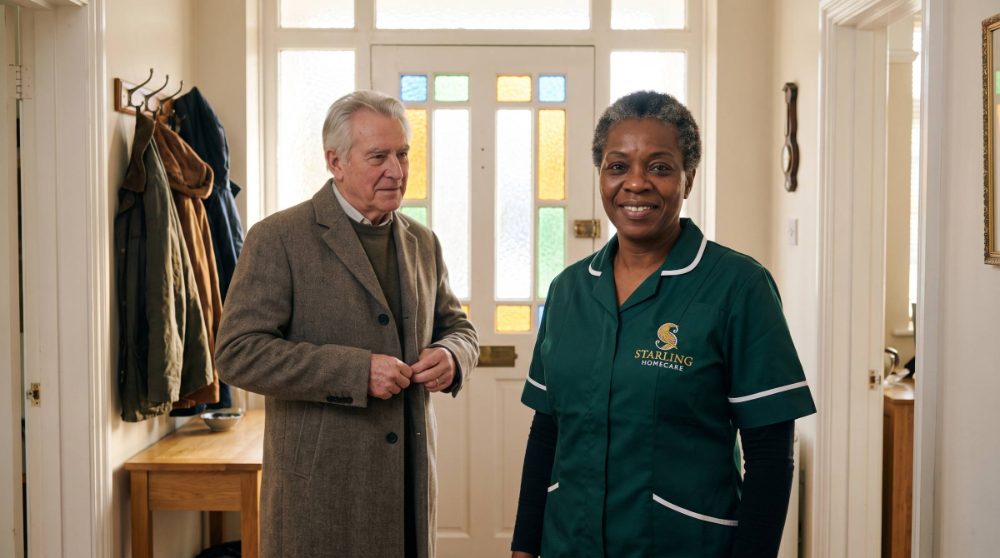
Starling Homecare provides visiting care and live-in care at home, including support around treatment days. That can mean a carer getting someone up and ready in the morning, going with them and staying through the appointment, and settling them at home afterwards.
It can also mean nothing at all on treatment days, and more support on the two days afterwards, when fatigue tends to peak. That pattern is common and there is no reason a care plan has to be evenly spread across a week.
Every person is different, which is why we write a person-centred care plan for each individual. What works for one person going through treatment can be wrong for someone else, so the plan is built around that person and changed as treatment changes.
Cancer care at home across Hertfordshire
You can read more about cancer care at home and about caring for someone with cancer at home, which covers the day to day support rather than the logistics of getting to treatment.
Each town has its own team and its own number: St Albans 01727 324 127, Harpenden 01582 824 830, Welwyn Hatfield 01707 714 000, Hemel Hempstead, Berkhamsted and Tring 01442 954 137, Hitchin 01462 534739, Hertford 01920 746779, and Radlett and Shenley 01923 988 550. You can also read about home care in Welwyn Hatfield on our area page.
Common questions
Will the NHS drive my mother to radiotherapy?
Only if she meets the eligibility criteria, which are based on medical, mobility or cognitive need rather than on distance or on nobody being available to drive.
Can a carer come to the appointment?
Yes. A carer can travel with someone, wait through the appointment and support them home. Some families use this only on the harder treatment days.
Is Mount Vernon moving?
Proposals for the future of Mount Vernon cancer services have been consulted on, including more treatment closer to home. Nothing described here should be taken as a settled outcome, so check the current position with your own team.
Sources checked on 8 September 2026: East and North Hertfordshire NHS Trust on Mount Vernon Cancer Centre and the Lister Macmillan Cancer Centre, NHS England on non-emergency patient transport eligibility criteria and on the Mount Vernon cancer centre review, and NHS guidance on the Healthcare Travel Costs Scheme. This article is general information to help families plan and is not medical advice. Everyone's treatment and circumstances are different, so please check your own position with your clinical team, and confirm transport eligibility directly with the service.
Arranging Care Is Simple
Starting care can feel like a big step. We keep it calm and straightforward, and we are here to guide you from your very first call.
1. Talk to us
Get in touch by phone or request a callback. We will listen, answer your questions and help you understand the options, so you can decide what feels right in your own time.
2. A home visit and initial consultation
We arrange a visit to understand your routines, your home and what matters most to you. Together we agree an initial consultation and shape the support that feels right.
3. Your care begins
A small, familiar team starts your care, arriving at the agreed times and staying involved as your needs change. We remain your trusted adviser throughout.
Whenever you are ready, we are here to help.