
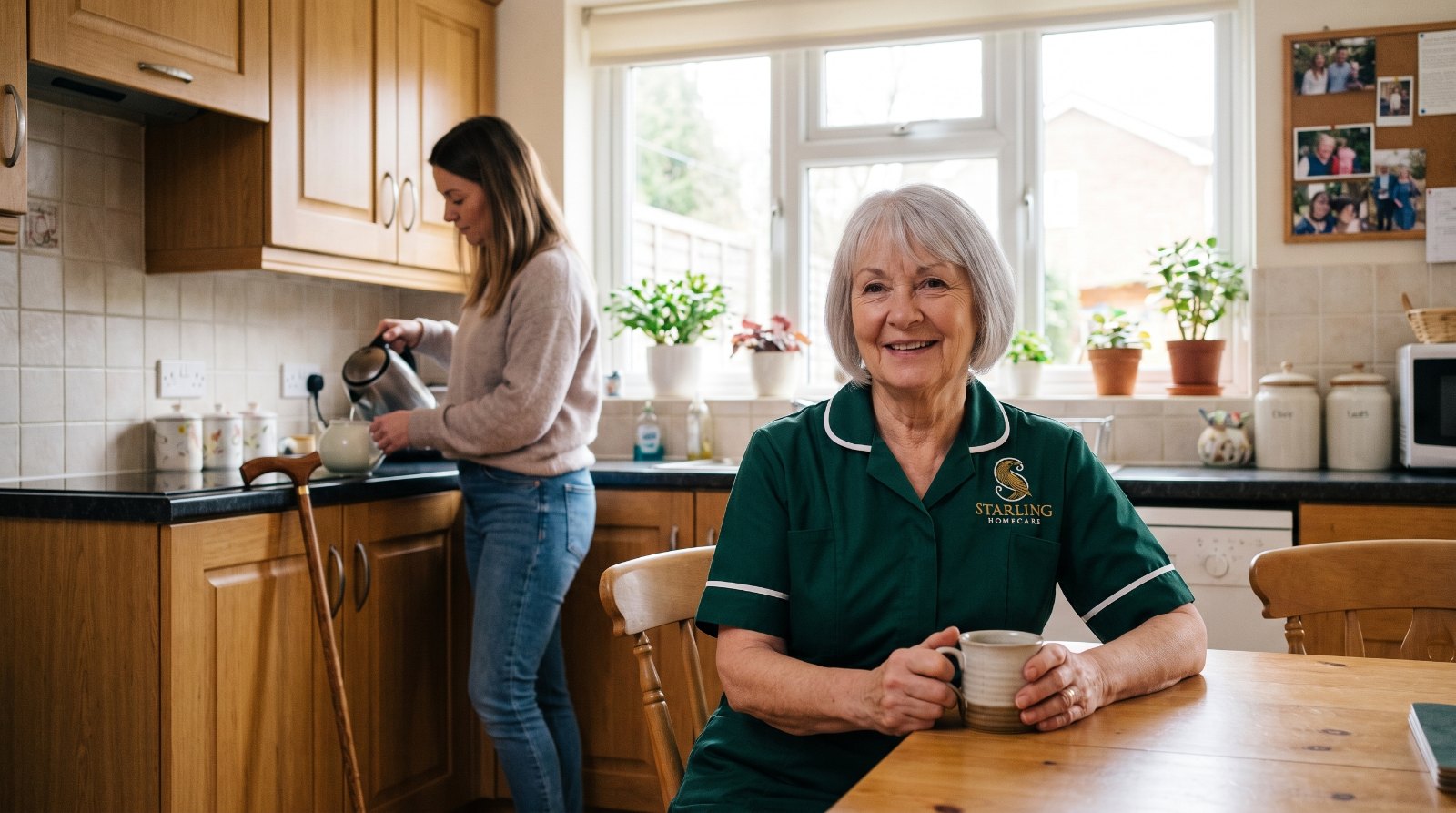
Can someone with FND live alone? Often, yes. The answer has very little to do with the diagnosis itself and almost everything to do with two things: what happens on their worst days, and how long they would be on their own before anyone noticed.
Functional neurological disorder is enormously variable. Some people have occasional symptoms and a full working life. Others have daily seizures, weakness or fatigue that reshapes everything. The same label covers both, which is why a general answer to this question is not much use.
What is useful is a set of questions that gets a family to an honest answer. This article sets them out. At Starling Homecare we support people living with FND across Harpenden and the surrounding villages, some living alone with a few visits a week, some with much more.
This article is general information written to raise awareness of FND. It is not medical advice. FND affects everyone differently, and what helps one person can be wrong for another, which is why every care plan we write is built around the individual. Please talk to your own GP, neurologist or therapy team about your situation.
Can someone with FND live alone safely? The question is exposure, not diagnosis
The right question is not whether the condition is serious. It is what happens in the gap.
If someone has a functional seizure at eleven in the morning and recovers by half past, living alone may be entirely reasonable. If the same person falls, cannot get up, and nobody is due until the following evening, that is a different situation with the same diagnosis.
So map the gap. On a bad day, how long could this person be on the floor, or unable to make a drink, or too fatigued to reach the bathroom, before anyone would know? That number, more than anything a scan shows, is what decides this.
What tends to change the answer?
Five things, in our experience.
The seizure pattern, and specifically whether there are falls. Seizures without warning that involve going to the ground carry a different risk from seizures where the person feels it coming and can get somewhere safe. Our piece on what to do when someone has a functional seizure covers the moment itself.
Mobility on the worst days rather than the average day. Families consistently answer this question based on how the person is when they are well, which is the wrong reference point.
Cognitive and speech symptoms. Functional cognitive symptoms are recognised by NHS inform as part of FND, and if someone struggles to explain what has happened, calling for help becomes harder exactly when it matters.
Whether the home works. Stairs, a bathroom upstairs and a kitchen that requires reaching and carrying all raise the stakes.
And the restriction spiral, which is the one families miss. The CODES trial patient leaflet describes how people become steadily more restricted by their seizures: less work, fewer friends, avoiding shops and public transport, and sometimes not leaving home at all. Living alone can quietly accelerate that, because there is nobody to keep the week open.
What makes living alone work?
Predictability, mostly. The things that help are unglamorous.
A check-in that happens at a known time, so the maximum gap is a known number rather than an open question. A plan for a bad day that the person has agreed while well, including who to call and what they want to happen. A phone that is genuinely reachable from the floor rather than on a shelf. And someone who knows their usual pattern well enough to spot when something is different.
Technology helps at the edges. A personal alarm or a falls sensor shortens the gap, and Hertfordshire County Council's adult social care team can advise on equipment as part of a care needs assessment, which anyone can request regardless of savings.
None of it replaces the last item on the list. A small, consistent team that knows the person is what turns a set of visits into an actual safety net, and because no two people with FND need the same thing, that plan is written around the individual rather than the condition.
How does home care from Starling Homecare help someone with FND live alone?
Starling Homecare is a family-run homecare provider registered with the Care Quality Commission, and supporting people living with FND at home is part of what we do. For someone living alone that is often a short visit at a known time rather than anything elaborate, and it is the predictability that does the work.
When does living alone stop working?
Usually gradually, and usually the person notices before the family does.
The signals we see are a rising number of near misses, meals being skipped because preparing them is too much, appointments missed on bad days, and a world that is getting smaller. When someone stops going out because of what might happen rather than what did happen, that is worth naming out loud.
At that point the answer is rarely a move. It is more often more support at home: an extra visit, a sitting service, help at the times of day that are hardest, or overnight cover. Our guide to supporting someone with FND at home covers what that support looks like in practice.
What about driving and getting out?
Independence is not only about the house. If FND affects driving, GOV.UK sets out that you must tell the DVLA about medical conditions that affect your driving, and that you can be fined up to £1,000 if you do not. The rules depend on the individual and the symptoms, so this is a conversation with the neurologist and the DVLA rather than something to work out from a website.
Losing a licence is often the moment living alone gets harder in Harpenden and the villages around it, where a lot of ordinary life assumes a car. Companionship visits that include getting out, rather than only tasks in the house, are frequently the most valuable hours a week for exactly this reason.
Where we support people with FND across Hertfordshire
Starling Homecare supports people living with functional neurological disorder at home across the whole county, including people living alone. The team you speak to is the one that covers your town.
Wherever you are in the county, you reach the team that actually covers your area:
- St Albans, 01727 324 127
- Harpenden, 01582 824 830
- Welwyn Hatfield, 01707 714 000
- Hemel Hempstead, 01442 954 137
- Berkhamsted, 01442 954 137
- Tring, 01442 954 137
- Hitchin, 01462 534739
- Hertford, 01920 746779
- Radlett and Shenley, 01923 988 550
Common Questions: Can Someone With FND Live Alone?
Can someone with FND live alone if they have functional seizures?
For many people, yes, with sensible planning. The CODES trial patient leaflet notes that functional seizures are not life threatening, that there are no recorded cases of severe harm, and that you do not need someone around all the time in case you have one. The practical questions are whether falls are involved and how long someone would be alone afterwards. Everyone is different, so check your own situation with your clinician.
What support helps someone with FND stay living independently?
Regular visits at predictable times, a plan for a bad day agreed in advance, a reachable phone or personal alarm, and a small consistent team who know the person's usual pattern. Hertfordshire County Council can advise on equipment through a free care needs assessment, which anyone can ask for regardless of income or savings.
Who provides home care for people with FND in Hertfordshire?
Starling Homecare supports people living with functional neurological disorder at home across Harpenden, St Albans, Welwyn Hatfield and the surrounding villages, as well as the wider county. We are a family-run provider registered with the Care Quality Commission. For someone living alone, the support that usually matters most is a small consistent team who know the person’s pattern, visits at predictable times, and an agreed plan for a bad day.
How do you know when someone with FND needs more support?
Watch for near misses rather than incidents, missed meals and appointments, and a life that is getting smaller. If someone is avoiding going out because of what might happen, that is usually the point to add support rather than to wait for something to go wrong.
Can someone with FND live alone straight after diagnosis?
Often, yes, if they were living alone before and the pattern of symptoms is known. The riskier moment is a change. A new symptom, a first functional seizure, a fall or a spell of severe fatigue all change the picture. That is when it is worth reviewing the plan, rather than assuming the previous arrangement still works.
What practical things help someone with FND live alone safely?
Simple things do most of the work. Keep a phone within reach at all times. Consider a pendant or wrist alarm if falls or seizures are a risk, and a key safe so help can get in. A Message in a Bottle in the fridge means paramedics find the person's details quickly. None of it replaces a written plan for who is called and when.
Can someone with FND live alone with visiting care rather than live-in care?
Usually that is where people start. Short visits at set times cover personal care, meals, medication and a check on how the day is going. The plan says what happens if a visit finds a bad day. Live-in care is the next step where nights or long stretches alone are the problem. Our FND care at home page describes both.
Does a care needs assessment help someone with FND live alone?
Yes. Hertfordshire County Council's care needs assessment looks at what the person can and cannot manage safely. Where someone is eligible, it can lead to funded support through Direct Payments. Even where the outcome is that care is arranged privately, the assessment gives a clearer picture of the risks. Our guide to the care needs assessment in Hertfordshire explains how to ask for one.
Can someone with FND live alone? An honest answer, person by person
Can someone with FND live alone? Often yes, sometimes with help, occasionally not, and the answer changes over time in both directions.
If you would like to talk it through with someone who supports people with FND every week, our Harpenden team is on 01582 824 830 or at [email protected]. You can also read about home care in Harpenden on our area page.
Sources checked on 7 September 2026: NHS inform on functional neurological disorder, the CODES trial patient leaflet on dissociative seizures, and GOV.UK on health conditions and driving. This is general information, not medical advice.
Arranging Care Is Simple
Starting care can feel like a big step. We keep it calm and straightforward, and we are here to guide you from your very first call.
1. Talk to us
Get in touch by phone or request a callback. We will listen, answer your questions and help you understand the options, so you can decide what feels right in your own time.
2. A home visit and initial consultation
We arrange a visit to understand your routines, your home and what matters most to you. Together we agree an initial consultation and shape the support that feels right.
3. Your care begins
A small, familiar team starts your care, arriving at the agreed times and staying involved as your needs change. We remain your trusted adviser throughout.
Whenever you are ready, we are here to help.