
If someone near you has a functional seizure, the most useful things you can do are quiet ones: clear anything hard or sharp out of the way, give them room, stay nearby, and wait. Do not restrain them, do not crowd them, and do not try to talk them through it.
That last point surprises most families, because it is the opposite of what instinct says. It is also the piece of advice that comes directly from the clinicians who treat the condition.
Functional (dissociative) seizures, sometimes still called non-epileptic attacks or NEAD, look very like epileptic seizures and are just as real. They are not put on and they are not imagined. What differs is what is happening in the brain, and that changes what helps.
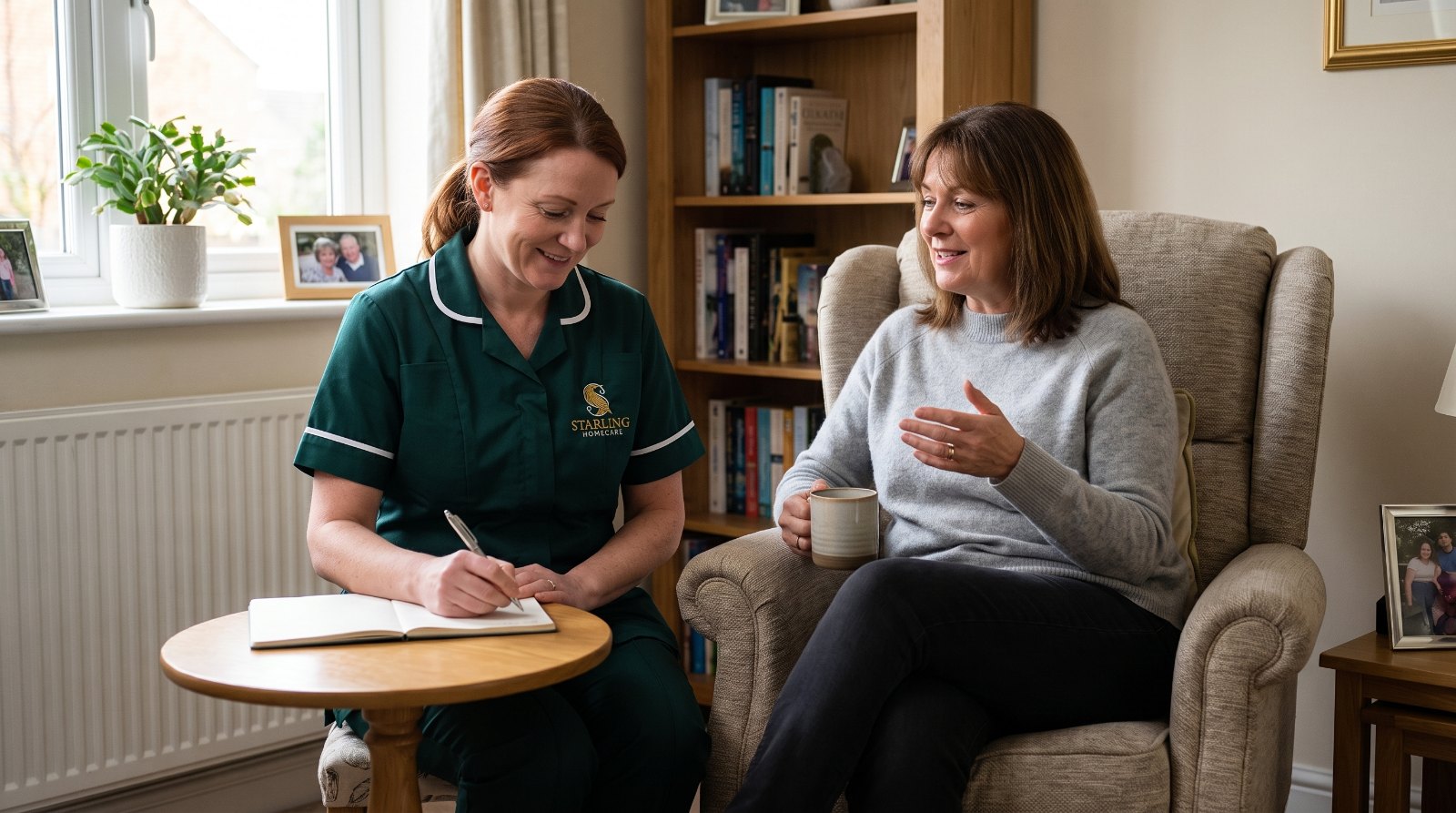
This article sets out what to do, what not to do, and what is worth writing down afterwards. At Starling Homecare we support families across St Albans and the wider county who are living with functional neurological disorder, and this is the question they ask us first.
This article is general information written to raise awareness of FND. It is not medical advice. FND affects everyone differently, and what helps one person can be wrong for another, which is why we build every care plan around the individual. Please talk to your own GP, neurologist or therapy team about your situation.
What is actually happening during a functional seizure?
An epileptic seizure is caused by sudden abnormal electrical activity in the brain. A functional seizure is not. It happens through a process called dissociation, which the CODES trial patient leaflet describes as a switching off in the brain that happens unconsciously.
People describe it as being cut off, zoned out, or there but not there. Some lose awareness completely. Others stay aware but cannot respond, which means they may hear you even when they cannot answer.
They are more common than most people realise. That same leaflet, written by the neurologists, neuropsychiatrists and psychologists behind the CODES trial, notes that around one in eight people newly referred to specialist epilepsy clinics turn out to have dissociative seizures.
What should you do while it is happening?
Four things, in this order.
Clear the space. Move anything hard, hot or sharp out of reach and put something soft under the head if you can do it without force. What is nearby usually causes any injury during a seizure, rather than the seizure itself.
Protect their dignity. If it happens in public and there is any warning, move them somewhere quieter and adjust clothing if needed. People with functional seizures often say the fear of being seen is worse than the seizure.
Stay close and stay calm. Your calm matters more than you would think. The CODES leaflet notes that if the people around are frightened, the person having the seizure may pick that up, and it can make the seizure worse.
Wait. Most functional seizures end on their own. Timing it is useful; hurrying it is not possible.
What should you not do?
Do not restrain them. Holding someone down during an attack can make it worse.
Do not talk to them through it. This is the counter-intuitive one. The advice from the clinicians is that it is best not to talk to the person during a seizure, because distress in the room can be absorbed even when the person cannot respond.
Do not put anything in their mouth. That is true of any seizure and it is never helpful.
Do not reach automatically for emergency epilepsy medication. This is the most important difference of all. The CODES leaflet is explicit that treatments given for epileptic seizures in an emergency can make dissociative seizures worse and can be dangerous.
When should you still call 999?
Use your judgement, not a rule. Call if the person has injured themselves badly, if you are genuinely unsure whether this is their usual pattern, if it is their first ever seizure and undiagnosed, or if anything about it frightens you in a way their normal seizures do not.
Epilepsy Action gives a clearer list for functional (dissociative) seizures. You do not usually need to call an ambulance. However, call 999 if it is someone's first seizure, if you do not know what type of seizure it is, if they are having repeated seizures, if the seizure continues for more than five minutes, if the person is unresponsive for more than ten minutes afterwards, or if they are injured or not breathing normally. Where the person's own clinician has given a plan for their usual pattern, follow that plan.
Knowing the usual pattern is what makes that judgement possible, and it is one of the strongest arguments for continuity in care at home. A carer who has seen the pattern before can tell the difference between a difficult seizure and a different one.
The reassurance in the clinical leaflet is worth holding on to. It states that the seizures are not life threatening, that people may bump and bruise themselves but there are no recorded cases of anyone coming to severe harm, and that it is not possible to stop breathing during one.
What is worth writing down afterwards?
More than you would expect, because the description is what gets the diagnosis and the treatment right.
The CODES leaflet notes that a specialist can usually diagnose the problem from a description, and that hearing an account from someone who has seen the seizures helps experts reach a correct diagnosis in at least eight out of ten cases. With a video, taken on a phone, that rises to about nine in ten.
So note the time it started and ended, what the person was doing beforehand, whether there was any warning, what the movements looked like, whether they responded to you, and how they were afterwards. If they are willing, and only with their agreement, a short phone video is genuinely valuable to their clinician.
Brain scans do not help with this diagnosis. What the person at home noticed does.
How does a Starling Homecare carer fit around functional seizures?
Quietly. The job is not to intervene during a seizure but to make the surroundings safe, keep the pattern recorded, and carry on with the ordinary business of the day around it.
Starling Homecare is a family-run homecare provider registered with the Care Quality Commission, and functional neurological disorder is one of the conditions we support people with at home. In practice that means a carer who knows this person’s usual seizure pattern, follows the plan they have agreed with their own clinician, and helps with the ordinary parts of the day that a bad spell interrupts.
That takes a small, consistent team rather than a rota of strangers, because knowing someone's usual pattern is the whole value. We build every plan around the individual, because what suits one person with FND can be wrong for the next. Our guide to supporting someone with FND at home covers the day-to-day side, and our FND care at home service explains how support is arranged.
If you are working out which NHS service covers you, our guide to FND support in Hertfordshire sets out the county split. Our St Albans team is on 01727 324 127 or at [email protected], and we support families across the city and the villages around it. You can also read about home care in St Albans on our area page.
Where we support people with FND across Hertfordshire
Starling Homecare supports people living with functional neurological disorder at home across the whole county, not only near our head office. The team you speak to is the one that covers your town.
Wherever you are in the county, you reach the team that actually covers your area:
- St Albans, 01727 324 127
- Harpenden, 01582 824 830
- Welwyn Hatfield, 01707 714 000
- Hemel Hempstead, 01442 954 137
- Berkhamsted, 01442 954 137
- Tring, 01442 954 137
- Hitchin, 01462 534739
- Hertford, 01920 746779
- Radlett and Shenley, 01923 988 550
Common Questions About What to Do in a Functional Seizure
Should you call an ambulance for a functional seizure?
Not automatically. The CODES trial patient leaflet notes that functional seizures are not life threatening and do not need emergency medical attention, and that emergency epilepsy treatments can make them worse. Epilepsy Action advises calling 999 if it is a first seizure, if you do not know what type it is, if seizures are repeating, if it continues for more than five minutes, if the person is unresponsive for more than ten minutes afterwards, or if they are injured or not breathing normally. Follow the plan the person's own clinician has given for their usual pattern.
Is a functional seizure the same as an epileptic seizure?
No. They can look very similar, but an epileptic seizure is caused by abnormal electrical activity in the brain and a functional seizure is not. Both are real and neither is put on. Some people have both, so anyone with a diagnosis should follow the plan their own clinician has given them.
Does Starling Homecare support someone who has a functional seizure at home?
Yes. Starling Homecare is a family-run, CQC-registered homecare provider, and we support people living with functional neurological disorder at home across St Albans, Harpenden, Welwyn Hatfield and the wider county, including people who have functional seizures. A carer does not intervene during a seizure. The role is to keep the surroundings safe, follow the plan the person has agreed with their own clinician, record what happened, and carry on with the day around it.
Why should you not talk to someone during a functional seizure?
Because they may take in more than they can respond to. The clinical guidance is that it is best not to talk to the person during a seizure, since fear in the room can be picked up and can make the seizure worse. Staying calm and nearby does more than reassurance spoken out loud.
How long does a functional seizure usually last?
It varies from person to person. Some episodes are over in a minute or two, and others go on for longer. Epilepsy Action advises calling 999 if a seizure continues for more than five minutes, or if the person is unresponsive for more than ten minutes afterwards, unless their own clinician has given a different plan for their usual pattern. Beyond that, what matters is whether the person is safe, whether they are recovering in their usual way, and whether anything is different from normal. If you are unsure, call 999.
Should you leave someone alone after a functional seizure?
No, not until they have fully recovered and can tell you how they feel. Afterwards, people are often exhausted, so a quiet space and rest help. If the person lives alone, it is worth agreeing in advance who they will contact after an episode. Our guide on whether someone with FND can live alone covers that.
What should a care plan say about a functional seizure?
It should record how episodes usually start, what they look like, roughly how long they tend to last for this person, what helps, what to avoid, when to call 999 and who to tell afterwards. At Starling Homecare, we agree that plan with you and, with your consent, your treating team before care starts. As a result, every carer responds in the same way. Our FND care at home page explains how that works.
Can you stop a functional seizure once it has started?
Not usually from the outside, and trying to force it to stop tends to make things worse. What helps is a calm, quiet room, fewer people around and no attempt to hold or restrain the person. Some people learn grounding techniques with their therapy team that help them earlier in an episode. However, that is part of treatment, which sits with the NHS rather than with care at home.
Where can you get help for a functional seizure in Hertfordshire?
Functional seizures are a form of FND, so the route is the same. Hertfordshire Community NHS Trust runs a specialist FND service from the Danesbury Neurological Centre in Welwyn for adults registered with a GP in East or North Hertfordshire, and referrals usually come through a GP or a neurologist. Our guide to FND support in Hertfordshire explains which service covers each area.
Knowing what to do takes the fear out of it
Most of the distress around functional seizures, for families as much as for the person, comes from not knowing what is supposed to happen. Clear the space, stay calm, wait, and write it down afterwards.
If you would like to talk through what support at home could look like, our St Albans team is on 01727 324 127.
Sources checked on 8 September 2026: the CODES trial patient leaflet on dissociative seizures (version 2.0, 2014), written by Dr Jon Stone, Professor Markus Reuber, Professor Laura Goldstein and colleagues, Epilepsy Action on functional (dissociative) seizures, and NHS inform on functional neurological disorder. This is general information, not medical advice.
Arranging Care Is Simple
Starting care can feel like a big step. We keep it calm and straightforward, and we are here to guide you from your very first call.
1. Talk to us
Get in touch by phone or request a callback. We will listen, answer your questions and help you understand the options, so you can decide what feels right in your own time.
2. A home visit and initial consultation
We arrange a visit to understand your routines, your home and what matters most to you. Together we agree an initial consultation and shape the support that feels right.
3. Your care begins
A small, familiar team starts your care, arriving at the agreed times and staying involved as your needs change. We remain your trusted adviser throughout.
Whenever you are ready, we are here to help.