
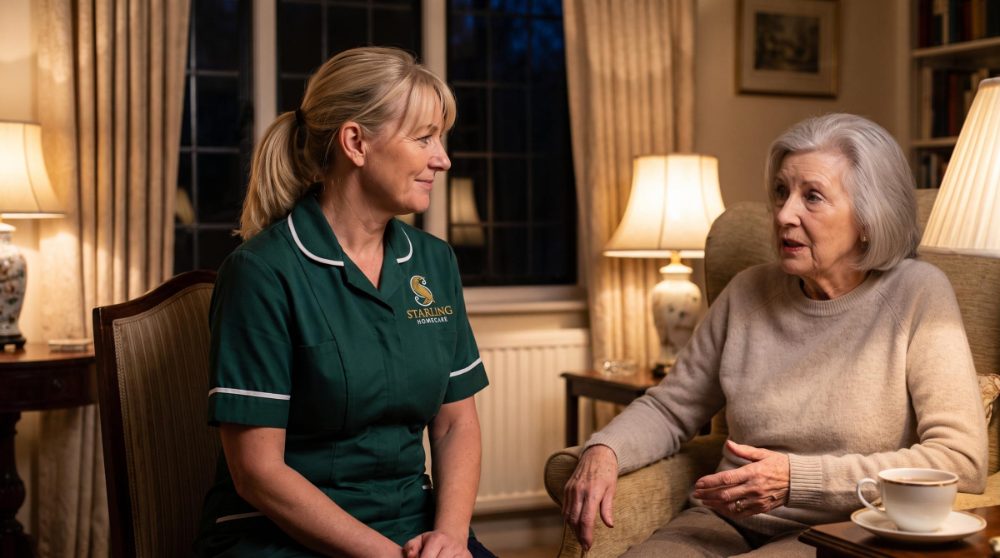
Overnight care in Harpenden usually begins in the evening, not at bedtime, because the hours before sleep decide how the night goes. A carer arrives while the house is still awake, helps settle the evening, stays through the night, and hands over what happened in the morning.
Most families come to this after a run of bad nights rather than after a single event. Someone is up three or four times, or is anxious as the light goes, and the person sleeping in the next room is running on very little rest themselves.
The question people ask us is rarely what a night carer costs. It is what the first night will actually be like, and whether having someone else in the house will make things worse before it makes them better.
That is a fair question, and the honest answer is that it depends almost entirely on how the evening is handled.
Why the evening decides the night
Distress in the late afternoon and early evening is common, and it often carries on into the night. The Alzheimer's Society describes this pattern as sundowning. A person becomes intensely distressed or agitated towards the end of the day, sometimes with hallucinations or delusions. That distress then makes it hard to sleep.
It is not necessarily linked to the sun setting, and it is not limited to the end of the day. It can happen at any stage of dementia, though it is more common in the middle and later stages.
What matters practically is that the causes are often ordinary. The Alzheimer's Society lists tiredness, hunger, pain or another unmet physical need. It also names too little daylight, an overstimulating environment, sensory impairment and low mood. Finally, it names the side effects of prescribed medicines.
Sometimes what looks like sundowning is simply the person trying to communicate something. Needing the toilet, being hungry, being in pain.
In our experience this is the single most useful thing a family learns. A difficult night is usually a signal, not a mystery, and the signal is often sent hours before bedtime.
What changes in the house before bed
The first evening of overnight care is quieter than families expect. A good night carer spends it watching how the house works rather than reorganising it.
A few small things tend to change, and they are the ones the Alzheimer's Society points to. Uneven indoor lighting and reflective surfaces can create shadows that unsettle someone. So curtains and blinds close once it starts to get dark. A television nobody is watching gets covered, or switched off properly.
The route from the bed to the bathroom is walked and cleared. A low light is left where it helps rather than where it dazzles. Background noise comes down.
None of this is dramatic. It is the difference between a night that is managed and a night that is survived.
What overnight care in Harpenden involves between the evening and the morning
There are two shapes of night cover, and they suit different situations. A sleeping night carer rests in the house and gets up when needed. A waking night carer stays awake throughout.
We have written about how to choose between them in our guide to overnight care in St Albans, and the same reasoning applies in Harpenden.
Either way, the work between the evening and the morning is much the same. Helping someone settle. Being there when they wake and are not sure where they are. Support to the bathroom safely. Repositioning if that is part of the care plan. Noticing pain, or a cough, or a change in breathing that has not been there before.
The point of a carer rather than an alarm is that a carer can respond to something before it becomes an incident. An alarm tells you after.
Meeting the carer before the first night
We do not send someone to a house at nine in the evening who has never been there.
Wherever it can be arranged, the carer who will be doing the nights visits during the day first, while everyone is rested and the house is bright. They meet the person and see the layout. They also learn the ordinary details that matter at two in the morning. Which side of the bed. Which words help. Whether the landing light stays on.
For a family in Harpenden or Batford, that first daytime visit is usually the point at which the whole idea stops feeling like an intrusion. It is much easier to accept help from someone you have already had a cup of tea with.
Starling Homecare is regulated by the Care Quality Commission, and the same care plan, the same records and the same standards apply at night as during the day. Nights are not a lesser service delivered by whoever is available.
What the morning handover tells you
The most underrated part of overnight care is the written record left behind in the morning.
After a week of nights you have something you have never had before, which is a pattern. What time the waking happens. Whether it follows a late nap, a missed meal, or a change of medicine. Whether it is happening every night or only on some.
That record is worth taking to the GP. It turns "he has been unsettled" into something a clinician can work with, and it is often what leads to a medicines review or a referral that actually changes things.
It also tells you honestly whether the level of cover is right. Some families find after a fortnight that they need fewer nights than they thought. Others find the opposite. Both are useful to know.
If you would like to talk this through, our Harpenden team is on 01582 824 830 or at [email protected]. You can also read how we work across the town on our Harpenden home care page.
Common Questions About Overnight Care in Harpenden
Can we try overnight care for a short period rather than committing to it?
Yes. Many families start with a few nights a week, often after a hospital stay. They then review it after a fortnight. A short trial answers the question better than any amount of discussion. It shows what the nights are actually like, rather than what everyone fears.
Will having a carer in the house make the confusion worse?
It can unsettle someone in the first night or two. That is why the daytime introduction matters so much. In our experience, familiarity is what settles it. So we keep the same small group of carers on the nights, rather than rotating people through. Consistency at night matters more than it does during the day.
What is the difference between overnight care and live-in care?
Overnight care covers the night only, usually from the evening to the morning. The family or daytime carers cover the rest. Live-in care means a carer lives in the home and supports the person across the whole day and night. Families often move from one to the other as needs change, and it is worth reviewing which fits every few months.
Arranging Care Is Simple
Starting care can feel like a big step. We keep it calm and straightforward, and we are here to guide you from your very first call.
1. Talk to us
Get in touch by phone or request a callback. We will listen, answer your questions and help you understand the options, so you can decide what feels right in your own time.
2. A home visit and initial consultation
We arrange a visit to understand your routines, your home and what matters most to you. Together we agree an initial consultation and shape the support that feels right.
3. Your care begins
A small, familiar team starts your care, arriving at the agreed times and staying involved as your needs change. We remain your trusted adviser throughout.
Whenever you are ready, we are here to help.