
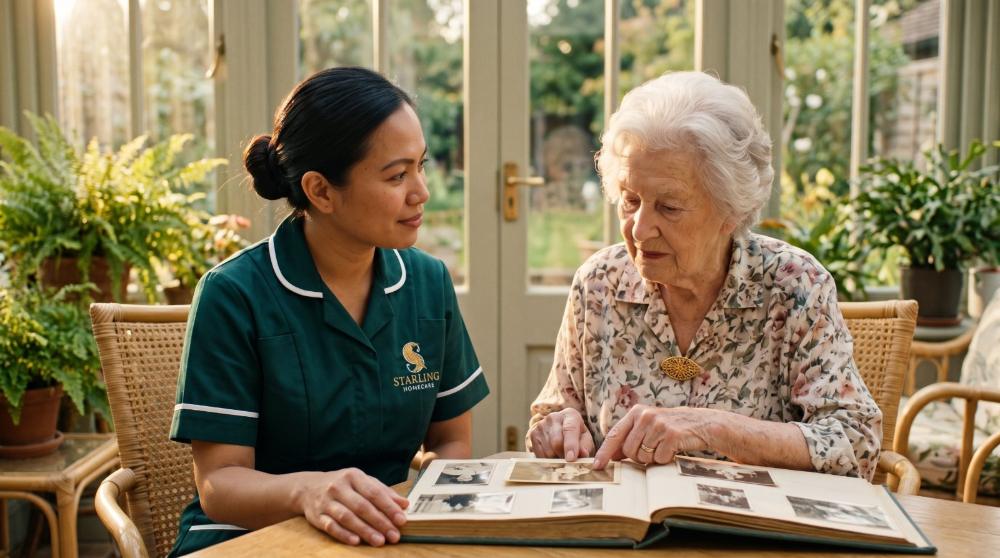
Dementia care at home in Hatfield means keeping someone's days recognisable: the same rooms, the same routine, the same small landmarks, with a trained carer quietly holding the parts that have become difficult. Familiarity is not sentiment here. It is one of the few things that reliably reduces confusion.
Most families reach this point already past the diagnosis. The question is no longer what is happening, it is how to run an ordinary week now that the ordinary week has stopped running itself.
What dementia care at home in Hatfield looks like on an ordinary Tuesday
Less dramatic than people expect, and more structured.
A carer arrives at the same time, uses the same greeting, and works through the morning in the same order: curtains, tea, washing, dressing, breakfast, medicines. The order is the point. Repetition does the work that explanation cannot, because a routine can be remembered by the body long after the reasoning behind it has gone.
Through the day the job is mostly to reduce the number of decisions someone has to make. Two shirts offered rather than a full wardrobe. A meal put in front of them rather than a question about what they fancy. Prompting rather than instructing, and never a quiz about whether they remember something.
Around that sits the practical care: help with washing and dressing, medication support with a written record each visit, meals and fluids, and someone noticing the small changes. A person with dementia often cannot report that they feel unwell, so noticing is a large part of what you are paying for.
The parts of the day that come apart first
In our experience, in roughly this order.
Medicines. Usually the first thing to slip, and the one with the sharpest consequences. Doses missed, doses doubled, boxes moved somewhere sensible and then lost.
Eating. Not because appetite goes, but because cooking is a long sequence of steps and sequences are exactly what dementia disrupts. Full cupboards and a person losing weight is a common and misleading picture.
Washing and dressing. Often resisted, and rarely about the washing. It is usually about dignity, or cold, or not recognising the need. A carer who knows the person can generally find a way round it that a stranger, or an exhausted relative, cannot.
The late afternoon. Many people become more unsettled as the light goes. Planning support around that hour, rather than treating it as a surprise every day, changes how the evening goes.
Why continuity matters more in dementia than anywhere else
With most home care, a changing rota is an inconvenience. With dementia it is a clinical problem.
A new face each visit means the reassurance has to be rebuilt from nothing each time, and someone who cannot place who you are will reasonably treat you as a stranger in their house. Refusal, distress and what gets written down as challenging behaviour are frequently just a rational response to an unfamiliar person arriving at the door.
It also means nobody accumulates the knowledge that makes the care work: that she takes her tea in the green cup, that he settles when the radio is on, that Thursdays are harder. This is the single most useful question to ask any provider in Hatfield or Welwyn Garden City. Not how many carers do you have, but how many different carers will my mother see in a month.
Local support in Hatfield and Welwyn Garden City
Paid care is one part of it, and the rest is worth knowing about because it is free or close to it.
Hertswise offers community dementia support across Hertfordshire for people living with dementia, memory loss or mild cognitive impairment, together with their carers and loved ones. It runs information and advice from specialist advisers, group and one-to-one support, and carers support groups. The referral system is open, so you can refer yourself or a relative without going through a professional. There is a five pound contribution for each session at a Hertswise Dementia Hub, and carers attend at no cost.
Welwyn Hatfield Borough Council also maintains an online health and wellbeing directory for the borough with a section for older people, which is a practical place to see what is running locally.
For the care side itself, Hertfordshire County Council will carry out a needs assessment. It is free, everyone has the right to one, and it commits you to nothing. HertsHelp, the county's free advice service, is on 0300 123 4044 if you would rather talk it through with someone independent before deciding anything.
When home stops being the safer place
Home is right for longer than most families assume, and it is not right forever. Being clear about the point of change is part of doing this honestly.
Visiting care works while the difficulties sit inside the visits. It stops being enough when the nights become unsafe, when someone is leaving the house without knowing where they are going, or when they are distressed for long stretches while alone. At that point the choice is between live-in care, which keeps the surroundings familiar while adding a person who is always there, and a residential setting.
Neither is a failure. Both are decisions taken in the person's interest, and knowing in advance what would trigger the conversation makes it far less frightening when it arrives.
Questions families in Hatfield and Welwyn Garden City ask
Is staying at home actually better for dementia?
Usually, in the earlier and middle stages, because familiar surroundings carry a lot of the memory load. A person who can find their own bathroom in the dark is safer in that house than in a better-equipped building they do not recognise. This changes as the illness progresses, and it changes at different points for different people.
What if my father refuses to let a carer in?
Common, and usually solvable with patience rather than persuasion. Introducing the carer as help with a specific task, keeping the first visits short, and having a familiar family member present at the start all help. What does not work is arguing about whether help is needed.
Can carers give medication for dementia?
Trained carers can support and administer prescribed medicines and record every dose, working to the care plan and to the GP's instructions. Anything clinical beyond that sits with the district nursing team or the GP, and a good carer is quick to escalate rather than improvise.
How do we get support for ourselves as the family?
Ask for a carer's assessment from the county council, which is separate from the assessment of the person with dementia and is your own right. Alongside it, the Hertswise carers support groups exist precisely for this, and respite care can give you a genuine break rather than a nominal one. Looking after yourself is not a distraction from looking after them.
Where to start
If you are arranging this for someone in Hatfield, Welwyn Garden City, Welwyn or Brookmans Park, the first step is usually working out which parts of the day have stopped working, rather than deciding on a level of care. It often helps to talk it through with someone who arranges dementia care every day and can tell you what is normal at this stage.
You can read more on our dementia and Alzheimer's care page, our county guide to arranging dementia care at home, or about how we work locally on our Welwyn Hatfield home care page.
Arranging Care Is Simple
Starting care can feel like a big step. We keep it calm and straightforward, and we are here to guide you from your very first call.
1. Talk to us
Get in touch by phone or request a callback. We will listen, answer your questions and help you understand the options, so you can decide what feels right in your own time.
2. A home visit and initial consultation
We arrange a visit to understand your routines, your home and what matters most to you. Together we agree an initial consultation and shape the support that feels right.
3. Your care begins
A small, familiar team starts your care, arriving at the agreed times and staying involved as your needs change. We remain your trusted adviser throughout.
Whenever you are ready, we are here to help.