
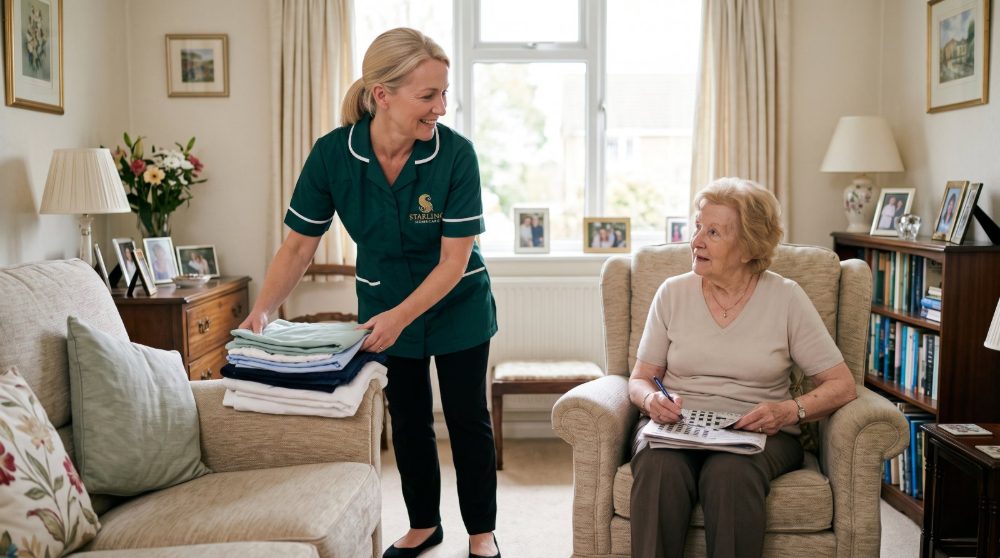
Domiciliary care means care delivered in a person's own home, and it is the official name for what most families simply call home care. If you are arranging domiciliary care in Hertfordshire, you are simply arranging home care by another name: planned visits from a trained carer to help with washing, dressing, meals, medication and the running of the house.
The term tends to appear at busy, worried moments. A discharge coordinator mentions a package of domiciliary care, or the council's paperwork asks about dom care, and a family is left translating jargon at the kitchen table.
We arrange this kind of care every day across Hertfordshire, so this guide does the translating. It sets out what the term covers, who regulates the service, and the practical steps to put support in place.
What does domiciliary care actually mean?
Domiciliary comes from the Latin word for home. In social care it describes services providing personal care for people living in their own homes, which is the definition the Department of Health and Social Care uses in its official statistics.
It is also thoroughly mainstream. In the week ending 14 May 2026, there were 499,364 people receiving CQC-regulated domiciliary care among the providers reporting to the Department of Health and Social Care. That is close to half a million households in England supported at home.
In practice, the care itself arrives as visits. A carer comes at agreed times, from one visit a week to several a day, and works through the support that has been planned with you.
Is domiciliary care the same as home care?
Yes. Domiciliary care, home care, care at home and visiting care all describe the same regulated service. The difference is who is speaking, not what is provided.
Professionals lean on the formal term. For instance, hospital discharge teams talk about domiciliary packages, and the Care Quality Commission registers providers to deliver personal care in people's homes. Families, understandably, just say home care.
Live-in care is the closely related exception, where a carer stays in the home rather than visiting. Our step-by-step guide to arranging home care in Hertfordshire walks through how the visiting model is set up.
What does a domiciliary carer help with?
Most visits are built around personal care: washing, bathing, dressing, continence support and moving safely around the house. Our personal care at home page explains how we approach this side of the work, with dignity front and centre.
Around that core, a domiciliary carer can prompt or assist with medication, prepare meals, help with shopping and laundry, and keep an eye on how someone is managing overall. Company is part of the job too, and often the part people come to value most.
Every arrangement is shaped to the person. One client wants twenty minutes each morning to start the day safely. Another has three longer visits a day and a carer who cooks lunch from scratch.
Who regulates domiciliary care in Hertfordshire?
Providers of personal care at home must register with the Care Quality Commission, the regulator for health and social care in England. Registration brings inspection, published ratings and enforceable standards on safety, staffing and leadership.
Starling Homecare is an independent, family-run provider regulated by the CQC. We would encourage any Hertfordshire family to check a provider's registration before care begins, including ours. It is one of the clearest signals that what happens behind a front door is properly accountable.
Regulation is also what separates a registered provider from informally arranged help, where no inspector ever calls.
How do you arrange domiciliary care in Hertfordshire?
There are two routes, and they can run in parallel. You can approach Hertfordshire County Council for a care needs assessment, which may lead to funded or part-funded support. Or you can contact a regulated provider directly, which is usually quicker and is how most of our clients begin.
Arranging it directly starts with a conversation and a home visit, so the care plan reflects real routines rather than a form. Visiting care with Starling starts from £34 an hour and is VAT exempt.
Our care funding guide explains costs and thresholds plainly, including when the council contributes and what happens if you fund your own care. We support families across St Albans, Harpenden, Hemel Hempstead, Hitchin, Hertford and the surrounding towns.
Common Questions About Domiciliary Care in Hertfordshire
How much does domiciliary care cost in Hertfordshire?
Visiting domiciliary care with Starling Homecare starts from £34 an hour, and homecare is VAT exempt. The overall cost depends on how many visits a week you need and how long each one lasts. A council needs assessment can establish whether you qualify for funded support.
How many visits a week can domiciliary care provide?
As few or as many as the situation needs. Some people have a single weekly visit for housekeeping and company, while others have four calls a day. If needs grow beyond visiting care, overnight and live-in options continue the same support at home.
Do I need a council assessment before arranging domiciliary care?
No. You can arrange care directly with a regulated provider at any time, and many families do. An assessment from Hertfordshire County Council is worthwhile if you may qualify for funding, and it can run alongside care that has already started.
In short, whatever word the paperwork uses, the service underneath it is simple: dependable help, at home, from people who take the responsibility seriously. If you are weighing up domiciliary care for someone in Hertfordshire, our St Albans team will talk it through in plain English on 01727 324 127 or at [email protected].
Arranging Care Is Simple
Starting care can feel like a big step. We keep it calm and straightforward, and we are here to guide you from your very first call.
1. Talk to us
Get in touch by phone or request a callback. We will listen, answer your questions and help you understand the options, so you can decide what feels right in your own time.
2. A home visit and initial consultation
We arrange a visit to understand your routines, your home and what matters most to you. Together we agree an initial consultation and shape the support that feels right.
3. Your care begins
A small, familiar team starts your care, arriving at the agreed times and staying involved as your needs change. We remain your trusted adviser throughout.
Whenever you are ready, we are here to help.