
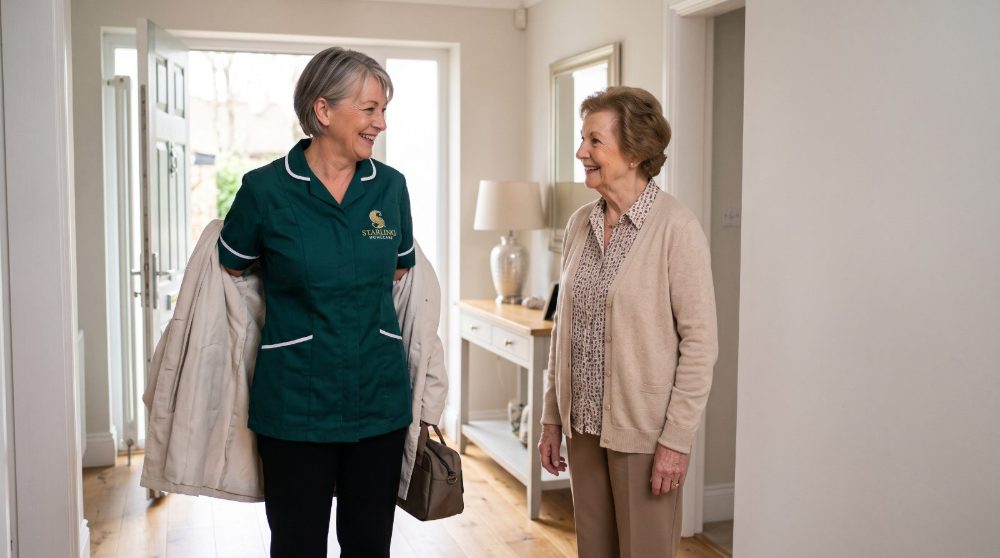
Private respite care at home is short-term care that you arrange and pay for yourself. It lets a family carer take a break while a paid carer looks after their relative at home. You can book it ahead for a planned break, or set it up at short notice when life throws something unexpected at you.
Caring for someone you love is steady, often unseen work. Many carers keep going until they have nothing left, partly because they cannot picture how a break would actually work.
This guide covers the mechanics. It explains how you set up private respite care at home, how we arrange cover, and what privately funded support looks like day to day.
In our experience, families find the idea far less daunting once they can see the steps. Respite is not all or nothing, and it does not mean handing over control.
What does private respite care at home mean?
Private respite care at home means you arrange the cover directly with a provider and pay for it yourself, rather than going through the council. Your relative stays in their own home, keeps their own routine, and their usual carer steps back for a while.
The word private simply describes the funding. Councils also offer respite, usually after a carer's assessment from the local authority, which can take time to set up.
If you are still weighing whether you need a break at all, rather than how to arrange one, our guide to respite care at home for family carers covers that side of the decision.
Arranging respite privately gives you more say. You choose the timing, the type of support and, where we can, the carer. For many families, that flexibility is the main reason they choose it. You can read more about our respite care at home and how we shape it around each household.
Planned or emergency: the two ways respite usually starts
Most respite begins in one of two ways. The first is planned. You book it in advance for a holiday, a hospital stay, a family event, or a regular weekly break that protects your own health.
The second comes at short notice, when a carer suddenly cannot continue. That might follow their own illness, a hospital admission or a bereavement.
Planning ahead gives you the most choice over timing and continuity. Life does not always allow it, though, and we can often arrange short-notice cover when carers are free.
How private respite care at home is booked
It starts with a simple conversation about what you need. We talk through who the care is for, what their day looks like, and when you need the break. You commit to nothing at this stage.
Next, we visit the home and agree a short care plan. The plan records the person's routine, their preferences, any medication, and the small details that make a day go smoothly.
We then match a carer to the household and confirm the times. Privately funded respite does not wait on a council carer's assessment, so it can move at your pace.
How we arrange cover so care stays consistent
Good respite should feel like a continuation of the care already in place, not a stranger starting again. We keep the same carer where we can, so your relative sees a familiar face.
Where more than one carer helps, a written handover and clear notes carry the routine across. The carer follows the care plan and your instructions, not a generic script.
As a CQC-registered, family-run provider, we treat continuity as part of the standard. The aim is simple. You come home to someone who is calm and well.
Visiting, overnight or live-in respite
Respite care at home is not one fixed thing. It can be short visiting calls through the day, overnight support so the carer sleeps, or full live-in care for a longer holiday.
Visiting respite suits households that need help at set times, such as mornings, mealtimes and bedtime. Overnight respite helps when nights bring broken sleep or feel unsafe to manage alone.
Live-in respite places a carer in the home around the clock for a set period. It works well for a week or two away. The right format depends on the person's needs and the length of the break.
What privately funded respite care costs
You pay for privately funded respite directly. We set out the cost in a written quote before anything begins. There are no hidden fees, and the quoted rate is the rate you pay.
Visiting care starts from £34 for a 30-minute visit. Live-in care starts from £255 a day, plus a weekly food allowance. Regulated home care is also VAT exempt, which keeps the cost clearer than many families expect.
If you are weighing up how to pay, our guide to how home care is funded in Hertfordshire sets out the options, including where council or NHS support may apply.
Common Questions About Private Respite Care at Home
How quickly can you arrange private respite care at home?
It depends on what you need and when. A planned break gives the most certainty and the best continuity of carer. When you need respite at short notice, we can often put cover in place quickly, subject to carer availability, after a brief conversation and a home visit.
How long can respite care at home last?
Respite is flexible. It can be a few hours that give a carer regular time to themselves. Some families use a few nights of overnight support. Others arrange a continuous spell of live-in care for a holiday of a week or two. There is no fixed minimum stay, and you can repeat the arrangement whenever it helps.
Is private respite care different from council-funded respite?
Yes, mainly in how you arrange and pay for it. Council-funded respite usually follows a carer's assessment and may involve a wait. You arrange private respite directly with the provider, which gives you more control over the timing, the type of support and the carer.
Taking a planned break, or knowing where to turn when you suddenly need one, is one of the most practical things a family carer can do. Understanding how respite works makes that decision far easier when the time comes.
To see how this looks in one of our local areas, read our guide to respite care in Harpenden, which covers the same support close to home.
If you would like to talk through respite care at home anywhere in Hertfordshire, our team is on 01727 324 127 or [email protected]. We are happy to explain the options and answer your questions.
Arranging Care Is Simple
Starting care can feel like a big step. We keep it calm and straightforward, and we are here to guide you from your very first call.
1. Talk to us
Get in touch by phone or request a callback. We will listen, answer your questions and help you understand the options, so you can decide what feels right in your own time.
2. A home visit and initial consultation
We arrange a visit to understand your routines, your home and what matters most to you. Together we agree an initial consultation and shape the support that feels right.
3. Your care begins
A small, familiar team starts your care, arriving at the agreed times and staying involved as your needs change. We remain your trusted adviser throughout.
Whenever you are ready, we are here to help.