
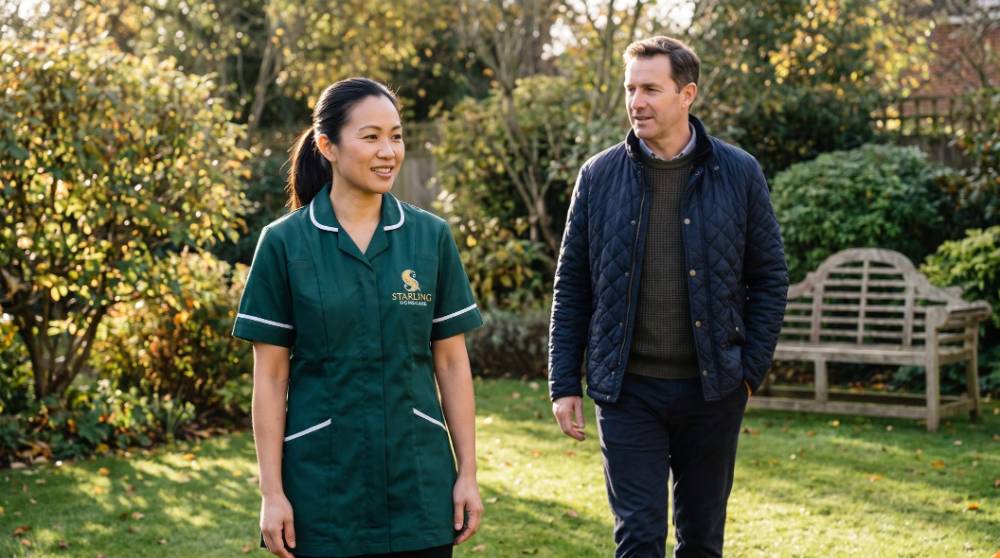
A brain injury case manager coordinates everything after a serious injury: the medical appointments, the therapy, the equipment, the housing and the long-term care. For most families, the case manager arrives with the personal injury claim. From that point, the case manager arranges the care at home rather than the family.
If you are a case manager, deputy or solicitor arranging care in Hertfordshire, our page for case managers, deputies and solicitors sets out what we are registered for, how we report, and how to make a referral.
That is a good thing, and it is also a change. This article explains what a case manager does and where the rehabilitation plan comes from. It then sets out what a care provider delivers under that plan, and what the care worker actually does day to day. We wrote it for families, and for case managers and deputies looking for a Hertfordshire provider who understands the arrangement.
Starling Homecare is a family-run provider registered with the Care Quality Commission. We take referrals from case managers, professional deputies and attorneys, work to their care plan, and can recruit and supervise a dedicated team around one client.
This article is general information. It is not medical or legal advice. Every brain injury is different, and the treating team and the case manager lead on the plan.
What does a brain injury case manager actually do?
The Brain Injury Group, a network of specialist solicitors and providers, describes case management as assigning a dedicated professional to coordinate all aspects of a client's care, rehabilitation and community reintegration. In other words, the case manager is the central point of contact. They make sure that medical appointments, therapy sessions, equipment needs and long-term care planning happen in the right order.
In practice, the case manager writes or holds the care plan and sets the goals with the therapy team. They decide how many hours of care the person needs and when, they recruit or commission the provider, and they review progress. The family stays at the centre. However, the coordination moves to someone whose job it is.
Where does the rehabilitation plan come from?
NICE's guideline on rehabilitation after traumatic injury says that people should leave hospital with a rehabilitation plan. It may take the form of a rehabilitation prescription or a patient-held rehabilitation passport, with a named rehabilitation coordinator as the lead contact. The guideline also says the rehabilitation team should consider ongoing contact with the person and their family after discharge, with education and a structured review of progress.
The case manager's plan grows out of that document. So when the case manager commissions a care provider, the plan is the brief. A good provider asks for it before the first visit and builds the care plan to match, rather than starting from a blank template.
Who else is usually involved?
Where the person cannot manage their own finances, the Court of Protection may appoint a professional deputy, often a solicitor, to manage the settlement and pay for care. Where the person made a lasting power of attorney before the injury, an attorney may hold that role instead. Our guide to arranging care with power of attorney explains what an attorney or deputy can and cannot decide.
Meanwhile, the NHS community neuro rehabilitation team stays involved for therapy, and Headway Hertfordshire offers peer groups and carers' support alongside. Our guide to brain injury support in Hertfordshire sets out which NHS team covers each side of the county.
What does a care provider deliver under a brain injury case manager's plan?
Consistency first. A brain injury case manager usually wants a small, stable team around one client. The reason is simple: the person's routine, prompts and triggers take time to learn, and a rota of strangers undoes that learning. Therefore, we recruit and supervise a dedicated team where the package needs it, and we keep the same faces where it does not.
Then the record. Case managers and deputies need a daily record they can rely on. It should say what the carer did, what changed, what the person managed themselves, and anything that needs escalating. We keep that record, share it with consent, and join reviews when invited.
Then the boundary. Our registration covers personal care. We do not carry out clinical or nursing tasks such as ventilation, tracheostomy or PEG feeding, and we say so at the outset so the case manager can commission those separately. Similarly, where someone's needs are primarily behavioural or psychological, we say that honestly too.
What does the care worker actually do day to day?
Less doing and more prompting than people expect. Headway describes the executive difficulties that follow injury to the front of the brain. They include problems with motivation and getting started, organisation, flexible thinking, problem solving and planning. Its practical advice is the basis of a good care plan. For example, use alarms and written prompts to begin an activity, keep a list of things to do, and keep regularly used items in one place. Plan back-up options in advance, divide activities into manageable chunks, and build weekly routines for regular tasks.
For memory, Headway's point is that it is not that the person will not remember but that they cannot. So the plan relies on external aids: a diary or memory book, calendars and to-do lists, alarms and voice recorders. It also means learning things correctly the first time rather than by trial and error. The carer's job is to keep those aids in use, not to become the memory.
For fatigue, which Headway defines as an extreme tiredness that sleep and rest do not relieve, the carer works to a paced week. Demanding tasks come early, rest is planned, early signs get noticed, and the targets for the day stay realistic. For behaviour and mood, where irritability, impulsiveness and low mood are common, the carer works calmly and consistently to the agreed plan. Above all, the carer records what happened rather than improvising.
How is the care funded?
Where there is a claim, the settlement or an interim payment usually funds the care while the claim runs, and the case manager or deputy authorises the hours. Where the person also has ongoing health needs, the case manager may pursue NHS Continuing Healthcare. The NHS arranges and funds that in full, and it can be provided at home. Our guide to NHS Continuing Healthcare explains the checklist and assessment. In addition, Headway runs an Emergency Fund of one-off small grants for practical needs, and applications go through its helpline on 0115 924 0800.
What should a brain injury case manager expect from Starling Homecare?
A provider that reads the plan before the first visit. A small team that stays. Proper records, respect for the clinical boundary, and hours that flex up and down as the plan changes, without fixed-term contracts. We arrange visiting brain injury care at home in St Albans, Harpenden, Welwyn Hatfield and Hemel Hempstead, and live-in care across the whole of Hertfordshire. That ranges from longer daytime blocks to overnight and full live-in support. Likewise, our guide to coming home after a brain injury covers the first weeks.
Where we take brain injury case manager referrals across Hertfordshire
Starling Homecare accepts case manager referrals across the whole county, not only near our head office. Each town has its own team and its own number.
Wherever you are in the county, you reach the team that actually covers your area:
- St Albans, 01727 324 127
- Harpenden, 01582 824 830
- Welwyn Hatfield, 01707 714 000
- Hemel Hempstead, 01442 954 137
- Berkhamsted, 01442 954 137
- Tring, 01442 954 137
- Hitchin, 01462 534739
- Hertford, 01920 746779
- Radlett and Shenley, 01923 988 550
Common Questions About Working With a Brain Injury Case Manager
Do you take referrals from a brain injury case manager?
Yes. We take referrals from case managers, professional deputies and attorneys. Under their care plan, we keep the daily record they need and can recruit and supervise a dedicated team around one client. Our visiting care covers St Albans, Harpenden, Welwyn Hatfield and Hemel Hempstead for visiting care, and the whole of Hertfordshire for live-in care.
Can a brain injury case manager change the hours of care?
Yes, within the agreed plan. Hours step up during a difficult period and back as recovery progresses, and there are no fixed-term contracts. In practice, packages range from a few hours a day to longer blocks, overnight support or full live-in care.
What can a home care provider not do under a brain injury case manager's plan?
Clinical and nursing tasks. Our registration covers personal care, so ventilation, tracheostomy care and PEG feeding sit with a nursing provider, and we say so at the outset. Treatment and therapy stay with the NHS and the case manager's therapy team. We support that work rather than provide it.
Does the family still have a say when a brain injury case manager is involved?
Yes. The case manager coordinates, but the person and their family remain at the centre of the plan. NICE guidance expects rehabilitation teams to keep involving family members and carers after discharge. A good provider talks to the family every visit and to the case manager at every review.
The arrangement works when everyone reads the same plan
A case manager brings order to something that would otherwise fall on the family. The provider's job is to make that order real on a Tuesday afternoon: the right person, at the right time, doing the right things, and writing it down. If you are a case manager, deputy or family looking for that in Hertfordshire, our St Albans office is on 01727 324 127.
Sources checked on 8 September 2026: Brain Injury Group on case management, NICE NG211, Headway on executive dysfunction, memory, fatigue and behaviour, the Headway Emergency Fund, and NHS Continuing Healthcare. This is general information, not medical or legal advice.
Arranging Care Is Simple
Starting care can feel like a big step. We keep it calm and straightforward, and we are here to guide you from your very first call.
1. Talk to us
Get in touch by phone or request a callback. We will listen, answer your questions and help you understand the options, so you can decide what feels right in your own time.
2. A home visit and initial consultation
We arrange a visit to understand your routines, your home and what matters most to you. Together we agree an initial consultation and shape the support that feels right.
3. Your care begins
A small, familiar team starts your care, arriving at the agreed times and staying involved as your needs change. We remain your trusted adviser throughout.
Whenever you are ready, we are here to help.