
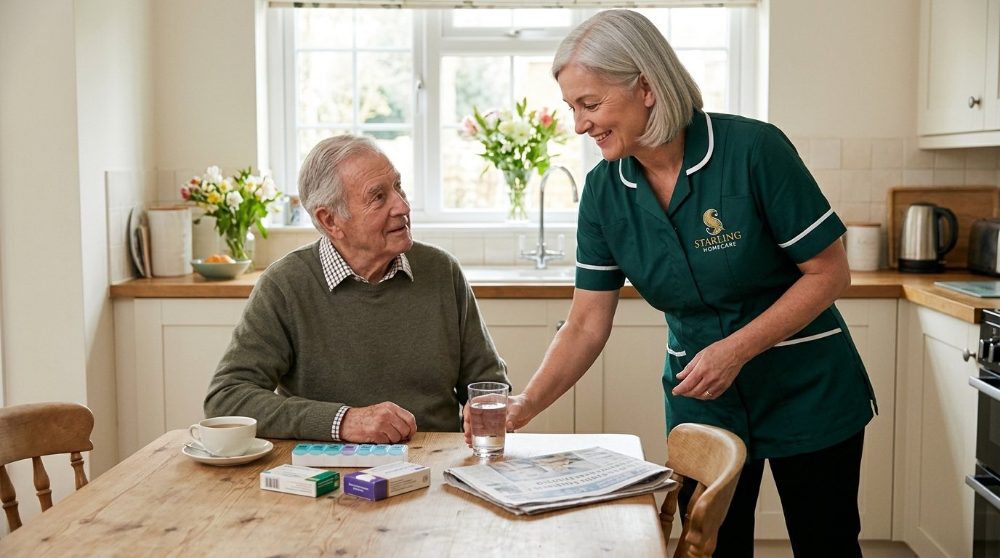
Parkinson's help at home is worth arranging when everyday tasks start taking much longer, when medication times are getting hard to keep, or when you are covering more than you can. Parkinson's UK suggests arranging care visits around dosing times. Support can start small, with a visit or two a week, and grow as needs change.
To talk anything through with someone local, our Tring team is on 01442 954 137.
Parkinson's tends to change things slowly, which can make it hard to know when to act. You might notice your mum taking longer to get dressed, or a missed tablet she brushes off. You may feel torn between respecting how much she still does and worrying about the days that are harder. If you work, or live some distance away, it can feel as though you are always one step behind.
Deciding when to bring in help with Parkinson's is something our team knows well, and it rarely has to be a big leap.
When is it time to get Parkinson's help at home?
Usually when the day starts to depend on someone being there at certain times. The NHS overview of Parkinson's disease explains that as the condition progresses, symptoms can get worse and daily tasks can become harder without help. Parkinson's UK says that even when someone lives with a partner or relative who cares for them, they can still need help with day-to-day tasks such as getting up, going to bed or bathing.
Signs that support could help:
- Washing and dressing take much longer, or leave her exhausted.
- Medication doses are late, missed or worrying her.
- Meals are becoming harder to prepare.
- You, or her partner, are covering more than feels sustainable.
- She is going out less than she would like.
Why does medication timing matter so much?
Parkinson's UK's guidance on taking medication on time explains that most Parkinson's drug treatments work by topping up dopamine in the brain, and that if medication is forgotten, symptoms may increase. Its practical ideas include:
- Setting an alarm on a phone or smart watch.
- A family member calling at the right time.
- Arranging care visits around dosing times.
- Using a pill box with sections for each day and time.
- Talking to a Parkinson's nurse if remembering doses is difficult.
Any question about the medicines themselves belongs with her GP, pharmacist or Parkinson's nurse.
What else can help before care starts?
An occupational therapist can make a real difference. Parkinson's UK says occupational therapists help with everyday tasks, advise on equipment and falls prevention, and suggest timing tasks for when energy is highest. You can usually reach one through the GP or the council's social services.
Parkinson's UK also says a needs assessment from the council is free and usually takes place at home, and that a family carer can ask for their own assessment.
How do you raise it with your mum?
Many people with Parkinson's are proud of how much they still manage. Focusing on energy and timing, rather than risk, often helps. You could try:
- "What if someone came at your morning tablet time, so the rest of the day's easier?"
- "You'd have more energy for the garden if someone helped with the shower."
- "Shall we have someone round for a chat first? You can decide after that."
When a parent is unsure, it can start with someone from Starling simply coming round for a chat. It does not have to be formal. It is a conversation to get to know her and find out what matters to her.
Who can help in Hertfordshire?
- Her GP or Parkinson's nurse, about symptoms, medicines and a referral to an occupational therapist.
- Parkinson's UK helpline on 0808 800 0303, free, Monday to Friday 9am to 6pm and Saturday 10am to 1pm. Its advisers include specialist Parkinson's nurses.
- HertsHelp on 0300 123 4044, Hertfordshire County Council's free advice service, for needs and carer's assessments.
How Starling Homecare can help
We are often called by sons and daughters, by husbands and wives, and by people arranging care for themselves. On the first call, our priority is to understand what is happening and what a typical day looks like for your mum. Usually the next step is an informal chat at her home. From there we propose a care plan, with your involvement and hers, so she can live independently on her own terms.
In Tring we arrange live-in care. In St Albans, Harpenden, Hemel Hempstead, Welwyn Hatfield, Potters Bar and Cheshunt our visiting care runs from 30 minute visits between 7am and 10pm, and our Parkinson's care can include:
- Medication prompting and support at the exact agreed times, with every dose recorded.
- Personal care with extra time built in.
- Steady, falls-aware support moving around the home.
- Meals suited to changing appetite and swallowing.
- Companionship, encouragement to stay active, and respite for a family carer.
- Overnight or live-in care later, if it is ever needed.
A small, familiar team gets to know your mum's good and harder days. With her agreement, we liaise with her GP, Parkinson's nurse and pharmacist and flag changes we notice. Carers do not give injections or carry out clinical tasks. Every family receives a written quote, and there are no long-term or fixed-term contracts. Our article on why timing matters in Parkinson's care at home goes deeper into planning visits.
Areas we cover
Starling Homecare's carers visit people at home in St Albans, Harpenden, Hemel Hempstead, Welwyn Garden City and Hatfield, Potters Bar and Cheshunt, and the villages around them. Elsewhere in Hertfordshire, including Berkhamsted, Tring, Radlett and Shenley, Hitchin and Hertford, we arrange live-in care.
If you are still working out what your mum needs, start with our guide for families worried about an elderly parent. Locally, here is how we arrange live-in care in Tring.
Frequently asked questions
When does someone with Parkinson's need help at home?
There is no fixed point. The NHS says that as Parkinson's progresses, daily tasks can become harder without help, and Parkinson's UK says extra support is likely in the advanced stages. Many families start earlier, when washing, dressing or keeping to medication times becomes difficult, with a visit or two a week.
Can a carer help Mum take her Parkinson's medication on time?
Yes. Parkinson's UK suggests arranging care visits around dosing times. Starling Homecare's carers prompt and support medication at the exact times agreed in the care plan and record every dose. They do not change medicines or doses; questions about medication go to the GP, pharmacist or Parkinson's nurse.
Can we get Parkinson's support at home in Tring?
Yes. Our Tring team, on 01442 954 137, arranges live-in care across Tring and nearby villages such as Aldbury, Wigginton and Long Marston. We would usually start with a phone call and an informal chat at your mum's home, then a care plan built around her medication times and a written quote.
If your mum lives in or near Tring and Parkinson's is making the days harder, a conversation now can help you plan the next step calmly. Our Tring team is on 01442 954 137. You will be talking to someone who arranges care every day, so you know what good support looks like before you decide anything.
Guidance checked on 26 October 2026 against Parkinson's UK, the NHS and Hertfordshire County Council.
Arranging Care Is Simple
Starting care can feel like a big step. We keep it calm and straightforward, and we are here to guide you from your very first call.
1. Talk to us
Get in touch by phone or request a callback. We will listen, answer your questions and help you understand the options, so you can decide what feels right in your own time.
2. A home visit and initial consultation
We arrange a visit to understand your routines, your home and what matters most to you. Together we agree an initial consultation and shape the support that feels right.
3. Your care begins
A small, familiar team starts your care, arriving at the agreed times and staying involved as your needs change. We remain your trusted adviser throughout.
Whenever you are ready, we are here to help.