
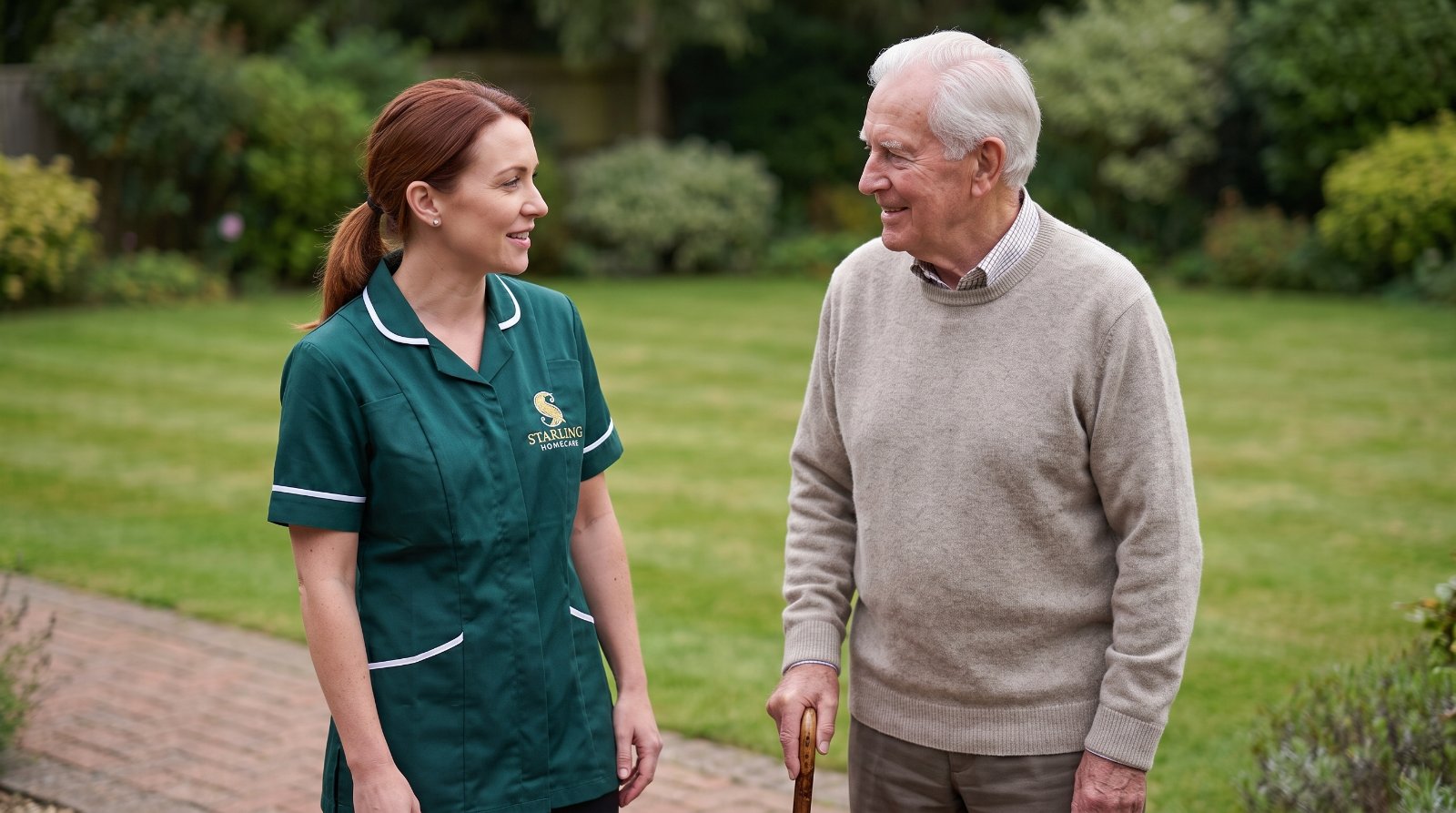
Later life care in Hertfordshire is the practical, non-medical support that helps someone stay in their own home as they grow older. It comes from three places rather than one: the county council, local charities and community groups, and regulated private providers. Most families end up using some combination of all three.
Very few people arrange this from a standing start. It usually begins with one thing that has stopped working, the stairs, the shopping, the driving, or the evenings.
That is the point at which most families search for the first time. The county's support map is not obvious from the outside, so this guide sets it out plainly.
What does later life care actually mean?
The term is broad, and the vagueness is part of why it is hard to research. In practice it covers everyday help rather than nursing: getting up and dressed, meals, medicines, housework, getting out, and company.
It is not a care home, and it is not clinical care. Your GP, the district nurses and the hospital teams still lead the medical side.
What later life care adds is the ordinary week. Someone notices the empty fridge, the unopened post and the near miss on the stairs.
Families often describe the aim as keeping life the same shape for as long as possible. That is a fair description of the job.
Where later life care in Hertfordshire comes from
Three routes run across the county, and they overlap rather than compete. Understanding the split early saves a great deal of time later.
First, Hertfordshire County Council assesses need and can arrange or fund care, subject to a financial assessment. Second, charities and community organisations cover the social and practical gaps the council does not reach.
Third, regulated providers supply care at home, paid for privately or through a direct payment. Our own support for people living at home in later life sits in that third route.
What the county council will and will not do
Anyone can ask Hertfordshire County Council for a care and support assessment, and the assessment itself is free. It is the door to everything the council offers, so it is worth going through even if you expect to fund care yourselves.
The council describes the assessment as a conversation about day-to-day life. You can have a friend or a relative with you, or someone to help you follow what is happening.
If the council then arranges care, its first review usually falls within six weeks of care starting, and after that it reviews every year. You can also ask for a review at any point if something changes, which matters because needs rarely stay still.
If you look after someone without pay, you can ask for a carer's assessment in your own right. It can happen on your own or alongside the person you care for.
What the council will not do is fill the social gaps, and it will not usually fund care for people above the financial thresholds. In much of Hertfordshire that means families arrange and pay for support themselves.
What charities and community groups add
This is the part families most often miss, and it is frequently the cheapest thing that helps. It also tends to be the part that keeps someone connected rather than simply safe.
Age UK Hertfordshire runs services for people over 50 across the county. Its Handyperson service takes on everyday DIY jobs at home and in the garden, and its Befriending service matches a volunteer who visits once a week.
Lunch clubs run weekly across the Broxbourne, Dacorum, East Hertfordshire, North Hertfordshire and Stevenage districts, with a two-course meal and company. Brainwaves is a club for people who are having problems with their memory.
Coverage across the county is not uniform, so it pays to check rather than assume. Age UK Hertfordshire's carers' support service, for instance, only covers the Dacorum area.
HertsHelp is the county's independent signposting service, on 0300 123 4044 or at [email protected]. It answers Monday, Tuesday, Thursday and Friday from 9am to 5pm, Wednesday until 7pm, and at weekends from 10am to 4pm.
How the picture changes from town to town
The structure of later life care in Hertfordshire holds everywhere in the county. What genuinely changes is what sits on the ground within a few miles of the front door.
A lunch club, a day service or a memory group in one district may have no equivalent in the next. Distance matters more than it looks on a map once someone has stopped driving.
We have written separately about each of the areas we cover, because the local answer differs. The guide to help at home in Hitchin looks at starting small, the Welwyn Garden City and Hatfield guide covers the small signs worth acting on, and the Tring guide is written for couples managing together.
If you already know roughly what you need, those town guides are the faster read. If you do not, keep going here.
A sensible order to do things in
Start with the council assessment, because it is free, it is a right, and it produces a written view of need. Even when a family funds care themselves, that assessment is a useful second opinion.
Ring HertsHelp next. An independent signposting service will name local groups that no provider, including us, knows as well.
Then look at regulated care for the gaps that remain. A good provider should say plainly what it would and would not cover, and how that fits around whatever is already in place.
One quiet piece of advice from our own experience: put something small in place before anyone needs it. A weekly visit that is already routine is far easier to increase than a new arrangement made in a crisis, which is also the argument for planning ahead before a crisis.
Common Questions About Later Life Care in Hertfordshire
What is the difference between later life care and home care?
In practice they overlap almost completely. Home care describes who delivers the support and how it is regulated, while later life care describes who it is for and what it aims to achieve. A family searching for one will usually find the other.
Do you have to pay for later life care in Hertfordshire?
That depends on a financial assessment carried out by the county council. The assessment of need is free to everyone, but any care the council then arranges is means tested, so many households in Hertfordshire arrange and fund support privately.
When should you start thinking about later life care?
Earlier than most people do. The useful moment is when small things start taking longer, rather than when something has gone wrong, because there is then time to choose calmly.
If you would like to talk any of this through, our team is on 01727 324 127 or at [email protected]. Starling Homecare is registered with the Care Quality Commission, and we are glad to explain what support at home would and would not involve before you commit to anything.
Arranging Care Is Simple
Starting care can feel like a big step. We keep it calm and straightforward, and we are here to guide you from your very first call.
1. Talk to us
Get in touch by phone or request a callback. We will listen, answer your questions and help you understand the options, with no pressure to decide anything straight away.
2. A home visit and initial consultation
We arrange a visit to understand your routines, your home and what matters most to you. Together we agree an initial consultation and shape the support that feels right.
3. Your care begins
A small, familiar team starts your care, arriving at the agreed times and staying involved as your needs change. We remain your trusted adviser throughout.
Whenever you are ready, we are here to help.