
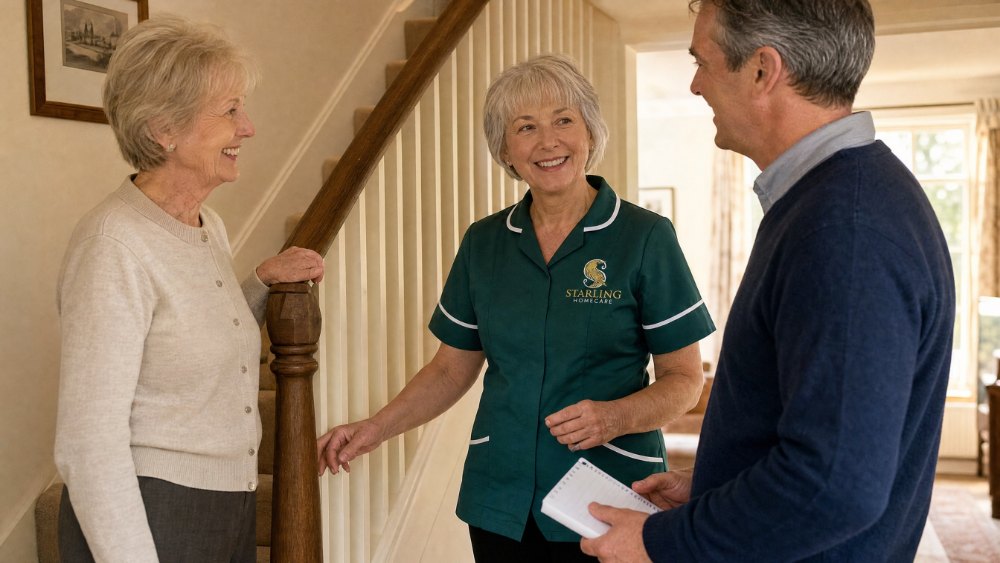
If your elderly parent can't manage stairs any more, start with the GP and a free needs assessment from Hertfordshire County Council. The NHS says equipment and small adaptations are free if your parent is assessed as needing them, and GOV.UK says a council grant can help with bigger changes. If they have fallen and cannot get up, call 999.
To talk anything through with someone local, our Tring team is on 01442 954 137.
Perhaps you noticed your mum pausing on every step, or she mentioned she now only goes up once a day. It can be sad to see a house she has loved start to work against her. You might also feel unsure what is possible, what it costs, and whether you are worrying too soon or too late.
These are steps we have walked through with families before, and you do not have to work them out alone.
Why are the stairs getting harder?
Often it is a mix of things, and the GP can help untangle them. The NHS lists muscles weakening with age, arthritis, low blood pressure, medicine side effects and eyesight problems. All can affect balance and falls.
The NHS advises seeing a GP if you are worried about balance or mobility. Our article on why the stairs are often the first sign looks at the early stages. This page is about the options once stairs have become hard.
What can I do this week to make the stairs safer?
A few small steps can help while bigger decisions wait:
- Book a GP appointment to talk about her balance, mobility and medicines.
- Light the stairs well. Age UK's Staying steady guide highlights good lighting, particularly on the stairs.
- Check the handrails. Age UK suggests handrails on both sides, and the NHS suggests safety rails on steps.
- Clear the top and bottom. Age UK suggests moving rugs and mats away from the top or bottom of the stairs.
- Ask for an assessment. The NHS says a council needs assessment is free, and it can identify adaptations that would help.
What are the options if an elderly parent can't manage stairs?
There are usually three kinds of help, and many families use more than one.
- Equipment and small adaptations. The council's page on changes to your home says equipment might help her get around without bigger changes.
- Bigger adaptations. GOV.UK says a Disabled Facilities Grant can pay for changes such as a stairlift or a level access shower, or an extension such as a downstairs bedroom.
- Help with the day. Care at home can support washing, dressing, meals and moving about, so the stairs are not faced alone.
Whether to adapt, rearrange how she uses the house, or both, is something to talk through with the assessor and with her.
How does the Disabled Facilities Grant work?
GOV.UK says the grant is up to £30,000 in England, and some councils may give more. It usually depends on household income and household savings over £6,000, and it will not affect benefits.
In Hertfordshire, the county council's Home Improvement Agency says an occupational therapist assessment is needed to apply. It lists the districts it covers, and Dacorum, which includes Tring, is not among them. For people outside those areas, it says to contact Adult Care Services for a referral.
How do I raise it with Mum?
Talk about what she wants to keep doing, rather than what she can no longer manage. You could try:
- "What would make the house easier for you, rather than us changing everything?"
- "Would you let someone from the council look at the stairs? It costs nothing to ask."
- "If someone helped in the mornings, would that make the stairs less of a worry?"
She may want time to think. That is natural, and it often helps to leave the door open.
Who can help in Hertfordshire?
- Her GP, about balance, mobility and medicines.
- HertsHelp on 0300 123 4044, Hertfordshire County Council's free advice service.
- Adult Care Services on 0300 123 4042, to ask for an occupational therapist assessment, as the council's Disabled Facilities Grant page describes.
How Starling Homecare can help
Adaptations can take time to arrange. Help at home can start sooner, and it means your mum can stay in the house she knows while the bigger decisions are made. It also lets your visits be about her, not the stairs.
Our later life care can include:
- support with bathing, dressing and mobility
- meal preparation and hydration support
- light housekeeping and laundry, so fewer trips up and down
- medication prompts and companionship
Our carers keep walkways clear, check lighting, notice changes and keep you informed. With her consent, they pass concerns to her GP. Carers do not give injections or carry out clinical tasks. In Tring we arrange live-in care, and the support can change as her needs change.
If your mum is unsure, we would usually begin with someone from our team simply coming round for a chat. It does not have to be formal. It is a conversation to get to know her and what matters to her, and that often breaks the ice. In urgent situations, care can usually start within a day or two.
Areas we cover
Starling Homecare's carers visit people at home in St Albans, Harpenden, Hemel Hempstead, Welwyn Garden City and Hatfield, Potters Bar and Cheshunt, and the villages around them. Elsewhere in Hertfordshire, including Berkhamsted, Tring, Radlett and Shenley, Hitchin and Hertford, we arrange live-in care.
For a wider starting point, see our guide for families worried about an elderly parent. Locally, here is how we arrange live-in care in Tring. If you are weighing up timing, our guide on the right time to look for a care provider may help.
Frequently asked questions
Can my elderly parent get a stairlift through the council?
GOV.UK says a Disabled Facilities Grant from the council can pay for changes such as a stairlift, up to £30,000 in England. It is means tested on household income and savings. In Hertfordshire, the council says an occupational therapist assessment is needed first, which you can ask for through Adult Care Services.
Is a council needs assessment free?
Yes. The NHS says a needs assessment from the council is free, and that equipment and small adaptations are provided free if someone is assessed as needing them. HertsHelp, Hertfordshire County Council's free advice service, on 0300 123 4044, can explain how to ask for one.
Can someone help my mum at home in Tring while we wait for adaptations?
Yes. Starling Homecare arranges live-in care in Tring, with help with washing, dressing, meals and moving about the home. Visiting care, from 30 minute visits, is offered in St Albans, Harpenden, Hemel Hempstead, Welwyn Hatfield, Potters Bar and Cheshunt. The care can change as her needs do. In urgent situations, care can usually start within a day or two.
When an elderly parent can't manage stairs, you do not need every answer before you call. Whether you are close by in Tring or juggling work further away, a first call is simply a conversation. Our Tring team is on 01442 954 137. You will be talking to someone who arranges care every day, so you can find out what good support looks like before you decide anything.
Guidance checked on 26 October 2026 against GOV.UK: Disabled Facilities Grants, the NHS guide to household equipment, Age UK's Staying steady guide, NHS: Falls and Hertfordshire County Council.
Arranging Care Is Simple
Starting care can feel like a big step. We keep it calm and straightforward, and we are here to guide you from your very first call.
1. Talk to us
Get in touch by phone or request a callback. We will listen, answer your questions and help you understand the options, so you can decide what feels right in your own time.
2. A home visit and initial consultation
We arrange a visit to understand your routines, your home and what matters most to you. Together we agree an initial consultation and shape the support that feels right.
3. Your care begins
A small, familiar team starts your care, arriving at the agreed times and staying involved as your needs change. We remain your trusted adviser throughout.
Whenever you are ready, we are here to help.