
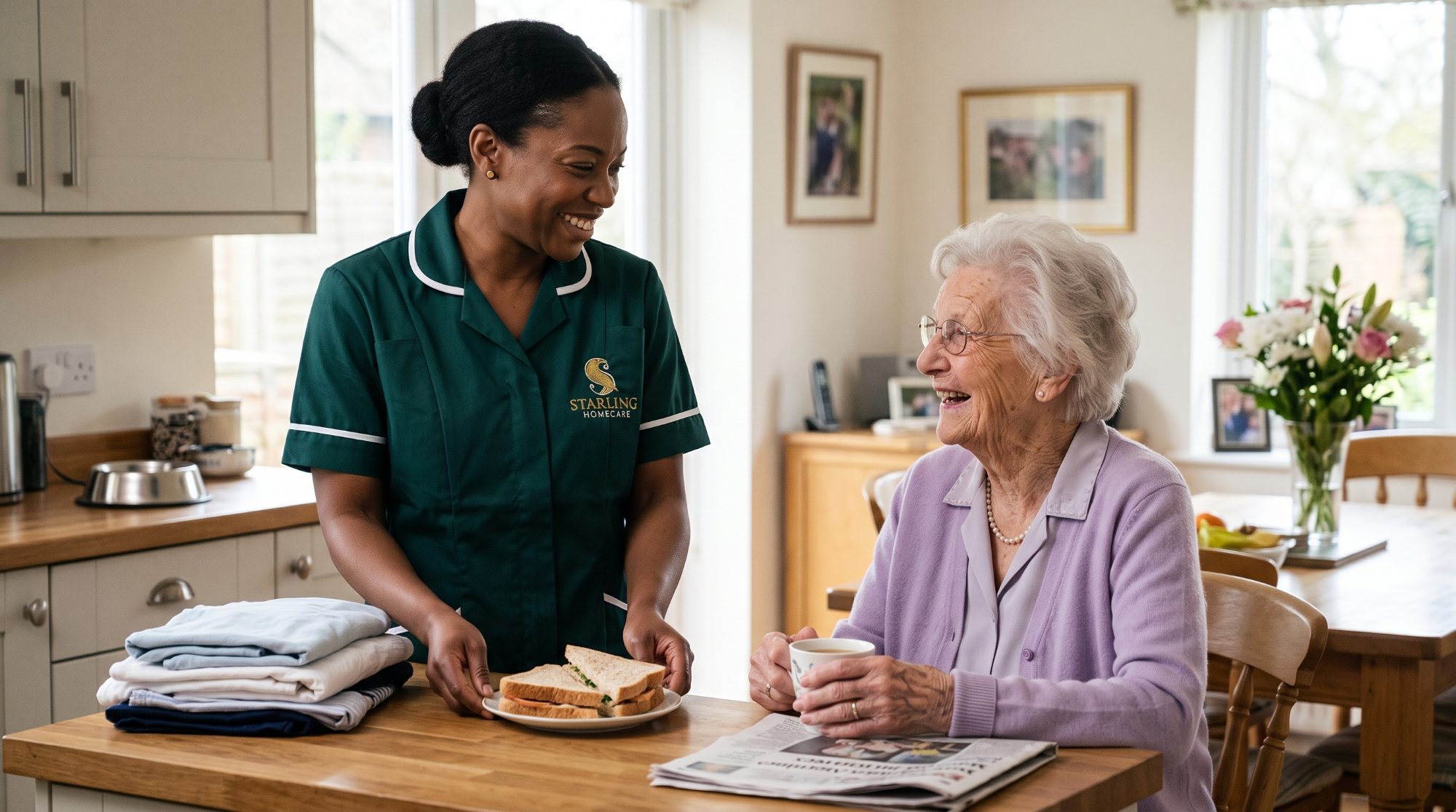
Domestic support at home in Hertfordshire is practical help with running a house. Cleaning, laundry, changing the bed, the shopping, a simple meal. It is done by a regular carer who comes to your relative rather than the other way round.
It is the lightest kind of home care we provide. For many families it is the first kind they ever arrange.
The service itself is straightforward. The harder question sits underneath it. Is the house the thing that needs help? Or is the house simply where you first noticed that something had changed?
What domestic support covers
The work is ordinary, and that is rather the point. A carer might:
- clean the kitchen and bathroom properly, not quickly
- do the washing, dry it and put it away
- change and air the bed
- do a food shop, or go along to help with one
- make a hot meal and leave something for later
- keep on top of the bins, the post and the recycling
- notice the light bulb that has gone and the milk that is out of date
Visits are usually short and regular. Once a week suits some households. Two or three times a week suits others.
The value is not really in any single task. It is in the fact that the same person keeps coming, and keeps track.
Is the house the problem, or the person?
A home that has slipped is worth paying attention to. It can mean several quite different things. Work out which one you are looking at before you decide what to arrange.
When the house really is the problem
Sometimes the work has simply become too much. Hoovering. Carrying wet washing. Standing at a sink. Reaching into a low cupboard. These are physical jobs, and they get harder before anything else does.
Your relative is still managing themselves well. They are washing, dressing, eating and going out. The house has just quietly moved beyond them.
This is where domestic support does its best work. It removes the part that has become hard. Everything else stays exactly as it was.
When the house is telling you something else
Sometimes the state of the house is a symptom rather than the illness. Post unopened for weeks. Food bought and never eaten. The same meal made three times in a day, or no meals at all. Washing done but never put away. A relative who says the cleaner is coming when no cleaner exists.
None of this means a crisis. It does mean the conversation is a wider one. Arranging a weekly clean on its own may leave the real difficulty untouched.
Where domestic support ends and personal care begins
It is worth being clear about the line. Families often ask us to blur it, and we would rather explain it.
Domestic support is help with the home. Personal care is help with the person: washing, dressing, using the toilet, getting in and out of bed. Prompting and support with tablets sits under medication management.
Plenty of our clients have both, in one visit, from one carer. What matters is that the plan says so. The carer must be trained and insured for what they are actually doing. Nobody should be quietly drifting into work they were never asked to do.
A regulated provider has to be explicit about this. Someone hired informally often is not.
Why it is often the right place to start
Many families come to us for a weekly clean and stay for years. That is not an accident. It is because domestic support solves a real problem while asking almost nothing of the person receiving it.
Nobody has to accept help with washing to accept help with the washing machine. There is no loss of dignity in having someone hoover.
So a household that would refuse a carer will often agree to a cleaner. That first regular visit then does two useful things. It gets the house back under control. It also puts a trained pair of eyes in the home every week.
Our carers are told to notice. If the fridge is full of food nobody has eaten, that gets fed back. So does a staircase that has started to look risky. So does a mother who seems less steady than she did a month ago.
Families very often hear about a change from us before they see it themselves. They visit at weekends. We come on a Tuesday morning.
Domestic support at home in Hertfordshire, town by town
We provide this support across the areas we cover, and the practical detail differs a little from place to place. We have written about how it works in St Albans, in Hitchin, and in Welwyn Garden City and Hatfield.
The domestic support and housekeeping page sets out the service itself.
Wherever you are, the arrangement is the same. A regular carer. A regular time. A written plan of what is being done. A local team you can ring.
Other help worth knowing about locally
Paid care is not the only thing available, and it would be odd of us to pretend otherwise.
HertsHelp is a free, independent service for anyone living in Hertfordshire. It is funded by Hertfordshire County Council and NHS partners, and delivered by local community organisations. It runs a helpline seven days a week on 0300 123 4044.
Its community navigators will visit someone at home. They help with paying bills and sorting out domestic paperwork. They also explain what local services and benefits are available.
If the difficulty is as much administrative as physical, that is often a better first call than ours.
How to arrange it
Talk to us about what is actually happening at home. Do not worry about which package you think you need.
We will visit and look at the house with you. Then we will say plainly whether domestic support is the right answer, or whether something else would help more.
If cost is part of the picture, our care funding guide explains how home care is paid for and what help may be available.
Frequently asked questions
Is domestic support the same as a cleaner?
Not quite. A cleaner cleans. A care worker providing domestic support works to a written plan. They are trained, insured and supervised, and they are expected to notice and report changes in how someone is managing. The cleaning is the same. What sits behind it is not.
Can the same carer do the housework and help with washing and dressing?
Yes, and many do. The important thing is that both are written into the care plan. That way the carer is trained and insured for the personal care as well as the domestic work, and everyone knows what the visit is meant to include.
How often do visits need to be?
There is no fixed answer. Some households do well with one longer visit a week. Others prefer shorter visits two or three times a week, which keeps things ticking over. We will suggest what we think fits, then work to what you decide.
Will my relative have the same carer each time?
That is what we aim for. It is the part of the service we work hardest at. Continuity is what turns a cleaning visit into a relationship where someone would notice if things changed. We will also tell you honestly what cover looks like when your regular carer is on leave.
Arranging Care Is Simple
Starting care can feel like a big step. We keep it calm and straightforward, and we are here to guide you from your very first call.
1. Talk to us
Get in touch by phone or request a callback. We will listen, answer your questions and help you understand the options, with no pressure to decide anything straight away.
2. A home visit and initial consultation
We arrange a visit to understand your routines, your home and what matters most to you. Together we agree an initial consultation and shape the support that feels right.
3. Your care begins
A small, familiar team starts your care, arriving at the agreed times and staying involved as your needs change. We remain your trusted adviser throughout.
Whenever you are ready, we are here to help.