
If Dad is missing right now and has dementia, call 999. Hertfordshire Constabulary says to call 999 immediately when a missing person is vulnerable to harm, and you do not have to wait 24 hours. If he is home but suddenly much more confused than usual, the NHS says go to A&E or call 999. Once he is home and safe, dementia walking and getting lost is something you can plan for, with expert guidance and local support.
To talk anything through with someone local, our Berkhamsted team is on 01442 954 137.
The fright of not knowing where Dad is can stay with you for days, even once he is home. You might also feel unsure what is normal for him now, or find yourself worrying about next time while you are at work or some distance away. Wanting to understand what happened is a sensible place to start, and the steps below can be taken one at a time.
Walking about is a worry our team knows well, and you will not be facing it on your own.
Why does someone with dementia go walking and get lost?
The Alzheimer's Society prefers the phrase "walking about" to "wandering", because there is usually a reason behind it. The charity suggests trying to understand why the person is walking about and what they need. Its common reasons include:
- Setting out with a goal, then forgetting where they were going.
- Confusion about the time, such as waking at night and thinking it is time to start the day.
- Pain or discomfort, needing the toilet, or feeling too hot or cold.
- Restlessness, anxiety, or boredom when the day has little in it.
- An old habit, like walking out at the time he used to leave for work.
- Looking for someone from the past, or feeling lost somewhere unfamiliar.
If you think he may be walking about because of pain, discomfort or illness, the Alzheimer's Society suggests talking to the GP.
What to do if he goes missing
First, call 999 if you believe he is at risk of harm. Hertfordshire Constabulary is clear that reporting someone missing is not a waste of police time. Then, while you wait, the police advice on what to do when someone goes missing suggests some simple steps:
- Search the house, loft, garden, shed and garage.
- Ring round friends, family and local hospitals.
- Keep a note of everything you have done and when.
The Alzheimer's Society suggests keeping a recent photograph of him, and making sure someone stays at home while others go looking, in case he comes back. When he comes home, it suggests reassuring him first and gently asking later why he went out.
The Herbert Protocol in Hertfordshire
The Herbert Protocol is a scheme for carers of people living with dementia. Hertfordshire Constabulary explains that carers fill in a form with details about the person, their past, their habits and the places they often go. If he goes missing, you hand it to the police, and it can save time at the start of a search.
In January 2026, Hertfordshire Constabulary announced it had adopted Safe and Found Online, a portal to help locate vulnerable missing people. The force urges family members, friends and carers of people at risk of going missing, including people living with dementia, to register key details and recent photographs, which officers can access straight away. It says the platform is free and profiles can be updated at any time.
Dementia walking and getting lost: what to do this week
For dementia walking and getting lost, the Alzheimer's Society suggests some practical steps:
- Keep a simple diary for two weeks: when he walks, where to, and how he seemed.
- Make sure he carries his name and a contact number, for example sewn into a coat.
- With his agreement, tell trusted neighbours and local shopkeepers, and ask them to call you.
- Save "in case of emergency" numbers in his phone.
There is no need to do all of this at once. One or two steps this week is a manageable place to begin.
The Alzheimer's Society also describes door sensors that play a recorded message, and pressure pads that alert a carer. However, phone tracking should only be switched on with his consent. Hertfordshire County Council also lists home technology, including door sensors and Herts Careline alarms.
The Alzheimer's Society advises against locking a person with dementia in alone, and suggests speaking to social services before locking doors.
How to raise it with your dad
He is still your dad, so keep it about his freedom. You could try:
- "You enjoy getting out every day. Can we make sure you always have my number on you?"
- "If I came with you on Thursday, would you show me your favourite route?"
- "The police have a form that helps if anyone gets lost. Shall we fill it in together?"
Who to call in Hertfordshire
- 999 if he is missing and at risk, or 101 if not.
- His GP if you think walking about may be due to pain, discomfort or illness.
- The Alzheimer's Society Dementia Support Line on 0333 150 3456.
- HertsHelp on 0300 123 4044, Hertfordshire County Council's free advice service.
How Starling Homecare can help
Our dementia and Alzheimer's care at home is there for exactly this kind of worry, so your visits can be about time together rather than keeping watch. Support can include:
- Visiting care in St Albans, Harpenden, Hemel Hempstead, Welwyn Hatfield, Potters Bar and Cheshunt, from 30 minute visits, at the times of day he tends to want to go out.
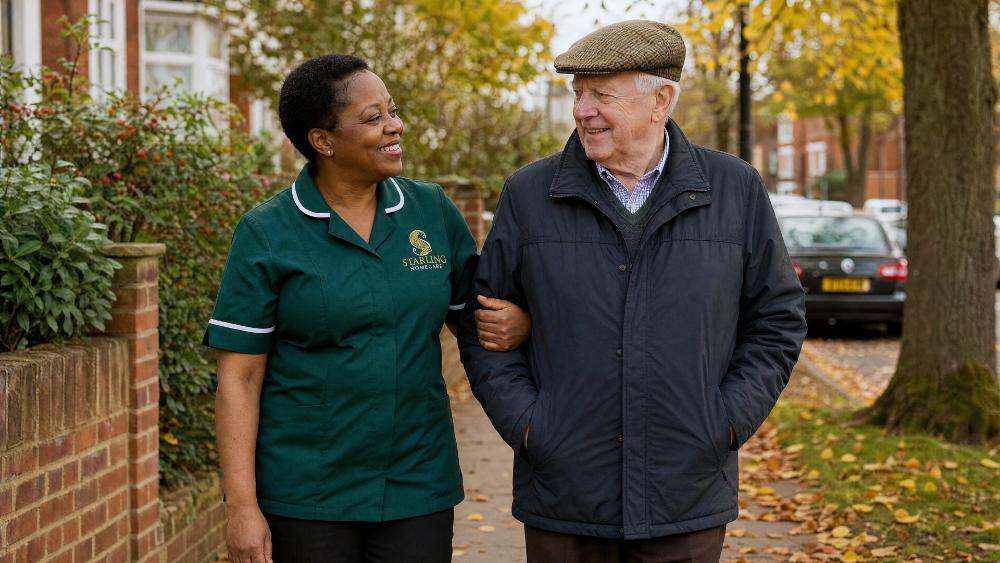
- Companionship, such as a walk together on a route he knows, or time spent on things he enjoys.
- Meal preparation, medication prompting and help around the house, which keep the day steady.
- Overnight care in the same areas, if he is often up and about at night.
- Live-in care or respite, if he needs someone there more of the time, or the family needs a break.
In practice, a carer gets to know his routine and notices changes. They keep the family informed and pass concerns on to the GP where needed. Carers do not carry out clinical tasks.
If Dad is unsure about help, we would usually start with someone from our team simply coming round for a chat. It does not have to be formal, and it often breaks the ice. From there, we stay alongside the family as his needs change, adjusting the care as we go. If he lives in Berkhamsted and you live further away, our guide to caring for someone with dementia at home may also help.
Areas we cover
Starling Homecare's carers visit people at home in St Albans, Harpenden, Hemel Hempstead, Welwyn Garden City and Hatfield, Potters Bar and Cheshunt, and the villages around them. Elsewhere in Hertfordshire, including Berkhamsted, Tring, Radlett and Shenley, Hitchin and Hertford, we arrange live-in care.
Read our guide for families worried about an elderly parent. You can also find out more about live-in care in Berkhamsted.
Frequently asked questions
Do I have to wait 24 hours before reporting him missing?
No. Hertfordshire Constabulary says you do not have to wait 24 hours. If he is not in immediate danger, you can report it online or call 101, and the force says both are dealt with in exactly the same way.
Is it safe to let someone with dementia go for walks alone?
The Alzheimer's Society suggests the family and the person agree together what level of risk is acceptable. The charity says it is important to balance independence with keeping the person safe.
Should we use a GPS tracker?
Tracking can help, but the Alzheimer's Society says the person must consent before it is switched on. So talk it through with him first.
Once Dad is home safely, it helps to know what support is nearby. In urgent situations, care can usually start within a day or two, as how care starts with us explains. Whenever you want to talk it through, our Berkhamsted team is on 01442 954 137, and you will be speaking to someone who arranges care every day.
Guidance checked on 26 October 2026 against Hertfordshire Constabulary, the Alzheimer's Society and the NHS.
Arranging Care Is Simple
Starting care can feel like a big step. We keep it calm and straightforward, and we are here to guide you from your very first call.
1. Talk to us
Get in touch by phone or request a callback. We will listen, answer your questions and help you understand the options, so you can decide what feels right in your own time.
2. A home visit and initial consultation
We arrange a visit to understand your routines, your home and what matters most to you. Together we agree an initial consultation and shape the support that feels right.
3. Your care begins
A small, familiar team starts your care, arriving at the agreed times and staying involved as your needs change. We remain your trusted adviser throughout.
Whenever you are ready, we are here to help.