
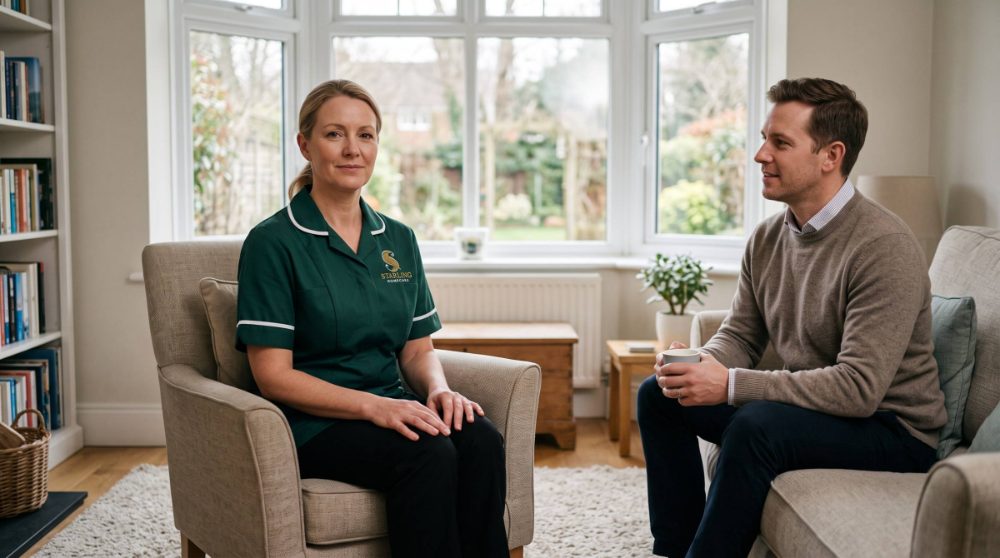
Double-handed care means two trained carers attend each visit together, often because a moving and handling assessment has found that one person cannot safely help with a transfer. It is decided by an assessment, not by preference, and the plan should say exactly which tasks need two people and why.
To talk anything through with someone local, our Welwyn Hatfield team is on 01707 714 000.
What does double-handed care mean in practice?
Two carers arrive at the same time and stay for the tasks that need them both. Usually that means transfers, such as moving between bed, chair and wheelchair, often with a hoist or other equipment.
The Health and Safety Executive's guidance gives a clear example. Some people need at least two carers when using a hoist: one to operate it, and one to keep the person safe and offer reassurance. For many families, that second role is the one that matters most.
Other parts of a visit may only need one person. For an idea of what an ordinary care visit involves, see our article on what happens when someone helps with washing and dressing in Hatfield.
Why might two carers be needed?
Moving and handling is a common reason. The HSE says the number of carers depends on the individual and the specific transfer. Some people can safely use a hoist at home without assistance, while others need help from a number of carers.
Council guidance also describes other reasons. For example, Bolton Council's guidance for care providers includes situations where behaviour puts carers at risk, or where safeguarding concerns mean two staff should be present.
Who decides whether double-handed care is needed?
The decision comes from an assessment. The NHS advises families to ask the council for a needs assessment and an occupational therapy assessment for moving and handling advice. In Welwyn Garden City and Hatfield, adult social care is run by Hertfordshire County Council.
A needs assessment is free. The NHS says it is carried out by a council worker such as a social worker or occupational therapist.
Then the care provider makes its own risk assessment in the home. The HSE expects this to look at the person, the room, each transfer, the equipment and the staff. The result goes into the care plan.
What equipment is usually involved?
The HSE lists the kinds of handling equipment used in care:
- mobile, standing and floor-raising hoists, with the right slings
- slide sheets and transfer boards
- turntables
- electric profiling beds
Councils may provide some of these. The NHS says you may be entitled to free equipment and home adaptations if they cost less than £1,000 each. Before buying anything expensive, the NHS suggests getting advice from an occupational therapist and trying it at home first.
How are double-handed visits arranged?
Both carers should arrive together, so nobody starts a transfer alone while waiting for the second person. The plan should record the method for each task. The HSE says it should name the hoist, the sling type and size, and the number of carers.
Continuity helps too. Carers who know the routine, and the person's preferences, make each transfer calmer. It is reasonable to ask a provider how they schedule pairs and what happens if one carer is delayed.
Finally, family members should not step in as the second carer unless that has been assessed and agreed. The NHS notes that some councils run free safe handling courses for family carers.
Can double-handed care change to one carer?
Sometimes. Councils review moving and handling packages to see whether newer equipment or methods would allow one carer to help safely. A Research in Practice briefing says occupational therapists usually lead these reviews.
The same briefing is candid about the limits. Single-handed care is not suitable for everyone, people may worry about feeling unsafe, and the person should be fully involved. A trial period can help.
Our physical disability care page explains how support at home is planned around equipment and an agreed method.
Frequently asked questions
Does double-handed care cost twice as much?
Usually more, because two carers' time is involved. If the council is funding care, the cost forms part of the care package after its financial assessment. Self-funders should ask any provider how it charges for paired visits.
Can a family member be the second carer?
Only if that has been assessed and agreed in the plan. A family carer can ask the council for a carer's assessment and about safe handling training. Nobody should be expected to fill the gap on the spot.
What happens if needs change after a fall or hospital stay?
Ask for a reassessment. An occupational therapist can review transfers and equipment, and the care plan should then be updated. Our guide to the first week after a fall covers who to contact early on.
How Starling Homecare can help
Starling Homecare is a family run, CQC registered provider with a local team for home care in Welwyn Hatfield. We provide personal care, post-hospital support and live-in care. If an occupational therapist has set out how someone should be helped, we can talk through what that means for visits.
Guidance checked on 2 November 2026 against the HSE and the NHS social care and support guide.
Arranging Care Is Simple
Starting care can feel like a big step. We keep it calm and straightforward, and we are here to guide you from your very first call.
1. Talk to us
Get in touch by phone or request a callback. We will listen, answer your questions and help you understand the options, so you can decide what feels right in your own time.
2. A home visit and initial consultation
We arrange a visit to understand your routines, your home and what matters most to you. Together we agree an initial consultation and shape the support that feels right.
3. Your care begins
A small, familiar team starts your care, arriving at the agreed times and staying involved as your needs change. We remain your trusted adviser throughout.
Whenever you are ready, we are here to help.