
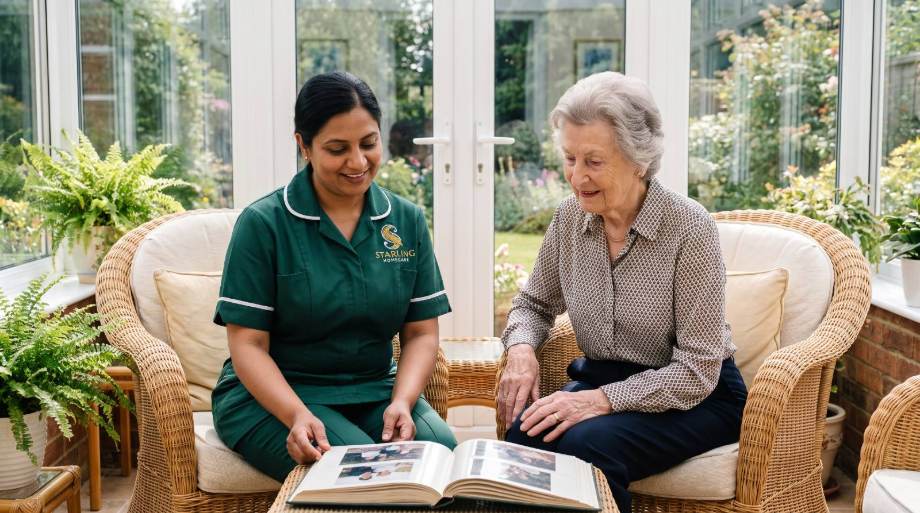
Families searching for a dementia care home in Brookmans Park are usually not shopping. They are trying to work out whether the person can carry on at home at all. A care home search is how that worry gets typed into Google.
It is a fair question and it deserves a straight answer. Dementia does not automatically mean a care home, and staying at home is not automatically kinder. What decides it is narrower and more practical than most families expect.
This piece is about what dementia specifically changes in that decision. We arrange care at home, so we have an interest. We have tried to be honest about the point where a care home becomes the better answer.
What dementia changes about the question
With most conditions, the question is how much help someone needs. With dementia it is usually about where the person is least confused.
A familiar house does a lot of quiet work. The route to the bathroom, the noise the boiler makes, the order of the kitchen. All of it is memory the person does not have to hold in their head.
Moving somewhere new removes that scaffolding at the exact point it is hardest to rebuild. That is the real argument for care at home. It is a strong one for as long as the person is safe.
It is not an argument that holds forever, which is the part care providers tend to skip.
The markers that suggest a dementia care home in Brookmans Park
The Alzheimer's Society puts it plainly. A person often moves into a care home because they can no longer get the right level of care where they live now.
It gives two examples worth holding on to. One is that the person is no longer able to manage daily tasks, such as eating, without another person's support. The other is that they are no longer safe at home, for example because they keep having falls.
Its wider test is the one families find most useful. Over time, the risks of staying at home can come to outweigh the benefits. That balance tips the decision, rather than any diagnosis or stage.
Notice what is not on that list. A diagnosis on its own is not a reason to move someone. Nor is a memory clearly worse than last year, or a frightened family.
What care at home can genuinely cover in dementia
A good deal, and more than most families assume before they ask. Carers can cover washing and dressing, meals, medication prompts, laundry, appointments and the shape of the day.
The dementia-specific value is continuity. The same small team arrives at the same times. So the person is not meeting a stranger during the hardest part of the day.
Cover can also grow in layers as the condition moves. One visit a day, then several, then overnight support. Then a live-in carer, if that becomes the right answer.
What care at home cannot do is be in the house every minute at ordinary visiting-care prices. Between visits, the person is on their own, and that is the honest limit.
When is a dementia care home in Brookmans Park the better answer?
There are situations where residential care is the kinder decision, and pretending otherwise helps nobody.
The clearest is sustained night-time risk. Someone is up and moving around the house at three in the morning, night after night. One carer or a sleeping relative cannot keep them safe.
The second is when the family carer is finished. A spouse who has not slept properly in months is part of the equation. A decision that protects one person by breaking another is not a good decision.
The third is medical complexity that needs nursing on site rather than visiting. If that is the direction of travel, a nursing home is the relevant option rather than a residential one. The GP or the memory service is the place to start.
What Brookmans Park adds to the decision
Brookmans Park and Welham Green sit in North Mymms parish, between Hatfield and Potters Bar. The station sits at the middle of village life. Two things follow for families here.
Adult children here often live in London and further out. So nobody may see the person at home for days at a time. That gap, rather than the dementia itself, is frequently what makes home feel unsafe.
A move also usually means leaving the village, because AL9 itself has little residential provision. Visiting then becomes a car journey rather than a walk, which changes how often it actually happens.
Neither point settles the question. Both belong in it.
A reasonable way to decide
Write down what would have to change for home to stop working, in specific terms. Nights, falls, eating, and the family carer's own health are the four that matter most in dementia.
Then ask whether each of those could be covered at home, at a price the person can sustain, and for how long.
If the answer is yes for the next six months, home is likely the better environment. You can revisit the decision later. If the answer is no on more than one, a dementia care home in Brookmans Park is worth looking at properly rather than reluctantly.
Starling Homecare is a family-run provider registered with the Care Quality Commission, and our Welwyn Hatfield team looks after Brookmans Park and Welham Green. You can read about dementia and Alzheimer's care at home, the wider home care or a care home decision in Brookmans Park, and what to ask about home care in Brookmans Park and Welham Green.
Common Questions About Dementia Care at Home in Brookmans Park
At what stage of dementia should someone move to a care home?
There is no stage that decides it. The Alzheimer's Society frames it as a balance: when the risks of the person staying at home come to outweigh the benefits, it may be time to consider a move. In practice that usually shows up as nights, falls or being unable to manage eating without support.
Can someone with dementia stay at home if they live alone?
Often yes, for a good while, provided the gaps between visits are safe ones. The question is not the diagnosis but how long the person would be alone if something went wrong, and whether cover can be increased as the condition changes.
Is dementia care at home cheaper than a care home?
It depends entirely on how many hours are needed. A few visits a day is usually less than a residential placement, while round-the-clock cover can cost more. Live-in care sits between the two and is worth pricing properly before assuming a care home is the affordable option.
Most families who ask us about a dementia care home in Brookmans Park are somewhere in the middle. Their parent is managing, but not comfortably. That is the right moment to look at both options calmly, rather than in a crisis after a fall.
If it would help to talk it through, our Welwyn Hatfield team is on 01707 714 000 or welwynhatfield@starlinghomecare.co.uk. The Alzheimer's Society guidance on when to consider a move is a good independent read alongside this.
Alzheimer's Society guidance checked on 9 September 2026. This article is general information and not clinical advice.
Arranging Care Is Simple
Starting care can feel like a big step. We keep it calm and straightforward, and we are here to guide you from your very first call.
1. Talk to us
Get in touch by phone or request a callback. We will listen, answer your questions and help you understand the options, so you can decide what feels right in your own time.
2. A home visit and initial consultation
We arrange a visit to understand your routines, your home and what matters most to you. Together we agree an initial consultation and shape the support that feels right.
3. Your care begins
A small, familiar team starts your care, arriving at the agreed times and staying involved as your needs change. We remain your trusted adviser throughout.
Whenever you are ready, we are here to help.