
What Is a Care Plan?
The direct answer
A care plan is the written document that sets out what support a person needs, how and when it is to be given, what matters to them, the risks involved and how they are managed, and who is responsible for what. In regulated home care it is a legal requirement: Regulation 9 of the Health and Social Care Act 2008 (Regulated Activities) Regulations 2014 requires care to be appropriate, to meet needs and to reflect preferences, and that can only be shown through an assessment and a plan. The plan is written with the person, not about them, before care starts, and it is reviewed whenever needs change and at least regularly.
Two documents are often confused. A council care and support plan is produced by Hertfordshire County Council after a care needs assessment and says what the council will fund. The provider’s care plan is the detailed working document the carers follow. This page is about the second.
Written by the Starling Homecare leadership team and reviewed by Rupen Faldu, Managing Director and the provider’s nominated individual. Last reviewed 24 October 2026; next review by April 2027. Sources are listed at the end of this page.
A care plan at a glance
- Written with the person and family after a home assessment, before the first visit.
- Records needs, preferences, routines, history and what the person can do for themselves.
- Sets out each visit: time, length, tasks, and how the person likes them done.
- Covers medication, moving and handling, nutrition, skin, continence and any condition-specific needs.
- Identifies risks and how carers manage them, and what to do in an emergency.
- Records consent, capacity where relevant, and who may be told what.
- Is reviewed when anything changes and at a set interval; Starling Homecare reviews at least every six months.
What a care plan contains
The person
Who they are, their life, work, family, faith and interests, what a good day looks like, and what they want from care. This is not padding: a carer who knows someone was a teacher, hates being rushed and likes the radio on at breakfast gives better care than one who only knows the tasks.
Needs and abilities
What the person needs help with and, just as important, what they can and want to do for themselves. Good care protects independence rather than eroding it, so the plan says “prompt” where prompting is enough and “assist” only where it is needed.
The visits
Each visit set out in order: the time, the length, the tasks, and the way the person prefers them done. A morning visit might read: knock and announce yourself, help to the bathroom, support with a wash at the sink, assist with dressing (chooses own clothes), prepare breakfast (porridge, tea with one sugar), prompt medication from the blister pack, leave the hall light on.
Risk assessments
The home itself (steps, lighting, trip hazards, equipment), moving and handling (how the person transfers, what equipment is used, how many carers), falls history, skin integrity, nutrition and hydration, continence, and anything specific to a condition such as seizures or hypoglycaemia. Each risk has a plan for managing it and a plan for what carers do if it happens.
Medication
What the person takes, when, whether carers prompt, assist or administer, where medication is kept, and what to do about a missed or refused dose. Medication support is one of the most tightly recorded parts of home care, and a medication administration record is kept for every visit where carers are involved.
Consent and capacity
The plan records that the person agrees to the care in it. Where someone may lack capacity to make a particular decision, the Mental Capacity Act 2005 applies: capacity is assumed unless shown otherwise, decisions are made in the person’s best interests, and the plan records who holds a lasting power of attorney for health and welfare and who may be consulted. It also records who the person has agreed may receive information about their care, which is what allows a daughter to see visit notes.
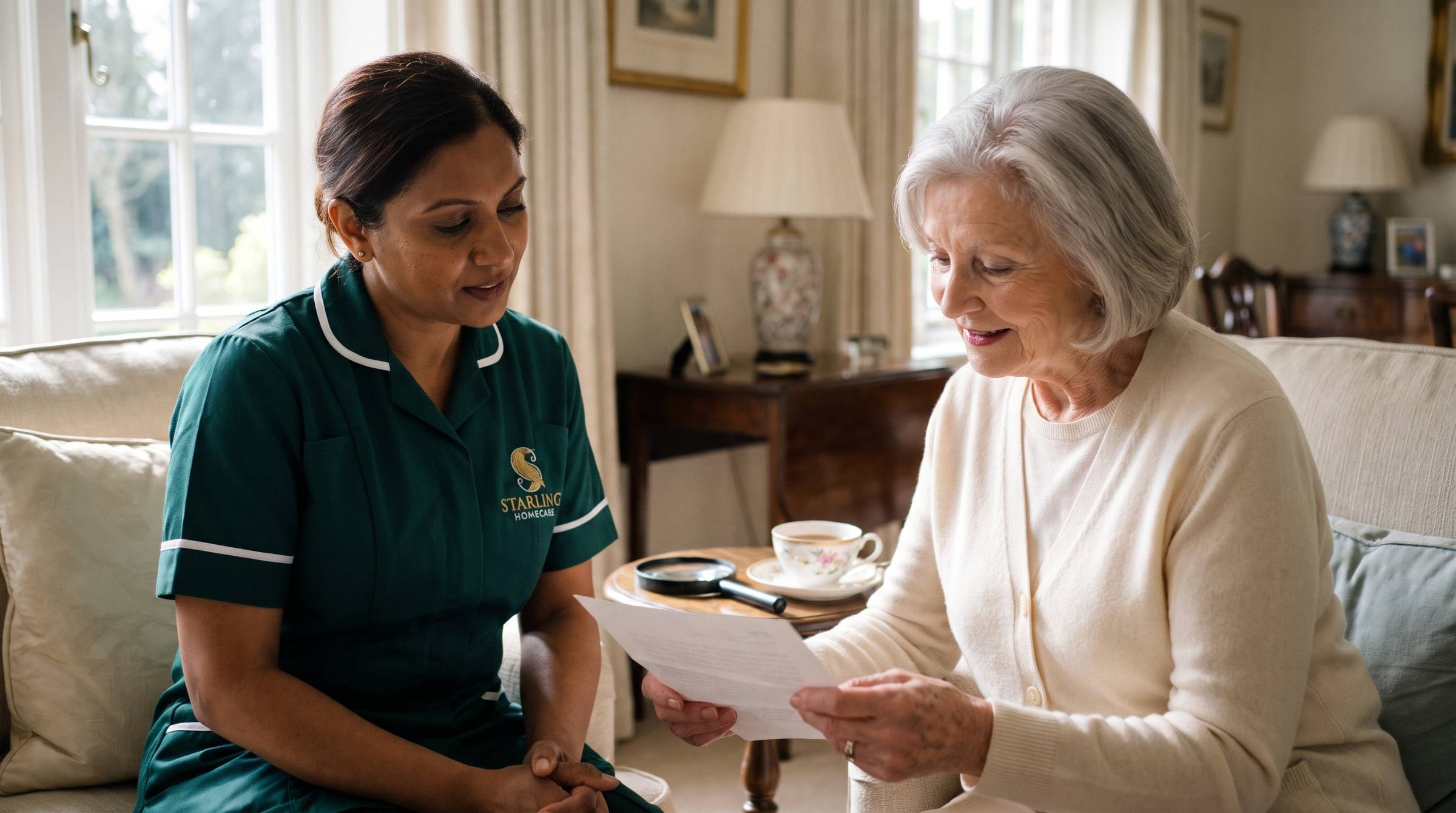
The provider’s field supervisor or deputy manager writes the plan after a home assessment, with the person, the family where the person wishes, and, with consent, input from the GP, district nurse or hospital discharge team. It is in place before the first visit. It changes whenever something changes: a fall, a hospital stay, a new diagnosis, a new medication, or simply a preference. A good provider also reviews it on a fixed cycle; Starling Homecare reviews every care plan at least every six months, sooner if needs change, with no charge for a review. The person and family can ask for a review at any time.
Most regulated providers now keep care plans and visit records in a digital care management system. Carers record each visit on a phone as it happens, including tasks done, medication, food and drink, mood and any concern. The office sees it in real time and can act the same day. With the person’s consent, named family members can see the records through an app, which for relatives who live far away is often the single most reassuring part of home care. Starling Homecare keeps records digitally and offers family access in this way; it also has GP Connect access, which allows the office to see the person’s current medication list and relevant GP information with their consent. Records are personal data and are held under UK GDPR and the Data Protection Act 2018.

Common questions about care plans
Can the family see the care plan?
Yes, with the person’s consent, or where a family member holds a lasting power of attorney for health and welfare and the person lacks capacity for that decision. Most providers share the plan at the assessment and give named family members access to visit records through an app.
How often is a care plan reviewed?
Whenever needs change, and on a fixed cycle. Starling Homecare reviews at least every six months, sooner if anything changes, at no extra charge. Families can ask for a review at any time.
Is the provider’s care plan the same as the council’s care and support plan?
No. The council’s plan follows a care needs assessment under the Care Act 2014 and sets out what the council will fund. The provider’s care plan is the detailed working document carers follow at each visit. A person funded by the council has both.
Where to go next
- Read what happens in a home care visit to see the plan put into practice.
- Read our guide to lasting power of attorney if you are arranging care for someone else.
- To arrange an assessment in Hertfordshire, call Starling Homecare on 01727 324 127 or request a callback.
Sources
- Regulation 9, person-centred care, legislation.gov.uk, accessed 24 October 2026.
- Mental Capacity Act 2005, legislation.gov.uk, accessed 24 October 2026.
- Data Protection Act 2018, legislation.gov.uk, accessed 24 October 2026.
- Care and support statutory guidance, Department of Health and Social Care, GOV.UK, accessed 24 October 2026.
- Adult social services, Hertfordshire County Council, accessed 24 October 2026.
Arranging Care Is Simple
Starting care can feel like a big step. We keep it calm and straightforward, and we are here from your very first call to help you explore what might feel right, whether that is with us or simply pointing you in the right direction.
1. Talk to us
Get in touch by phone or request a callback. We will listen, answer your questions and help you understand the options, so you can decide in your own time.
2. A home visit and initial consultation
We arrange a visit to understand your routines, your home and what matters most to you. Together we agree an initial consultation and shape the support that feels right.
3. Your care begins
A small, familiar team starts your care, arriving at the agreed times and staying involved as your needs change. We remain your trusted adviser throughout.
Whenever you are ready, we are here to help.