
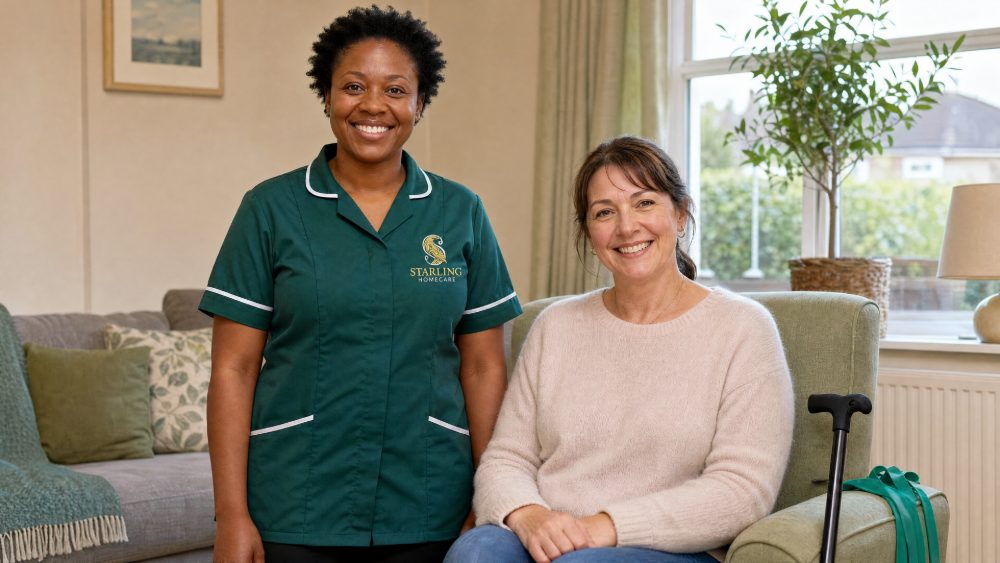
Live-in care for FND makes sense when the problem is not any one task but the unpredictability of the whole day. Functional neurological disorder can mean a good morning, a seizure at lunchtime and legs that will not hold by evening. A live-in carer is there for all of it, so the person can keep doing what they can without a family member on call around the clock. This guide explains when live-in care fits FND, what it looks like, and what to agree before it starts.
Families usually reach this question after months of patching. A partner has cut their hours, a parent has moved into the spare room, and nobody has slept properly since the diagnosis. The care itself is manageable. It is the being there, all day and every day, that has become impossible.
Starling Homecare is an independent, family-run provider regulated by the Care Quality Commission. We provide live-in, overnight and visiting care for people with FND across Hertfordshire. Clinical background below comes from neurosymptoms.org, the patient guide written by neurologist Professor Jon Stone, read on 28 September 2026.
When live-in care for FND is the right fit
Visiting care works well when the difficult moments are predictable, such as washing in the morning or getting to bed at night. FND often does not work like that. Functional seizures can come at any time, weakness can arrive with fatigue, and a bad hour can make a hot drink unsafe. So the need is for someone nearby, not for a fixed appointment.
In our experience, live-in care for FND fits best in three situations. First, when seizures are frequent enough that the person should not be alone for long. Second, when symptoms swing widely across the day, so visit times keep missing the hard moments. Third, when a family carer is close to exhaustion and needs to step back into being a partner or a son or daughter again.
If the question is still whether someone can manage alone, start with our guide to whether someone with FND can live alone, which maps the gap on a bad day.
What live-in care for FND looks like day to day
The carer lives in the home, usually with their own room, and supports the person through the day. Crucially, the approach follows the rehabilitation principle. The person does as much as they can, and the carer makes the rest possible. That matters with FND, because over-helping can quietly shrink someone's world.
So on a good day the carer may do very little beyond company, cooking and a lift to physiotherapy. On a difficult day they help with washing, dressing and moving safely around the house. During a functional seizure they keep the space safe and stay calm, in line with the plan the person's clinical team has agreed. Our guide to what to do during a functional seizure sets out that approach.
The carer can also help with the practice the therapists set, whether that is pacing, graded activity or physiotherapy exercises. For how treatment is delivered, see our guide to FND treatment.
Breaks, cover and continuity
A live-in arrangement is only as steady as its cover. The person has a main carer, and a familiar second carer covers the agreed breaks. For someone with FND, that familiarity matters more than usual, because tiredness and unsettled days can make symptoms harder. So we introduce the second carer early rather than on the first day of a holiday.
We also plan breaks into the arrangement from the start. Where seizures happen at night, a live-in carer may not be the whole answer, because they need to sleep. In that case a waking night, or a mix of live-in and night cover, is safer. We talk that through at the assessment.
What to agree before live-in care starts
A little planning makes the first fortnight far smoother. Four things are worth writing down. First, the seizure plan: what they look like for this person, what helps, and when to call for help. Second, the rehabilitation goals, so the carer supports them rather than working around them. Third, the good-day and bad-day routines. Fourth, who the carer contacts in the family, and when.
Once we have assessed the person and matched a carer, live-in care can often begin within a week or two. For costs, our guide to live-in care costs sets out how the price is built. For the wider picture, see live-in care in Hertfordshire.
Where we provide live-in care for FND
Each of our areas has its own local team and number:
- St Albans: 01727 324 127
- Harpenden: 01582 824 830
- Welwyn Hatfield: 01707 714 000
- Potters Bar: 01707 714 000
- Hemel Hempstead: 01442 954 137
- Berkhamsted: 01442 954 137
- Tring: 01442 954 137
- Hitchin: 01462 534739
- Hertford: 01920 746779
- Radlett and Shenley: 01923 988 550
Common questions about live-in care for FND
Can a live-in carer help during a functional seizure?
Yes. The carer keeps the space safe, stays calm and follows the seizure plan agreed with the person's clinical team, including when to call for help. They do not restrain the person.
Will live-in care for FND make someone more dependent?
It should not. We follow the rehabilitation principle: the person does what they can, and the carer helps with the rest. The carer also supports the exercises and pacing the therapists set.
Is live-in care for FND suitable if seizures happen at night?
Sometimes. A live-in carer needs to sleep, so frequent night seizures may need waking night cover as well. We look at the pattern at the assessment and recommend what is safe.
FND is real, it varies, and it can improve, and the right support at home gives that improvement room to happen. If you would like to talk about live-in care for someone with FND in Hertfordshire, our St Albans office is on 01727 324 127. The neurosymptoms.org patient guide is the best place to read about the condition itself.
Arranging Care Is Simple
Starting care can feel like a big step. We keep it calm and straightforward, and we are here to guide you from your very first call.
1. Talk to us
Get in touch by phone or request a callback. We will listen, answer your questions and help you understand the options, so you can decide what feels right in your own time.
2. A home visit and initial consultation
We arrange a visit to understand your routines, your home and what matters most to you. Together we agree an initial consultation and shape the support that feels right.
3. Your care begins
A small, familiar team starts your care, arriving at the agreed times and staying involved as your needs change. We remain your trusted adviser throughout.
Whenever you are ready, we are here to help.