
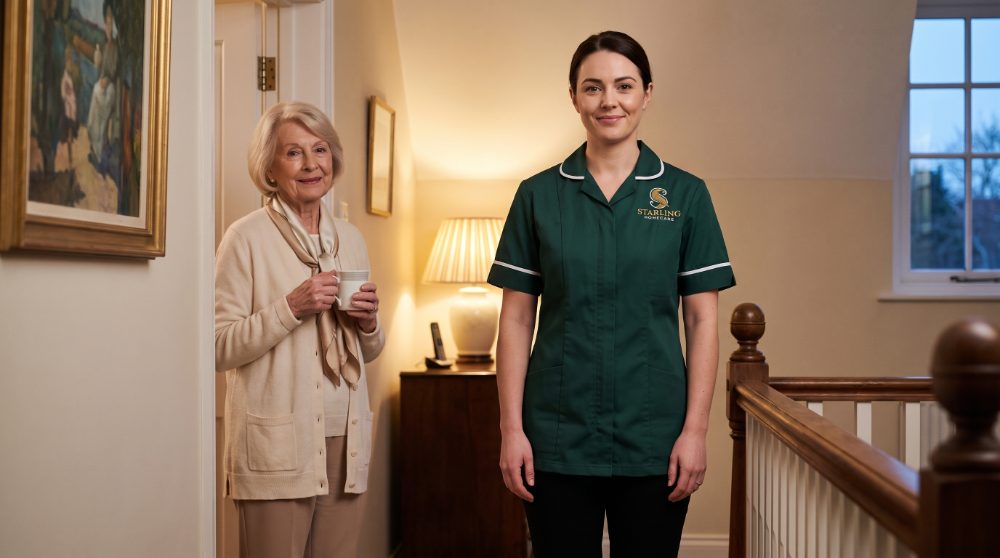
Families usually arrange overnight care in Radlett for the person who is awake in the night, but the reason it starts is often the person lying awake beside them. A carer comes to the house for the night. The husband, wife or daughter who has been getting up three times since spring can finally sleep through. Starling Homecare provides sleeping nights and waking nights across Radlett, Shenley and Letchmore Heath from our Radlett team on 01923 988 550.
Families rarely ring us about sleep. They ring about a fall, a night of wandering, or a discharge from hospital. Then, a few minutes into the call, someone mentions that they have not slept properly for months.
That second sentence usually matters more than the first. Broken sleep is the quiet reason many home arrangements come apart, and it is the one thing nobody writes down. This article is about the carer's nights, not only the nights of the person being cared for.
Why the carer's broken sleep, not the night itself, usually ends care at home
Someone can help a person up at two in the morning for years. What cannot last is their spouse doing it every night without a proper sleep in between. In our experience, the arrangement fails at the family carer's end first.
Carers UK describes the pattern plainly. Trouble sleeping for more than a night or two makes everything harder. The charity lists constant tiredness, dropping off during the day, difficulty concentrating and making decisions, and low mood. Over the long term, it notes, lack of sleep also raises the risk of high blood pressure, diabetes and obesity.
The scale is not small. The Carers UK State of Caring 2025 survey heard from more than 10,500 carers. Of those, 74 per cent said they felt stressed or anxious, and some were unable to sleep because of it. A further 42 per cent said their physical health had got worse through caring. Sleep is the point where the carer's health and the cared-for person's safety meet.
How do you know the nights are already unsafe for both of you?
There is no test, but there are signs we hear about again and again. The carer falls asleep in the armchair at four in the afternoon. Someone misses a tablet, or gives it twice, because nobody is sure what happened at three. They drive to Watford General, about six miles from Radlett, on two hours of sleep.
Three questions help. How many times were you up last night, and the night before? What did the following day look like? And if you were ill tomorrow, who would do the night? If the honest answer to the last one is nobody, the night is already the weak point. That is true whatever the daytime looks like.
None of this is a criticism of the carer. It is a description of what months of interrupted sleep do to anyone. It also marks the point at which a night carer stops being a luxury and becomes the thing that keeps the household safe.
What overnight care in Radlett does for the person who has been getting up
The mechanics are simple. A carer arrives in the evening, stays until the morning, and is the person who responds in the night. On a sleeping night, the carer sleeps in a separate room and gets up when needed. On a waking night, the carer stays awake throughout because the person needs regular help or checking. We explain the two in more detail in our Hemel Hempstead overnight care article. The choice depends on how many times a night the person actually needs help.
For the family carer, the first night is usually the strangest. Most people tell us they lie awake listening anyway. By the second or third night, the body accepts that someone else is on duty. That is the night the sleep debt starts to come back.
The person receiving care gains too. After a week of proper sleep, the carer who was up three times a night is themselves again: patient, warm and steady. That matters as much as anything the night carer does.
Does overnight care in Radlett have to be every night?
No. When the purpose is the family carer's recovery, two or three nights a week are often enough to start with. The carer sleeps properly on those nights and manages the others knowing rest is coming. Our Hitchin overnight care article explains how families choose the level of night cover.
The right nights are the ones that produce a proper stretch of sleep, not simply any nights. Two nights running before a demanding day tends to work better than a fixed rota chosen for its neatness.
We review it after a fortnight. If the carer is still exhausted, the pattern is wrong, not the carer.
What Radlett and Shenley families can use alongside a night carer
Radlett and Shenley have no hospital of their own, and much of the nearest support is countywide rather than local. Carers in Hertfordshire supports unpaid family carers across the county, including Hertsmere. It is the first place we suggest for advice on your own rights and breaks.
Under the Care Act 2014, the family carer is entitled to a carer's assessment in their own right. The NHS guidance on carers' breaks makes an important point. The council will only fund respite care for people it has assessed as needing it. So if you want council help, ask for both the carer's assessment and a care needs assessment for the person you look after. Our Radlett respite care article explains what Hertfordshire funds and how to ask.
For the night that goes wrong, Watford General Hospital has the nearest emergency department, open around the clock. A night carer who knows the person makes that call sooner, and more calmly, than a relative who has been awake since midnight.
When overnight care becomes live-in care
Some families find that nights are only half the problem, and that the days have grown as heavy. At that point, a carer living in the house may be simpler than arranging nights and long days separately. Our guide to live-in care in Radlett and Shenley explains how that works and what the house needs.
For most families we support in Radlett, though, overnight care is enough on its own. The person stays in their own bed, the carer stays in theirs, and the nights stop being the thing that decides everything else. Our overnight care service page sets out what is included. Our Radlett and Shenley area page covers the wider team.
Common Questions About Overnight Care in Radlett and Shenley
Can overnight care start before we know whether we need sleeping or waking nights?
Yes. Most families start with sleeping nights and a written note of every time the carer is woken. After a week the note shows how many times help was needed and at what hours. That tells you whether you need a waking night or a sleeping night is enough.
Where does the night carer sleep in a Radlett house?
On a sleeping night the carer needs a separate room with a bed, and somewhere to make a hot drink. On a waking night the carer needs no bedroom. A comfortable chair within reach of the person is enough. We agree the practical arrangements at the first visit, before booking any night.
Will the person we care for accept a stranger in the house at night?
Often more easily than the family expects, because the carer meets them in daylight first. We arrange an evening meeting before the first night. By then the person has met the carer, learned their name and watched them make tea. The first night then starts with a familiar face rather than an unknown one.
If you are in Radlett, Shenley or Letchmore Heath and the nights have become the hardest part of caring, our Radlett team is on 01923 988 550 or at [email protected]. Talking it through with someone who arranges nights every week is usually a useful place to start.
Arranging Care Is Simple
Starting care can feel like a big step. We keep it calm and straightforward, and we are here to guide you from your very first call.
1. Talk to us
Get in touch by phone or request a callback. We will listen, answer your questions and help you understand the options, so you can decide what feels right in your own time.
2. A home visit and initial consultation
We arrange a visit to understand your routines, your home and what matters most to you. Together we agree an initial consultation and shape the support that feels right.
3. Your care begins
A small, familiar team starts your care, arriving at the agreed times and staying involved as your needs change. We remain your trusted adviser throughout.
Whenever you are ready, we are here to help.