
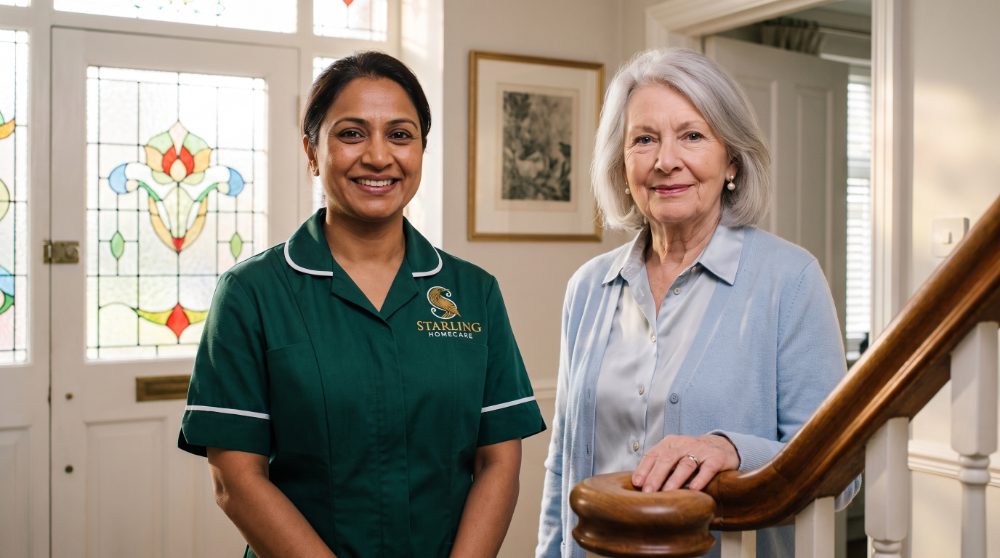
Personal care in Hitchin often starts with a husband or wife who has been managing it alone. Washing, dressing, help in the bathroom, the things nobody outside the house sees. When that becomes too much, a paid carer can take over some or all of it. The arrangement can be built so that the couple keep their privacy and the marriage keeps its shape. This guide is written for the partner doing the caring, because that is who usually makes the first call.
It is a hard call to make. Couples we meet in Hitchin, Ickleford and Great Offley have often been managing for a long time before anyone else knew. The tipping point is rarely one dramatic event. More often it is a bad back, or a night of not sleeping, or the slow realisation that the person you married has become a patient in your eyes.
What follows is how we approach it, and what the NHS says about the help you are entitled to as a carer. The sources were read on 22 September 2026.
What personal care in Hitchin actually covers
The NHS describes what a paid carer at home can help with. The list runs from getting out of bed, washing and dressing and using the toilet, to preparing meals, remembering medicines and getting ready for bed. Personal care is the intimate part of that list. It is also the part that changes a relationship when one partner does it for the other.
A visit can be as short as help with a shower and dressing in the morning. It can be as full as morning, lunchtime and evening calls. The NHS guide is clear that home care is flexible, from an hour a week to several hours a day. That is how it should be approached: start with the task that is hardest for you, not with a full timetable.
What personal care is not is housework. If the cleaning and laundry have also become too much, that is domestic support. We explain the difference in our guide to personal care at home.
The conversation between the two of you comes first
In our experience the person receiving care has usually noticed the strain long before their partner says anything. So the first conversation is not about carers at all. It is about the fact that you are tired, and that you want to be a wife or a husband again rather than a nurse. Letting someone else do the bathroom leaves more of the day for the two of you.
Framed that way, most people accept help more readily than their partner expected. Some want a say in who comes, and in whether the carer is a woman or a man. Both are reasonable requests and we take them seriously when we match a carer.
The other thing to settle early is what stays yours. Some couples want the carer to do everything personal, so that nothing between them feels like a task. Others want the carer to do the shower and dressing while the partner keeps the evening routine. There is no right answer, only the one that suits your marriage.
How a first personal care visit works in Hitchin
Before any visit, someone from our Hitchin team comes to the house to meet you both. We talk through what you have been doing, what hurts, what the person prefers, and what a good morning looks like. That becomes a written care plan the carer follows, so you are not explaining it again at the door.
The partner is usually present for the first few visits, then gradually not, as the person and the carer get used to each other. Continuity matters more in personal care than in any other kind of home care. So we keep the same small group of carers wherever we can. The Care Quality Commission regulates Starling Homecare, which means our carers are trained, checked and supervised to a standard you can look up.
We also plan around Hitchin itself. A carer covering Ickleford or Great Offley on a morning round has travel time built into the rota. So the visit time you agree is one you can plan around. If you are wondering how a package builds from there, our guide to home care in Hitchin covers the wider picture.
Personal care in Hitchin and the carer's assessment you are entitled to
This is the part the caring partner usually does not know. The NHS says that if you look after someone regularly, you can ask for a carer's assessment. The assessment is free, and anyone over 18 can have one. Someone from the council looks at how caring affects your health, your sleep, your free time and your relationships. They can recommend things like someone to take over caring so you can take a break.
The carer's assessment is separate from the needs assessment your partner might have, but the NHS says you can ask for both at the same time. In Hertfordshire you request it through the county council's adult social services. Carers in Hertfordshire, a charity whose services are free to carers, is on 01992 58 69 69. It runs groups, courses and a Carers Passport discount card.
Whether or not the council ends up paying for anything, the assessment is worth having. It puts on record what you have been doing. If a break is what you need most, our guide to respite care in Hitchin explains how a regular one can be arranged.
Paying for it
Some couples in Hitchin pay for personal care themselves and some have council support. The route to finding out is the needs assessment. Age UK says you are entitled to one regardless of income and savings. The NHS says that if the council contributes it must give you a care and support plan with a personal budget. If it does not, it must still give free advice.
Attendance Allowance is the benefit most relevant here. GOV.UK confirms it is not means tested, and it exists for exactly the kind of help personal care provides. Many couples use it to fund the morning visit. Our guide to whether Attendance Allowance is means tested explains what is and is not looked at.
Common questions about personal care in Hitchin
Can my wife have a female carer for personal care?
Yes. A preference for a female or male carer for personal care is reasonable and we plan for it when we match carers. Tell us at the first visit and it goes in the care plan.
Do I have to stop caring for my husband if a carer comes in?
No. Personal care from a paid carer can cover one task or all of them. Many partners keep the parts they want to keep. The point is to take the physical and emotional strain off you, not to take your role away.
Can I get help as a carer in Hitchin even if my partner does not qualify for council care?
Yes. The NHS says a carer's assessment is free and separate from your partner's needs assessment. Carers in Hertfordshire supports carers across the county at no cost. Neither depends on the person you care for qualifying for council-funded care.
Handing over the most private parts of caring for someone you love is not giving up. It is usually the thing that lets you carry on. If you are in Hitchin, Ickleford, Great Offley or nearby and would like to talk it through with someone who arranges this every week, our Hitchin team is on 01462 534739. You can also email [email protected]. The NHS guide to help at home from a paid carer is a good place to read more.
Arranging Care Is Simple
Starting care can feel like a big step. We keep it calm and straightforward, and we are here to guide you from your very first call.
1. Talk to us
Get in touch by phone or request a callback. We will listen, answer your questions and help you understand the options, so you can decide what feels right in your own time.
2. A home visit and initial consultation
We arrange a visit to understand your routines, your home and what matters most to you. Together we agree an initial consultation and shape the support that feels right.
3. Your care begins
A small, familiar team starts your care, arriving at the agreed times and staying involved as your needs change. We remain your trusted adviser throughout.
Whenever you are ready, we are here to help.