
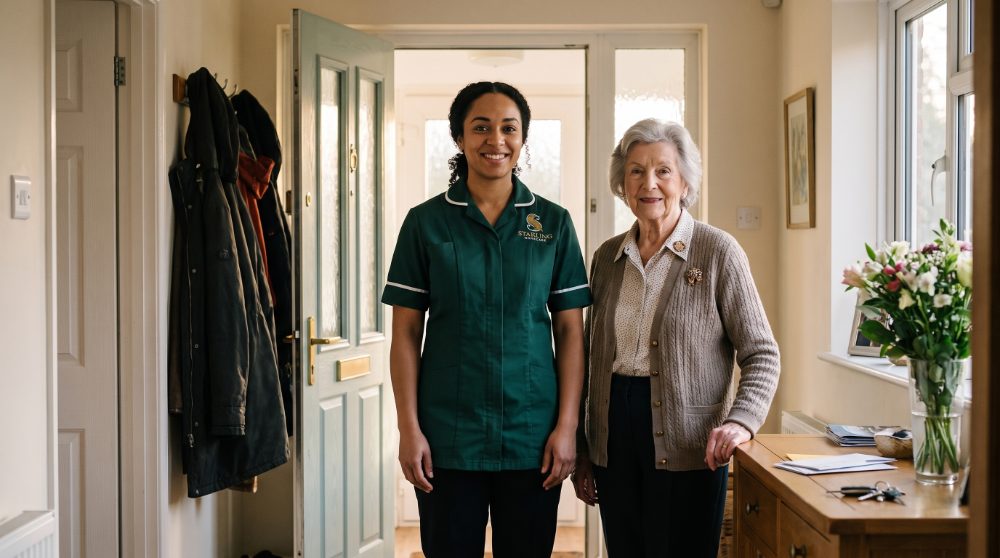
Personal care in Harpenden is usually arranged by someone who has a train to catch. The daughter in Batford who does her mother's shower before the 7.42. The son who drives over from Southdown after work to help his father to bed. It works until it does not. This guide is for the working family at that point. It explains how a morning and an evening visit take the two hardest hours of the day, and how to set them up so they fit around a job rather than fighting it.
The strain in these households is rarely the caring itself. It is the timing. Personal care happens at the two ends of the day, exactly when a working adult is least available. The NHS list of what a paid carer helps with reads like a commuter's morning: getting out of bed, washing and dressing, medicines, breakfast. Then, twelve hours later, getting settled for the night.
What follows is how we build those visits in Harpenden, and what the NHS says about the help available. We read the sources on 23 September 2026.
What personal care in Harpenden covers, and when
Personal care in Harpenden means the intimate part of home care: help with washing, dressing, the toilet and getting in and out of bed. For a working family the useful way to think about it is in visits rather than tasks. A morning visit gets the person up, washed, dressed and breakfasted, with medicines taken, before the family's day starts. An evening visit reverses it. Lunchtime and afternoon are often fine without help, or covered by a neighbour or a day centre.
The NHS describes home care as flexible, from an hour a week to several hours a day. That flexibility is the point here. Two visits a day on weekdays and none at the weekend, when the family is around, is a common pattern in Harpenden. It is a legitimate one. If the need is more about the house than the person, that is domestic support. Our guide to personal care at home explains the difference.
Personal care in Harpenden at a time that holds
A morning visit that drifts is worse than no visit, because the family has planned around it. So the first thing we settle at the assessment is the window. Not "morning", but between 7.30 and 8.00, and what happens if the person is not ready. We build the Harpenden round so that it covers Batford, Southdown and the town centre in a sensible order. A carer's travel time sits in the rota rather than borrowed from the visit.
The second thing is continuity. Personal care is intimate, and a person accepts it far more readily from someone they know. We keep the same small group of carers on a household, and we tell the family before anyone new comes. The Care Quality Commission regulates Starling Homecare, so the carers who arrive at 7.30 meet a standard for training, checks and supervision that you can look up.
The third is what the family still does. Some keep the weekend. Some keep the evening and hand over the morning. Writing that down avoids the drift where the carer does more each week and the family quietly stops. Our guide to how to choose a home care agency in Harpenden covers the questions that show whether a provider can hold a time.
The handover between carer and family
In a working household the carer and the family rarely meet, so the handover happens in writing. The carer records each visit: what she did, what the person ate, whether they took their medicines, and anything that looked different. The family reads it on the train. In our experience that record is what lets a son in an office in London relax. He knows by nine o'clock that the morning went well.
It is also what catches decline early. The carer who does the same morning five days a week notices a slower walk, a missed step or a change of mood. She sees it weeks before a weekend visitor would. That is worth more than the shower.
You are a carer too, even with a full-time job
The NHS says anyone over 18 who looks after someone regularly can ask for a free carer's assessment from the county council. It looks at how caring affects your work as well as your health. Hertfordshire County Council takes the request through its online form and works with Carers in Hertfordshire, whose services are free. If you are employed, you also have a legal right to a week of carer's leave a year. Our guide to carer's leave while working explains it.
Both matter for the same reason. A working carer who never asks for anything is the one who ends up off sick. Our guide to respite care in Harpenden covers the longer breaks.
Paying for personal care in Harpenden
The council route starts with a needs assessment for the person. The NHS says that if the council contributes, it must provide a care and support plan with a personal budget. Many Harpenden families fund the two daily visits themselves, often with Attendance Allowance, which GOV.UK confirms is not means tested. Our guide to home care costs in Harpenden sets out how a visit is priced and what should be in the rate.
Common questions about personal care in Harpenden
Can personal care in Harpenden be fixed at a set time each morning?
Yes, within an agreed window. We set the window at the assessment, for example between 7.30 and 8.00. We build the Harpenden round so travel time sits in the rota, and we tell the family if a visit will be late. A time that holds is the whole point for a working household.
Does personal care in Harpenden need weekend visits if the family is there?
No. Weekday morning and evening visits with none at the weekend is a common pattern, and it can change later. The plan follows the family's availability rather than a standard timetable.
How do I know what happened at the morning visit if I have already left for work?
The carer records every visit: what she did, what the person ate, whether they took their medicines and anything that looked different. The family can read it after the visit. Anything that needs a decision comes by phone rather than sitting in the notes.
Handing the two hardest hours of the day to someone reliable is what lets a working family keep caring for the rest of it. If you are in Harpenden, Batford, Southdown or nearby and would like to talk it through, our Harpenden team is on 01582 824 830. You can also email [email protected]. The NHS guide to help at home from a paid carer describes what to expect from any provider.
Arranging Care Is Simple
Starting care can feel like a big step. We keep it calm and straightforward, and we are here to guide you from your very first call.
1. Talk to us
Get in touch by phone or request a callback. We will listen, answer your questions and help you understand the options, so you can decide what feels right in your own time.
2. A home visit and initial consultation
We arrange a visit to understand your routines, your home and what matters most to you. Together we agree an initial consultation and shape the support that feels right.
3. Your care begins
A small, familiar team starts your care, arriving at the agreed times and staying involved as your needs change. We remain your trusted adviser throughout.
Whenever you are ready, we are here to help.