
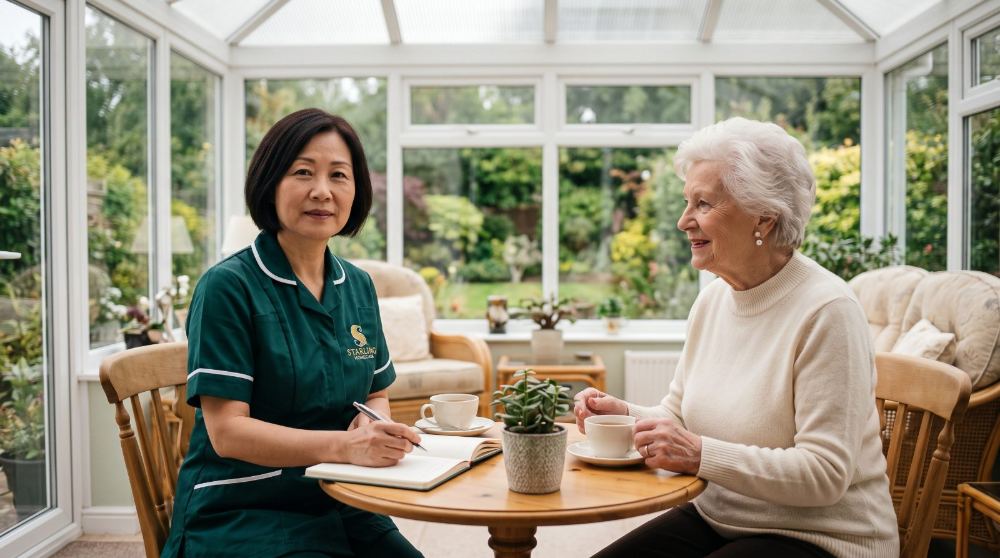
End of life care at home in Welwyn Garden City and Hatfield works best when it is planned before it is needed. If someone's wish is to stay at home, talking about that wish early, and writing it down, makes it far easier to honour when the time comes.
Most families put the conversation off, and understandably so. It feels too soon to raise it, right up until it is too late to raise it well.
In our experience, the families who cope best at the end of a life are rarely the ones who knew the most about care. They are the ones who knew what the person wanted, because they had asked.
Why does planning ahead make staying at home possible?
When end of life care is arranged in a rush, decisions fall to whoever happens to be in the room, often during a hospital admission, often at night. The person's own preferences can get lost in the urgency.
A plan changes that. When wishes have been recorded and shared, the GP, the district nursing team and the care provider can all pull in the same direction from the first phone call. Home stops being a hope and becomes an arrangement.
Planning ahead commits nobody to anything. Marie Curie is clear that a plan can be changed at any point. What it does is spare a family from guessing at the worst possible moment.
What is an advance care plan?
An advance care plan is a record of the care someone would like in the future, made while they can still say so. Marie Curie describes it as the process of deciding, and writing down, what matters: how and where you would like to be looked after, and who should be consulted if you cannot speak for yourself.
It can hold small things as well as large ones. Where you want to be cared for, certainly, but also the routines, comforts and people that make a day feel like yours.
There is no set template. Marie Curie suggests a simple rhythm: think about what you want, talk to the people close to you, record it, discuss it with your healthcare team, and share it so the right people can find it.
Who should know about the plan in Welwyn Garden City and Hatfield?
Start with the GP. Ask for the wishes to be noted in the person's healthcare records, so that out-of-hours doctors and community teams can see them, not just the people who were in the conversation.
The local hospice matters here too. Isabel Hospice is based in Welwyn Garden City and cares for people across eastern Hertfordshire, with support that is free of charge and can be provided at home, at its community hubs or at its in-patient unit.
And tell the care provider. When we support someone through their last months at Starling, the advance care plan shapes the care plan: the visits, the routines and the way carers work are built around what the person has said matters.
Where does home care fit alongside the clinical team?
Doctors and nurses look after symptoms and treatment. Home carers look after the day: washing and dressing done gently, meals, the house kept steady, and a familiar face arriving when they said they would.
That steadiness is what lets a family step back from being a workforce and simply be a family. Our guide to end of life care at home covers what that day-to-day support involves in more detail.
The paperwork your GP can explain
Alongside an advance care plan, there are more formal documents, and it helps to know their names. A DNACPR decision and a ReSPECT plan record recommendations for emergency care. An advance decision to refuse treatment, and a lasting Power of Attorney for health and welfare, are the legally binding routes.
This is not something to untangle alone, and it is not something we advise on. The GP, or the hospice team, can explain which of these fits the situation and how each one is put in place.
Common Questions About End of Life Care at Home in Welwyn Garden City
When should we start planning end of life care at home?
Earlier than feels natural. The best time is while the person can still take a full part in the conversation, ideally soon after a life-limiting diagnosis. Plans made early can be revisited as things change; conversations left too late cannot be had at all.
Is an advance care plan legally binding?
No. Marie Curie explains that an advance care plan guides decisions rather than binding them, though professionals should try to follow it. If someone wants legally binding arrangements, an advance decision to refuse treatment or a lasting Power of Attorney can provide that, and the GP can explain both.
Who should have a copy of an advance care plan?
The GP, so it can be reflected in healthcare records; the closest family members; and the care provider, so daily support follows it. Keep the original somewhere the household can find, and tell people where it is.
None of this needs to be done in one sitting, and none of it needs to be done alone. If you are in Welwyn Garden City, Hatfield or the wider borough and would find it useful to talk through how care at home works towards the end of life, our local team is on 01707 714 000, and there is more about how we support the area on our Welwyn Hatfield home care page.
Arranging Care Is Simple
Starting care can feel like a big step. We keep it calm and straightforward, and we are here to guide you from your very first call.
1. Talk to us
Get in touch by phone or request a callback. We will listen, answer your questions and help you understand the options, so you can decide what feels right in your own time.
2. A home visit and initial consultation
We arrange a visit to understand your routines, your home and what matters most to you. Together we agree an initial consultation and shape the support that feels right.
3. Your care begins
A small, familiar team starts your care, arriving at the agreed times and staying involved as your needs change. We remain your trusted adviser throughout.
Whenever you are ready, we are here to help.