
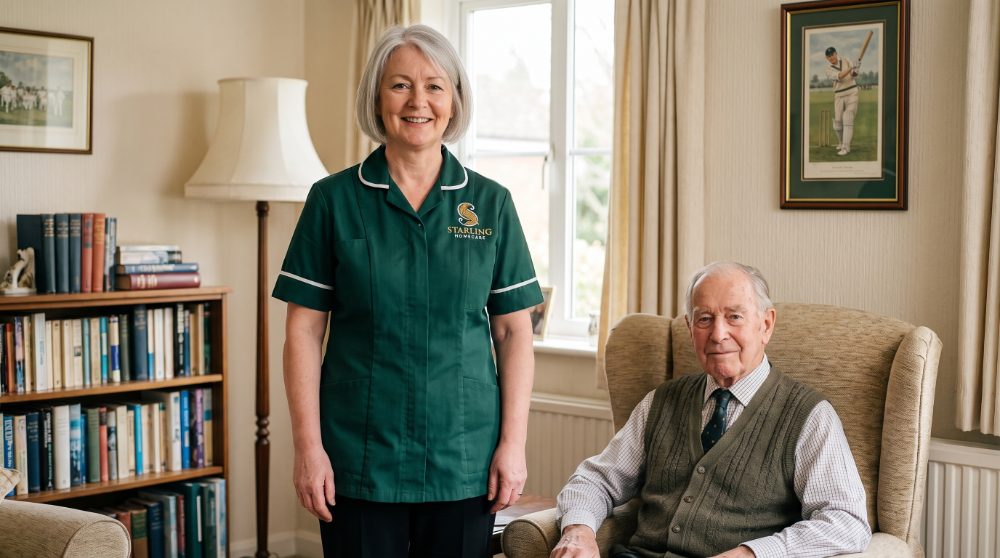
Personal care in Hemel Hempstead is hardest to arrange for the person who has never once accepted help. The father who ran a business, the husband who did the DIY, the woman who nursed everyone else. When washing and dressing become difficult, the practical part is easy to solve. The part that stalls is pride, and this guide is about getting past it without anyone losing face.
Families in Boxmoor and Apsley tell us the same story in different words. Dad will accept help with the garden but not the shower. Mum will let a carer cook but not help her dress. The refusal is not stubbornness for its own sake. It is the last place where someone still feels entirely themselves, and it deserves that respect.
What follows is how we approach it, and what the NHS says personal care actually involves. We read the sources on 23 September 2026.
What personal care in Hemel Hempstead means, in plain words
The NHS lists what a paid carer at home helps with. The list runs from getting out of bed, washing and dressing and using the toilet, to preparing meals, remembering medicines and getting settled in the evening. Personal care is the first half of that list, the intimate half. It can be as little as help in and out of the shower twice a week. It can also be as much as a morning and evening visit every day.
The word that matters is help. A carer does not take over the shower. She makes it safe and possible. Then she does exactly as much as the person cannot do that morning, which changes from day to day. For someone who has never accepted help, that distinction is the whole argument.
If the worry is more about housework than washing, that is domestic support rather than personal care. Our guide to personal care at home explains where the line sits.
Personal care in Hemel Hempstead starts with respecting the refusal
In our experience the person who says no to personal care is usually saying yes to something else. They want to feel capable, to keep their privacy, and not to be a burden. So the conversation goes better when it starts there. Not "you need help washing". Rather, "I want you to keep doing everything you can, and I want the shower to stop being the thing you dread on a Tuesday".
Two practical points move most people. The first is choice of carer. A man who will not accept help from a young woman may accept it from a male carer, or from an older woman. Asking for that is entirely reasonable. The second is starting with the least intimate task. A carer who comes twice a week to help with feet, nails and a bath, and who is otherwise there for a cup of tea, becomes someone the person knows. By the time anything more personal is needed, she is not a stranger.
What does not work is presenting it as a decision already made. The person has to be in the room when everyone agrees the plan, and it has to be a plan they can change.
How a first personal care visit works in Hemel Hempstead
Before any care starts, someone from our Hemel Hempstead team visits the house to meet the person and the family. We ask what a good morning looks like, what they can still do and what they want left alone. We also ask whether they prefer a female or male carer. That becomes a written care plan, and the person keeps a copy.
The first visits are deliberately light. The carer learns where things are, how the person likes the bathroom set up, and what order they do things in. Continuity matters more in personal care than anywhere else. So we keep the same small group of carers, and we tell the family in advance when someone new is coming. The Care Quality Commission regulates Starling Homecare, which means our carers meet a published standard for training, checks and supervision.
We settle timing around the person, not the rota. A carer covering Boxmoor and Apsley on a morning round has travel built in. So an eight o'clock visit means eight o'clock. For the wider picture of how visits build up, our guide to home care in Hemel Hempstead covers it.
Dignity in the detail
Good personal care is mostly invisible. The bathroom is warm before the person goes in. Towels stay where the person left them. The carer talks about the cricket, not the task. The door stays closed and the person stays covered whenever they can be. None of this is complicated. Yet all of it is the difference between help that feels like a loss and help that feels like a hand.
Families sometimes ask whether they should stay for the first visits. Our answer is usually yes for the meeting and no for the shower. The person is more likely to accept help from a professional than from their own daughter. Equally, the daughter is more likely to keep her relationship intact if she is not the one holding the towel.
Paying for personal care in Hemel Hempstead
The route to council support is a needs assessment, which the NHS says is the place to start. If the council contributes, it must give you a care and support plan with a personal budget. Many families in Hemel Hempstead fund personal care themselves, often with Attendance Allowance, which GOV.UK confirms is not means tested. Our guide to whether Attendance Allowance is means tested explains what the assessment looks at. For visiting care rates, see our personal care page.
Common questions about personal care in Hemel Hempstead
Can my father have a male carer for personal care?
Yes. A preference for a male or female carer is reasonable, and it is one of the first things we ask at the assessment visit. Tell us and it goes into the care plan, so every visit honours it rather than negotiating at the door.
What if he refuses help on the day?
A carer does not force personal care on anyone. On a day the person refuses, the carer does what is welcome and keeps the visit calm. She records what happened and tells the family and our office. A pattern of refusals is a reason to revisit the plan together, not to give up on it.
How little can personal care in Hemel Hempstead start with?
Very little. Two visits a week for a bath and help with feet and nails is a common starting point. The NHS describes home care as flexible from an hour a week upwards. Most packages grow from there only when the person is ready.
The people who have never accepted help are often the ones who do best once they let someone in, because they set the terms. If you are in Hemel Hempstead, Boxmoor, Apsley or nearby and would like to talk it through, our Hemel team is on 01442 954 137. You can also email hemel@starlinghomecare.co.uk. The NHS guide to help at home from a paid carer describes what to expect from any provider.
Arranging Care Is Simple
Starting care can feel like a big step. We keep it calm and straightforward, and we are here to guide you from your very first call.
1. Talk to us
Get in touch by phone or request a callback. We will listen, answer your questions and help you understand the options, so you can decide what feels right in your own time.
2. A home visit and initial consultation
We arrange a visit to understand your routines, your home and what matters most to you. Together we agree an initial consultation and shape the support that feels right.
3. Your care begins
A small, familiar team starts your care, arriving at the agreed times and staying involved as your needs change. We remain your trusted adviser throughout.
Whenever you are ready, we are here to help.