
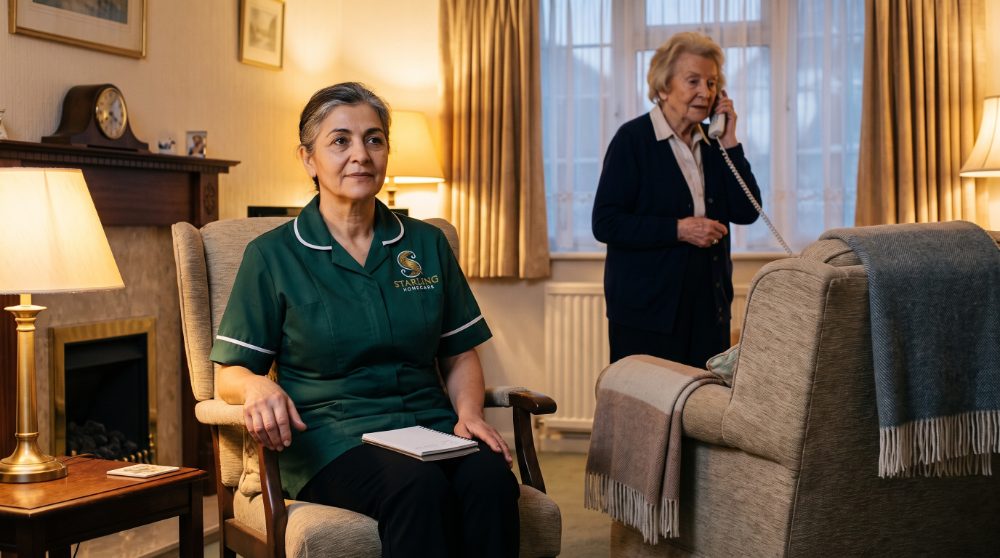
Overnight care in Potters Bar does not have to be every night. It can be two nights a week, a run of ten nights after a hospital stay, or every night for a month and then none.
Our own overnight care runs from a few nights a week to every night, and the NHS guide to help at home says the same in plainer words: a paid carer can be needed for an hour a week, several hours a day, or at night, and the arrangement can be temporary or long term.
Families rarely hear that. The picture most people have is all or nothing, either someone is there every night or the person is on their own, and that picture is what makes the decision feel so heavy. This article is about the middle, which is where most overnight care in Potters Bar actually happens. Starling Homecare is a family run provider registered with the Care Quality Commission, and our Potters Bar team covers the town along with Cuffley and Northaw.
The four patterns overnight care usually takes
The first is the fortnight home from hospital. Nights are the risk in the first days back, when someone is weaker than they think and the bathroom is further than it was. Ten or fourteen nights of cover, then a review, is a common and sensible shape.
The second is the bad patch. An infection, a change of medication or a spell of low mood can unsettle nights for a few weeks and then pass. Cover the patch, not the rest of the year.
The third is the carer’s rest. Where a husband or wife is doing the nights, two or three covered nights a week can be the difference between managing and not. The person being cared for may be fine. It is the sleeper next to them who needs the cover.
The fourth is every night, and it is real. When nights are consistently unsafe, the pattern is nightly, and at that point the question becomes whether live-in care in Potters Bar is simpler. We say so when it is.
How to choose which nights
Our overnight care page suggests a week of notes before deciding anything, and it is the single most useful thing a family can do. Each morning, write down whether the night was disturbed, what happened, and what could have gone wrong if nobody had been there. Do it for seven nights.
The notes tend to show a pattern nobody had noticed. The difficult nights follow the busy days, or the evenings a daughter cannot visit, or the nights after a bath. Once the pattern is visible, you can cover the nights that need it and leave the others alone.
Where the notes show no pattern, only randomness, that is information too. Random nights are harder to cover selectively, and it usually points to more cover rather than less.
Sleeping nights, waking nights, and which suits a part time pattern
A sleeping night means the carer sleeps in the home and gets up if needed. It suits someone who rarely wakes but should not be alone. A waking night means the carer stays awake throughout, which is right when someone wakes often, needs help to the bathroom or with medicines in the night, or would be unsafe unobserved.
For a few nights a week pattern, the sleeping night is the more common choice, because the point is usually reassurance and a response if something happens. Waking nights tend to belong to the fortnight home from hospital and to the every night pattern, where the need is active rather than precautionary.
The level can change between nights. A family might book waking cover for the first three nights after discharge and sleeping cover for the rest. What matters is that the level matches the night rather than the label.
Why part time nights work in Potters Bar in particular
Many of the families we speak to in Potters Bar are arranging care from a distance, often from London. The town is well connected for a visit and not at all connected for a three in the morning phone call.
A pattern of covered nights gives a family in the capital specific nights they do not have to worry about, rather than a general anxiety about all of them.
It also works alongside a spouse who is coping but tired, which is a common picture in the roads around Cuffley and Northaw where couples have lived a long time. Two covered nights a week, on the nights the notes say are worst, can keep a couple at home together for a good deal longer.
Continuity still matters on a part time pattern. We keep the night team small so the same one or two carers cover the same nights, because a stranger at midnight is not a rest for anyone.
Knowing when to stop, or when to change
A pattern that was right in March may be wrong by June. Review it, and be willing to move it in either direction.
The signs that cover can reduce are steady undisturbed nights on the covered nights and no incidents on the uncovered ones. The signs it should grow are the opposite: the uncovered nights start producing the phone calls.
There is no long term or fixed term contract on our overnight care, so the pattern can change as the notes change. If every night is now the right pattern, we will talk you through live-in care, which is often calmer than nightly visits once days need help as well.
Common questions about overnight care in Potters Bar
Can you have overnight care just a few nights a week?
Yes. Our overnight care runs from a few nights a week to every night, and many families start with the nights that a week of notes shows are hardest. The pattern can step up or down as things change.
What is the difference between a sleeping night and a waking night?
On a sleeping night the carer sleeps in the home and responds if needed, which suits someone who rarely wakes. On a waking night the carer stays awake throughout, which is the safer choice when someone wakes regularly or needs help with the bathroom or medicines during the night.
How do you know when overnight care is no longer needed?
When the covered nights are consistently undisturbed and the uncovered nights produce no incidents, cover can usually reduce. Keep the morning notes going for a fortnight before changing anything, so the decision rests on what happened rather than on one good week.
Deciding by the week, not for life
If you are lying awake in London wondering whether your mother in Potters Bar is all right, the answer is not necessarily every night, and it is not necessarily none. Do the week of notes, cover the nights that need it, and review.
Our Potters Bar team is on 01707 714 000 or [email protected], and you can read more about our home care in Potters Bar and the villages.
Guidance on this page was checked on 14 September 2026 against the NHS social care guide, Help at home from a paid carer.
Arranging Care Is Simple
Starting care can feel like a big step. We keep it calm and straightforward, and we are here to guide you from your very first call.
1. Talk to us
Get in touch by phone or request a callback. We will listen, answer your questions and help you understand the options, so you can decide what feels right in your own time.
2. A home visit and initial consultation
We arrange a visit to understand your routines, your home and what matters most to you. Together we agree an initial consultation and shape the support that feels right.
3. Your care begins
A small, familiar team starts your care, arriving at the agreed times and staying involved as your needs change. We remain your trusted adviser throughout.
Whenever you are ready, we are here to help.